

On a quiet afternoon in October 2023, a woman named Elena realized she could recall her grandmother’s favorite perfume but couldn’t remember the story of how her grandparents actually met. It’s a heavy feeling when we realize the threads of our history are fraying. You likely feel that same deep desire to ensure your family’s unique essence isn’t lost to time. We all want our children to feel rooted in something real. Recognizing the importance of family stories acts as a gentle anchor; it keeps your loved ones grounded when life gets stormy. Research from Emory University in 2010 showed that kids who know their family history have much higher self-esteem and a stronger sense of control over their lives.
In this guide, you’ll discover how sharing your narrative builds lasting resilience and keeps your essence alive for generations to come. We’ll also look at practical ways to document these moments before they fade. Because let’s face it, if you don’t record the truth now, your nephew might eventually tell everyone you were a secret agent instead of a middle school librarian. This article previews the simple steps you can take to become a true steward of your heritage today.
Key Takeaways
- Learn to look beyond simple names and dates to discover the living bridge that connects your ancestors’ wisdom to your descendants’ futures.
- Discover how the importance of family stories acts as a psychological anchor, building resilience and confidence in the hearts of younger generations.
- Find out why social media isn’t a reliable archive for your legacy and how to protect your narrative from the “bit rot” of the digital age.
- Master the art of gathering family lore through video, ensuring your unique spirit is caught on camera—even if your brother insists on wearing that questionable Hawaiian shirt.
- Explore how a secure “Digital Vault” can safeguard your essence for 99 years, offering a lasting sanctuary for your life’s most meaningful moments.
More Than Just Names on a Tree: Why Family Stories Matter
When we look at an old black and white photo, we often see faces that feel like strangers. We might know their names, but we don’t know what made them laugh or what kept them awake at night. This is where the importance of family stories becomes clear. These narratives act as a living bridge, connecting the people who came before us to the children who will carry our names forward. While the study of families, family history, and dates gives us a skeleton, it’s the stories that provide the heartbeat. Understanding the importance of family stories helps us realize that we are part of something much larger than ourselves.
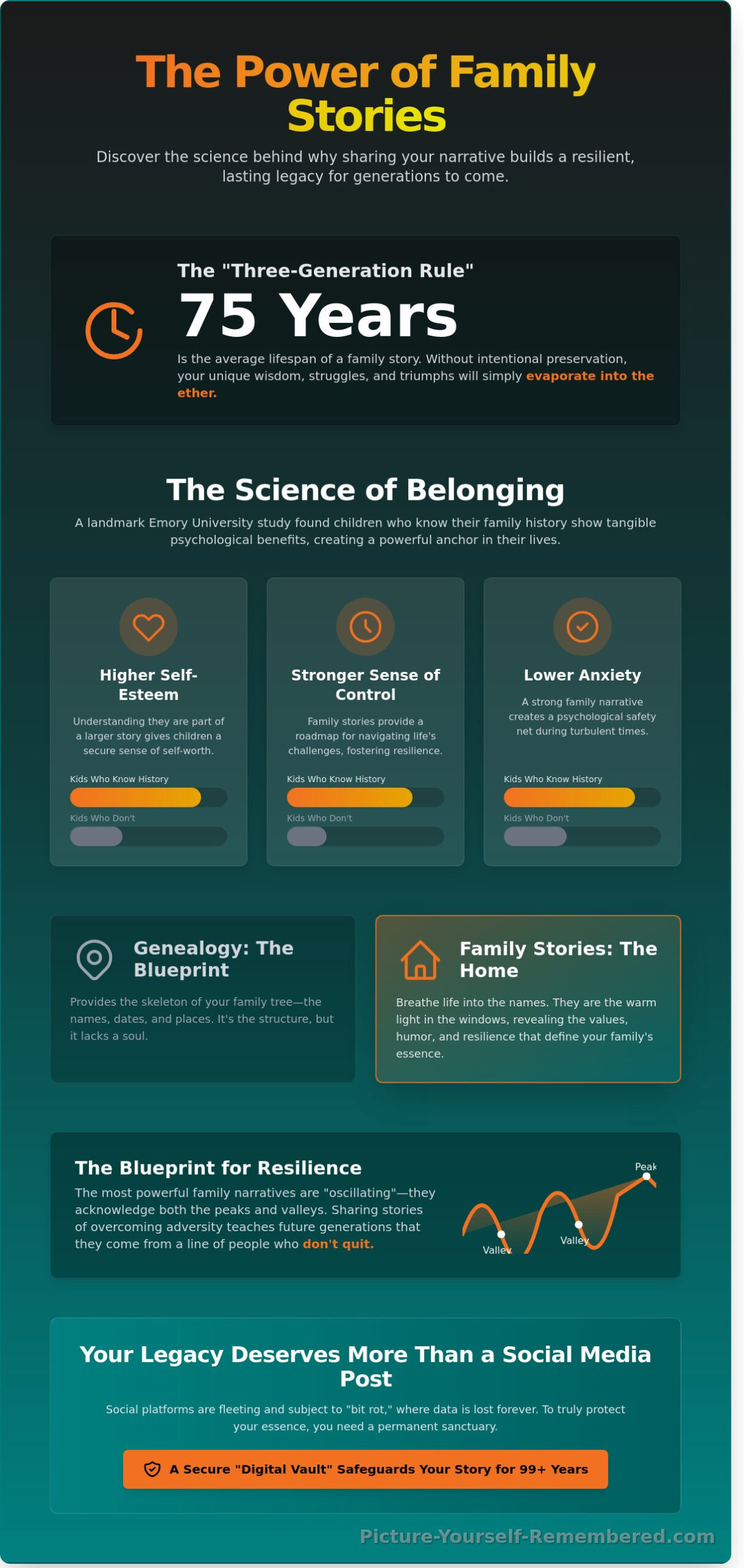
Think of genealogy as the blueprint of a house and family stories as the warm light in the windows. One tells you the structure exists; the other tells you it’s a home. By sharing these tales, we engage in the intergenerational transmission of our deepest values. We aren’t just passing down a recipe for sourdough; we’re passing down the resilience it took to keep that starter alive during a move across the country. These stories are the most valuable inheritance you can leave, offering a guiding light that money simply cannot buy.
To better understand the process of capturing these memories, watch this helpful video:
The Emotional Architecture of a Legacy
Stories create a sense of belonging that’s hard to find in our fast-paced, digital world. They build a shared history filled with rituals and inside jokes that act as the social glue for a family. When you hear a grandmother’s voice on a recording or see her eyes sparkle in a video, you capture an essence that a simple text document can’t reach. It’s the difference between reading a weather report and feeling the sun on your face. To start building this architecture, try this: Next time you’re at a family dinner, ask one person to share a story about a time they failed at something. It’s a great way to show younger generations that mistakes are just part of the plot. Plus, it’s usually funnier than hearing about how Great Uncle Mort was a perfect saint, which we all know is a lie anyway.
The Problem of the “Fading Narrative”
Sociologists often point to the “Three Generation Rule,” which suggests that most family stories vanish within 75 years if they aren’t intentionally preserved. This is a staggering loss of wisdom. Many of us know the sting of the unasked question that lingers after a loved one passes away. We define narrative loss as a silent erosion of family identity, where the unique wisdom of a lifetime simply evaporates into the ether. By taking stewardship of your narrative now, you ensure that your essence remains a source of strength for those who follow. Your life is a masterpiece worth preserving with the utmost care and artistry.
The Science of Belonging: How Narratives Build Resilient Families
In 2001, psychologists Robyn Fivush and Marshall Duke from Emory University developed the “Do You Know?” scale. They asked children 20 simple questions about their lineage, such as where their grandparents grew up or how their parents met. The results were striking. Kids who knew their family history showed significantly higher self-esteem and lower anxiety levels. This isn’t just about trivia; it’s about the importance of family stories in creating a secure sense of self. When children understand they are part of something larger than themselves, they develop a grounded confidence that carries them through life’s storms.
Life isn’t a straight line toward success. Fivush and Duke identified the “oscillating narrative” as the most powerful type of family story. These tales acknowledge that the family has faced peaks and valleys, yet they always stuck together. When you tell a child about a great-aunt who lost her business but started over, you’re giving them a blueprint for survival. You’re teaching them that they come from a line of people who don’t quit. These narratives don’t just recount facts; they distill the very essence of a family’s strength.
Stories as a Psychological Anchor
Knowing your roots provides a steadying influence during times of crisis. Recent research on family storytelling suggests that these shared histories boost emotional intelligence in teenagers. It’s tempting to only share the “heroic” version of your past, but the honest version is actually more effective. True resilience grows from seeing the cracks in the foundation and knowing the house still stands. It’s the difference between a polished portrait and a candid photograph that captures the real grit and beauty of a moment.
Bridging the Generational Gap
Stories have a magical way of humanizing our elders. To a teenager, a grandfather might just be the man who falls asleep in his recliner after lunch. But when that grandfather shares a story about his first heartbreak or a job he lost, he transforms into a mentor. He becomes a person with a rich, lived experience rather than just a relative. This shift fosters deep empathy, turning a simple Sunday visit into a cherished lesson in stewardship.
Try sharing a “failure story” during your next family dinner. Tell them about the time you tried to fix the sink and ended up flooding the basement, or perhaps the spectacular disaster of your first date. Showing that mistakes are part of growth makes you more approachable. Plus, it’s a great way to prove that even the “wise elders” were once young and occasionally clueless. When you begin to curate these memories, you are performing an act of love for those who will follow in your footsteps.
Beyond the Dusty Attic: Modern Ways to Preserve Your Narrative
We often think of our history as a collection of yellowed photos tucked away in a shoebox or a handwritten journal resting on a bedside table. While these physical treasures carry a certain weight and the nostalgic scent of the past, they are also incredibly fragile. Understanding the importance of family stories means recognizing that the medium we choose dictates how long those stories will breathe. If we want our essence to reach our great-grandchildren, we have to look past the limitations of the attic.
The Limitations of Physical Media
Physical items face a constant battle against the elements. Records from the National Archives suggest that environmental factors like humidity and light can degrade paper and film significantly within just 20 to 30 years. Fire and floods can erase a lifetime of memories in a single afternoon. For instance, the 1973 fire at the National Personnel Records Center destroyed approximately 16 million military personnel files, a staggering loss of individual history that could never be recovered. Beyond these risks, analog heirlooms are difficult to share. If you have only one original wedding portrait from 1952, only one descendant can keep it. This creates a “legacy lottery” where history is siloed rather than shared.
Why Managed Digital Storage Wins
You might think a social media profile is a safe archive, but these platforms aren’t designed for a 99-year legacy. Digital experts often warn about “Bit Rot,” a process where digital files become unreadable as software and hardware evolve. Think of this as the “VHS problem.” Most families have tapes from 1995 that they can no longer play because the technology has vanished. Managed stewardship goes beyond simple storage; it involves actively updating files to modern formats so they remain accessible.
By choosing intentional stewardship, you can build resilient families by sharing narratives that offer strength during life’s inevitable storms. A digital time capsule acts as a living heirloom, allowing you to schedule a heartfelt message for a wedding in 2046 or a graduation in 2060. It ensures your voice is heard exactly when it’s needed most. Plus, it saves your descendants from having to explain to future generations why you spent so much of 2024 posting blurry photos of your sourdough bread. You can find more details on preserving family history to ensure your narrative remains vibrant and secure.
Actionable Tips for Your Digital Legacy:
- Audit your assets: Identify the five most important photos or letters in your possession this week.
- Digitize with intent: Scan those items at a high resolution, at least 600 DPI, to ensure they can be enlarged or restored later. For a complete guide on this process, explore digitizing old photos to transform your cherished memories into lasting digital treasures.
- Add the “Why”: Record a two-minute voice memo explaining the story behind one specific photo. A picture tells a thousand words, but your voice provides the soul.
Capturing the Spark: Practical Tips for Gathering Your Family Lore
Before you press record or pick up a pen, take a quiet moment to sit with your “why.” You aren’t just collecting dry facts or dates; you’re acting as a steward for a living legacy. Setting a reflective, comfortable mood helps your loved one feel safe enough to share the vulnerable parts of their journey. When you approach the conversation with this level of intentionality, you reveal the true importance of family stories as anchors for future generations.
To capture the most vibrant narrative, consider these practical steps for your session:
- Choose video to capture the soul. While written notes are precious, video records the twinkle in an eye or the specific way a grandmother’s hands move when she describes her wedding day.
- Prioritize authenticity over perfection. Don’t worry about background noise or a stumbled sentence. These quirks make the recording feel real and personal.
- Plan for the long term. Technology changes quickly, so ensure you have a plan to migrate these files every few years to keep them accessible for future milestones.
Prompts to Unlock Cherished Memories
Generic questions usually lead to generic answers. If you ask someone where they lived, they’ll give you an address. If you ask, “What did your childhood home smell like?” you might hear about the scent of pine needles or fresh bread. Ask about a lesson they learned the hard way that they’d want you to skip. These sensory and emotional triggers move the conversation from a list of events to a rich tapestry of experience. For a deeper collection of prompts designed to unlock cherished narratives, explore these interview questions for family history that help you move past surface-level answers and into the heart of a life well lived. Just remind them that Uncle Bob’s famous fishing story grows by two inches every decade, so record the truth now before the fish becomes a whale.
The Art of the Oral History Interview
Being an active listener is your most vital role during the session. It requires you to be fully present, honoring the silence as much as the speech. For those who want to master these techniques, you can find deeper guidance on oral history preservation to ensure your interview is both professional and heartfelt.
One of the most effective tools you can use is the “10-Second Rule.” After your loved one finishes a thought, count to ten in your head before asking the next question. This brief pause often invites them to share a deeper, more reflective postscript they hadn’t planned to say. A 2022 survey by the Family History Federation found that 83% of people regret not asking their elders more questions. By using these intentional pauses, you ensure you aren’t part of that statistic. When you truly grasp the importance of family stories, you realize that the best parts often emerge in the quiet moments between the questions.
Ready to turn these memories into a lasting masterpiece? Start your legacy journey today and ensure your family’s heartbeat is heard for centuries to come.
Picture Yourself Remembered: Safeguarding Your Essence for 99 Years
Your life is a masterpiece of experiences, not just a collection of dates on a calendar. Picture-Yourself-Remembered serves as your personal legacy architect, ensuring your most cherished moments don’t fade like old photographs left in the sun. We transform fleeting smiles and whispered wisdom into a lasting digital legacy that stands the test of time. By utilizing a secure Digital Vault, we protect your essence for 99 years. This isn’t just about cloud storage; it’s about the intentional stewardship of your soul’s journey. We understand the deep importance of family stories, so we’ve built a sanctuary that treats your narrative with the quiet dignity it deserves.
The power of our service lies in scheduled delivery. You can choose exactly when your messages arrive, allowing you to be present for milestones you might physically miss. Imagine your words of encouragement landing in a loved one’s inbox exactly when they need them most. It’s like a time capsule that actually works, unlike that shoebox you buried in the garden in 1998 that now contains nothing but damp dirt and a very confused earthworm. This system provides a unique peace of mind, knowing your voice will remain a guiding light for your descendants.
A Message Across Time
There is a profound, heart-stirring impact when a grandchild hears your voice on their 21st birthday. Hearing the specific cadence of your laughter and the warmth in your tone bridges the gap between then and now in a way that text never could. Video messages allow your personality to breathe across the decades, offering a hug from the past. If you’re ready to start, you can learn how to create a video legacy through our gentle, step-by-step guide.
Your First Step Toward Forever
You don’t need to record your entire life story in one sitting. In fact, we encourage you to start small. A single five-minute video can completely change a family’s trajectory, providing an anchor of identity for generations. To make this process accessible, our Basic Membership offers a simple, low-pressure way to begin your journey of stewardship. Here are a few actionable ways to start today:
- Record a 60-second message explaining the origin of a family heirloom.
- Share one piece of advice you wish you had known at age twenty-five.
- Describe your favorite childhood memory in vivid detail.
The importance of family stories is found in these small, honest moments. Don’t wait for the perfect time to begin, because your story is already a work of art. Begin your journey of being remembered today.
Securing the Threads of Your Legacy
Your life isn’t just a collection of dates; it’s a vibrant tapestry woven from every laugh shared and every challenge overcome. We’ve explored how these narratives build resilient families and why moving beyond the dusty attic is vital in our digital age. Understanding the importance of family stories means realizing that your perspective is the compass your grandchildren will use to find their way. Let’s be honest, if you don’t record the real story of the 2014 Thanksgiving turkey disaster, your nephew will definitely claim he was the one who saved the day.
Founder Stanley Poe created Picture Yourself Remembered to bridge the gap between generations with a sense of quiet dignity. Our secure digital vault is built for endurance, ensuring your essence is delivered exactly as intended over a 99 year timeline. You don’t have to navigate this journey alone. Our team provides compassionate support to help you distill your most cherished memories into a lasting masterpiece.
Start your digital legacy with a Basic Membership today.
Your voice is a treasure that deserves to be heard long after the present moment fades. Take this small, intentional step today to ensure your light continues to shine for those who haven’t even met you yet.
Frequently Asked Questions
Why is it important to share family stories with children?
Sharing family stories gives children a sense of belonging and a roadmap for their own lives. According to a 2010 study from Emory University, kids who know more about their family history show higher levels of emotional well-being and self-esteem. Try starting a “Sunday Story” tradition where you share one specific memory from your childhood during dinner. It turns a simple meal into a bridge between generations and fosters a deep sense of security.
What are the best questions to ask for a family history interview?
The best questions are open-ended prompts that invite sensory details and emotional truth rather than simple dates. Instead of asking when someone was born, ask, “What did your grandmother’s kitchen smell like on a Saturday morning?” or “What was your most adventurous moment during the summer of 1982?” For a comprehensive set of prompts designed to draw out the richest memories, explore these essential interview questions for family history that guide you through meaningful conversations with your loved ones. Use a voice recorder on your phone so you can focus on the conversation. This keeps the dialogue natural and captures the unique rhythm of their voice for future generations.
How do family stories help with resilience?
Family stories build resilience by showing children that challenges are a natural part of life that can be overcome. When kids hear about a relative who survived the 1918 flu or rebuilt a business after a fire, they learn that their DNA contains the strength to endure. Understanding the importance of family stories helps them see themselves as part of a long line of survivors. It is like giving them an invisible suit of armor made of memories.
Is digital video storage safe for a 99-year legacy?
Digital storage is only safe if you follow the 3-2-1 rule: three copies, two different media types, and one off-site location. Data from Backblaze in 2023 shows that hard drives have an annual failure rate that increases significantly after 36 months of use. To ensure your 99-year legacy, upload videos to a secure cloud service, but also keep a physical copy on a high-quality M-Disc. Think of it as an insurance policy for your most cherished moments.
What if I don’t think my family stories are interesting?
Your everyday experiences are the very things your descendants will find most fascinating in the future. A 2022 poll found that 72% of adults regret not asking their parents about their daily routines or first jobs. Don’t worry about being a “main character” in a movie; just describe your first car or the price of a movie ticket in 1995. Even your story about the time you accidentally dyed the dog blue is a masterpiece of family lore.
How can I preserve my family history if I’m not tech-savvy?
You don’t need a degree in computer science to keep your narrative alive and well. Start by writing in an acid-free, archival-grade journal, which is designed to last over 200 years without yellowing or deteriorating. If writing feels like a chore, use a simple one-button digital recorder to capture your thoughts. You can also partner with a legacy architect who can handle the technical filming and editing for you, leaving you free to simply share your heart.
Can family stories help with the grieving process?
Storytelling is a powerful tool for healing that helps maintain a connection with those we have lost. The 1996 “continuing bonds” theory suggests that healthy grieving involves finding ways to keep a relationship with the deceased alive through memory. Spend an evening looking at old photos and recounting the specific lessons that person taught you. This practice honors their essence and ensures their influence continues to ripple through your family for many decades to come.
What is the difference between genealogy and family storytelling?
Genealogy provides the facts, while storytelling provides the soul and the emotional heartbeat of a family. While a family tree might tell you that your great-grandfather was born in 1892, a story tells you that he had a booming laugh and always kept peppermint candies in his pocket. Recognizing the importance of family stories means moving beyond names and dates to capture the true personality of your ancestors. One is a map; the other is the journey itself.
