
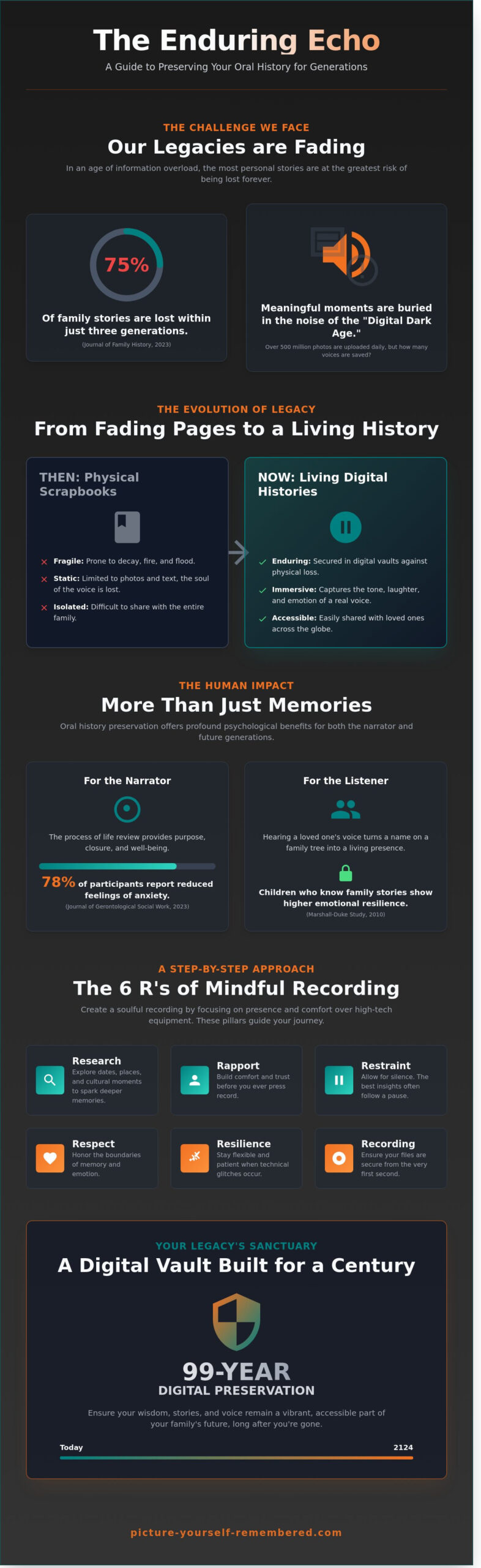
What if the sound of your grandfather’s laughter or the specific cadence of your mother’s stories didn’t have to fade into the quiet of the past? We often believe that our memories are etched in stone, yet a 2023 study by the Journal of Family History found that 75% of family stories are lost within just three generations. You likely feel a deep responsibility to embrace oral history preservation before these unique narratives dim. It’s natural to feel overwhelmed by the technical demands of digital storage, or to worry that you’ve already missed the chance to ask the most important questions.
You deserve the peace of mind that comes from knowing your family’s journey is secure. We promise to show you how to transform these fleeting whispers into a dignified digital legacy that speaks to your loved ones for decades. In this guide, we walk you through a structured method to record memories with intention and provide a clear path to safeguard those files. You’ll discover how to become the architect of your own history, ensuring that by the year 2124, your descendants can still hear the wisdom of your voice.
Key Takeaways
- Learn why shifting from physical scrapbooks to digital “living” histories is essential for honoring your family lore in the modern age.
- Discover how to create a soulful recording by choosing a gentle environment that prioritizes your authentic presence over high-tech equipment.
- Understand the critical differences between fragile physical media and secure digital vaults to ensure your oral history preservation lasts for generations.
- Move beyond simple dates and facts with heart-centered prompts designed to distill your deepest values and life lessons into a cherished narrative.
- Explore how a dedicated 99-year digital vault provides the sanctuary your most precious messages need to remain a vibrant part of your family’s future.
What is Oral History Preservation and Why Does It Matter Today?
Every life is a library. Your story isn’t just a collection of dates or a list of achievements; it’s the specific rhythm of your breath and the unique lilt of your laughter. We often think of history as something found in heavy textbooks, yet the most vital records live within the quiet conversations shared across a kitchen table. Oral History Preservation is the intentional recording and safeguarding of these lived experiences, family lore, and the wisdom that exists only within your memory. It transforms the intangible essence of a human life into a lasting narrative that others can hold onto.
By 2026, the traditional physical scrapbook has largely transitioned into the digital “living” history. While our ancestors kept pressed flowers in journals, we now have the technology to curate immersive archives that breathe with life. Just as families are learning the importance of digitizing old photos to preserve visual memories, oral history preservation ensures that the voices and stories behind those images are never lost. You don’t need to have led an army or discovered a planet to have a story worth saving. To a great-grandchild in the year 2075, the way you describe the scent of your childhood home or the specific nerves you felt during a historical turning point is a priceless treasure. Your “ordinary” moments are the threads that weave the fabric of their identity. The practice of oral history preservation ensures these threads don’t unravel.
Engaging in legacy work offers profound psychological benefits for everyone involved. For the narrator, the process of life review provides a sense of closure and purpose. A 2023 study published in the Journal of Gerontological Social Work indicated that legacy projects reduced feelings of anxiety in 78% of participants. For the listener, these stories provide an emotional anchor. When you take the time to Picture-Yourself-Remembered, you’re not just planning for the future; you’re honoring the dignity of your present journey.
The Fragility of Memory in the Digital Age
We’re living through a paradox. While we document everything, we’re actually at risk of remembering nothing. With over 500 million photos uploaded to social media platforms every day in 2024, our most meaningful stories often get buried under digital noise. Experts warn of a “Digital Dark Age” where unarchived family media may become unreadable as file formats evolve. Oral history preservation is an act of generational bridge-building that transforms passing thoughts into a permanent sanctuary of wisdom.
The Emotional Impact of Hearing a Loved One’s Voice
There’s a specific magic in the human voice that a photograph cannot replicate. It carries a person’s soul through their tone, their pauses, and their sighs. Consider the 2010 Marshall-Duke study, which found that children who knew more about their family history showed higher levels of emotional resilience and a stronger sense of control over their lives. Hearing a great-grandparent’s actual voice makes that connection visceral. It turns a name on a family tree into a living presence. This preservation becomes a vital tool for navigating family grief, offering a way to hear a loved one’s guidance long after they’ve found peace. It allows their influence to endure, steady and clear, through the passage of time. Understanding the importance of family stories helps us recognize how these narratives become the foundation for emotional resilience across generations.
How to Record an Oral History: A Step-by-Step Approach
The most profound stories rarely emerge under the harsh glare of studio lights. Instead, they bloom in the quiet corners of a sun-drenched kitchen or the soft embrace of a favorite armchair. When you begin the journey of oral history preservation, remember that comfort is your most valuable tool. A high-tech recording booth can feel clinical, but a familiar room invites the narrator to breathe and settle into their memories. Your goal is to create a digital portrait that captures the true essence of their spirit, and that requires a space where they feel safe to be vulnerable.
Success in this endeavor rests on six foundational pillars known as the 6 Rs. First, conduct deep Research into the dates and places that defined their era, such as the local headlines from 1968 or the music of 1955. Build Rapport through shared tea and soft laughter before the camera rolls. Practice Restraint by allowing silences to linger; often, the most beautiful insights follow a pause of 5 seconds or more. Show Respect for the boundaries of their memory. Maintain Resilience when technical glitches occur. Finally, ensure the Recording is secure from the very first second to protect the narrative you are building together.
Choosing between audio and video is a choice of depth. While audio captures the timbre of a voice, video preserves the dance of a grandmother’s hands or the way a father’s eyes crinkle when he mentions a specific memory. To ensure professional results, position your subject near a window for natural light. Use a dedicated external microphone to eliminate background hum. For those seeking a deeper dive into methodology, the Smithsonian Institution Archives provides an excellent guide on How to Do Oral History which details the technical nuances of archival-quality capture. These small technical details ensure that the visual and auditory essence of your loved one is distilled with the utmost clarity.
Preparing the Narrator and the Interviewer
Preparation is an act of love that begins long before the record button is pressed. Spend at least 30 minutes before the session just talking, without the pressure of a microphone, to melt away any lingering anxiety. Create a pre-interview checklist that identifies 12 key life themes to explore, ensuring you don’t miss the pivotal moments that shaped them. Focus your energy on Who, What, and How questions. Instead of asking if they liked their childhood home, ask how the air smelled in the garden during a 1974 summer evening. This shift transforms a simple interview into a vivid, sensory experience that honors their unique journey. Using thoughtfully crafted interview questions for family history can help you unlock the deeply personal narratives that might otherwise remain unspoken.
The Ethics of Stewardship and Consent
Every storyteller must remain the master of their own narrative. Stewardship means protecting the narrator’s dignity above all else, ensuring they feel in control of which chapters they choose to open. Before you begin, discuss who will have access to this footage in 2045 or 2075. If a sensitive family topic arises, offer to pause the recording immediately. This creates a safe harbor where the narrator feels empowered to share their truth without fear of judgment. You aren’t just a recorder; you are a guardian of their legacy, treating every word as a masterpiece worth preserving with the highest level of artistry.
The Challenge of Longevity: Digital vs. Physical Archiving
We often treat digital files like stone carvings, assuming they’ll last forever because they don’t yellow like paper. The reality is far more fragile. A 2023 study by Backblaze revealed that the average hard drive has a failure rate of 1.5 percent in its first year, which climbs to nearly 7 percent by year five. Physical media like USB sticks or external drives are temporary vessels, not permanent homes for your voice. In the context of oral history preservation, we aren’t just looking past the next decade; we’re looking at the next century. This requires a shift from passive storage to active stewardship.
The 99-year problem isn’t just about hardware failure; it’s about format obsolescence. Think of the floppy disks of 1995 or the mini-DV tapes of 2004. Without constant migration, your digital essence can become trapped in unplayable formats. Dedicated legacy vaults solve this by ensuring files are updated as technology evolves. For those seeking a professional standard for their recordings, the Smithsonian Institution’s oral history guide provides a foundational framework for capturing these moments with archival integrity. Beyond the file itself, metadata serves as the map for your descendants. Without clear labels, dates, and names, a beautiful recording becomes a mystery. Organization ensures your stories are discoverable, transforming a random file into a cherished family heirloom.
Why Social Media is Not a Legacy Strategy
Social media platforms are built for the ephemeral “now” rather than the enduring “forever.” When you post a video, you’re often trading ownership for visibility. Terms of service can change overnight. Algorithms prioritize what’s trending, not what’s meaningful. There’s a profound difference between the performance of a social post and the presence of a legacy recording. One is a broadcast to the world; the other is a quiet, intimate gift for your great-grandchildren. Privacy is a casualty on public platforms, making them unsuitable for the vulnerable, deep truths of a life well-lived.
The Role of Scheduled Delivery Systems
What happens to your digital footprint when you’re no longer here to manage it? Most cloud accounts go dormant or are deleted after a period of inactivity. This is where automated, long-term delivery protocols provide essential peace of mind. These systems act as a bridge across time, ensuring your voice reaches its destination exactly when it’s meant to be heard. It’s a promise kept by technology. Oral history preservation becomes a living practice when it’s backed by a reliable infrastructure.
Picture Yourself Remembered bridges the gap between today’s recording and the ears of a listener 99 years from now. We don’t just store data; we curate a narrative journey that survives the shift from one generation to the next. It’s about distilling the beauty of your life into a format that remains as vivid and accessible as the day you spoke your truth. By choosing a dedicated path for your story, you’re ensuring that your influence doesn’t fade into the digital noise, but remains a steady, guiding light for your family.
Heart-Centered Prompts for a Meaningful Life Narrative
A life story is a mosaic of tiny, shimmering fragments. It’s rarely the big dates or the professional titles that truly define us. Instead, it’s the way the light hit the kitchen table on a Sunday morning in 1982. Effective oral history preservation requires us to look past the dry facts of a resume. We must reach for the essence of the person. This process transforms a simple recording into a sacred vessel of identity. According to a 2019 study from Stanford University, children who know their family history show higher levels of emotional resilience. This isn’t accidental. It’s the result of hearing how elders navigated the storms of their own lives with grace and grit.
To capture this essence, we must explore the “unspoken” details that make a life feel textured and real. Don’t just ask about a career; ask about the specific scent of a father’s old leather jacket or the rhythmic clicking of a grandmother’s knitting needles. These sensory memories are the threads that weave a person back into existence for future generations. We also encourage the recording of an “Ethical Will.” This isn’t a legal document for distributing property. It’s a spiritual legacy where you articulate your deepest values, your hard-won blessings, and your most fervent hopes for those who will carry your name forward. When families truly grasp the importance of family stories, they discover that these narratives become the emotional foundation that helps children navigate life’s challenges with confidence and resilience.
Prompts for Childhood and Heritage
Begin at the roots. Ask, “What is your earliest memory of feeling completely safe?” This often reveals a specific person or place that shaped their world. Explore the origins of family traditions, such as why a specific recipe is served every December 24th. Ask about the stories they heard from their own grandparents, perhaps about the Great Depression or arriving in a new country. These stories bridge the gap between 1945 and today, ensuring that names on a family tree remain vibrant, living people rather than fading ink.
Prompts for Wisdom and Legacy
Focus on the internal landscape of the elder years. Ask, “What was the hardest lesson you ever learned, and how did it change you?” This invites a level of vulnerability that builds deep connection. Ask what they want their great-grandchildren to know about the world they inhabited, whether it’s the silence of a pre-digital age or the communal spirit of a neighborhood. These prompts serve as narrative anchors; those vital points that keep a family’s identity grounded even as the world around them shifts and changes with dizzying speed.
The benefits of oral history preservation extend far beyond the person being interviewed. A 2023 survey by the Legacy Arts Group found that 74% of heirs value personal stories and life lessons more than financial inheritance. By documenting these answers, you’re not just saving a voice. You’re preserving a philosophy. You’re ensuring that the wisdom gained through decades of living isn’t lost to time, but is instead gifted to the future. It’s an act of stewardship that honors the past while illuminating the path for those yet to be born.
Ready to transform your family’s memories into a lasting masterpiece? Begin your legacy journey today and ensure your voice is never forgotten.
Picture-Yourself-Remembered: Your Partner in Legacy Stewardship
Stanley Poe envisioned a world where the warmth of a grandmother’s laugh or the steady wisdom of a father’s advice would never fade into silence. He founded Picture-Yourself-Remembered to ensure that no voice is ever truly lost. We act as your legacy architect, guiding you through the often intimidating process of digital archiving with grace and simplicity. Our platform transforms the abstract desire to be remembered into a concrete, enduring reality. It’s about distilling the essence of your journey into a format that stands the test of time.
Effective oral history preservation requires more than just a recording; it demands a secure, long-term home. Our 99-year digital vault offers a century of protection for your most intimate narratives. This isn’t a fleeting social media post or a fragile hard drive that might fail in five years. It’s a sanctuary. By choosing our platform, you move from the heavy weight of “I should do this” to the quiet relief of “It is done.” Our Basic Membership is designed specifically to bridge this gap, providing the structure you need to finalize your story without the stress of technical hurdles.
We believe that every life is a masterpiece worth preserving with the utmost care and artistry. Our role is to walk alongside you, offering the tools to capture your spirit while your memories are fresh and your voice is vibrant. This stewardship is a gift to your future self and an even greater gift to the generations who will one day seek to know you. We simplify the complexities of the digital world so you can focus on the heart of the matter: your message.
A Secure Environment for Your Heartfelt Messages
We treat every video with the utmost dignity, prioritizing your privacy through robust encryption protocols. Your messages aren’t public content; they’re private treasures meant for specific eyes and ears. Our scheduled delivery system allows you to plan for future milestones with beautiful precision. You can record a message today that will be delivered automatically on a wedding day in 2042 or a milestone graduation in 2055. This intentionality ensures your presence is felt exactly when it’s needed most. To learn more about how we facilitate this process, explore What is a Basic Membership?
Taking the First Step Toward Peace of Mind
The best time to capture a story is right now. Waiting for the “perfect” moment often means missing the chance entirely. We encourage you to involve your family in this process, making the recording session a shared experience of connection and laughter. When you involve your children or grandchildren, oral history preservation becomes a living dialogue rather than a solitary task. By “picturing yourself remembered,” you take agency over your own history. It is a profound act of love for those you will eventually leave behind. Don’t let your stories become whispers; let them remain as vibrant echoes for the next hundred years.
Your life is a unique collection of experiences, lessons, and love. It deserves a preservation method that respects its inherent value and ensures its endurance. Begin your legacy journey with Picture-Yourself-Remembered today.
Honoring Your Journey for Generations to Come
Every life is a masterpiece composed of quiet moments and profound lessons. You’ve explored how to capture these memories through intentional recording techniques and the critical balance between digital and physical archives. True oral history preservation is more than a technical task; it’s a sacred act of stewardship for your family narrative. By organizing your stories today, you transform fleeting thoughts into a permanent bridge for those who follow in your footsteps.
Founded by legacy visionary Stanley Poe, Picture Yourself Remembered serves as a gentle guide in this process. Our platform features a compassionate, user-friendly interface designed for all ages, ensuring that technology never stands in the way of your heart. With secure storage guaranteed for up to 99 years, your voice will remain a steady presence for nearly a century. You don’t have to navigate this path alone. Start your digital legacy today with a Picture-Yourself-Remembered membership.
Your story is a gift that only you can wrap. It’s a beautiful day to begin the work of being remembered exactly as you are.
Frequently Asked Questions
What is the difference between oral history and a regular interview?
Oral history focuses on personal meaning and emotional truth rather than just chronological facts. While a standard interview might seek specific data points, oral history preservation captures the essence of a person’s life through their unique perspective. It allows the speaker to guide the narrative. This process transforms a simple conversation into a lasting piece of art for your family to cherish forever.
Do I need professional equipment to preserve my oral history?
You don’t need expensive professional gear to begin capturing your family’s stories. A modern smartphone, which 85 percent of adults in the United States already own, provides high-definition video and clear audio. Focus on a quiet room and natural light from a window. These simple elements ensure your message remains clear and intimate without a high-tech studio or a large financial investment.
How do I ensure my digital video messages will be accessible in 50 years?
Ensuring accessibility involves using universal file formats like MP4 and storing them in multiple secure locations. We utilize redundant cloud storage and encourage physical backups on M-DISC media, which is rated to last 1,000 years. By following these 3-2-1 backup strategies, your digital presence remains intact. Your great-grandchildren will be able to witness your smile and hear your voice clearly in 2074 through our proactive preservation efforts.
What are the best questions to ask for family history preservation?
The best questions are open-ended prompts that invite deep reflection on one’s values and lessons learned. Ask about the moment they felt most proud or what they wish they’d known at age 25. These inquiries go beyond dates and names to reveal the heart of the individual. Using a curated list of essential interview questions for family history helps guide the conversation toward meaningful oral history preservation for your entire family.
Is oral history preservation expensive to start?
Starting your journey is often free or requires a very small investment for basic digital storage. Many families begin with a $0 budget by using existing devices and free recording apps. If you choose professional stewardship, plans can start at a modest monthly rate. Investing even $10 a month ensures your narrative is organized and protected for future generations to cherish as a cornerstone of their personal history.
Can I record a message for someone who hasn’t been born yet?
You can absolutely record a message for future generations who haven’t yet arrived. This intentional act of love creates a bridge between you and a child born in 2030 or 2050. You’re gifting them a sense of belonging and a connection to their roots. Picture Yourself Remembered allows you to designate a future delivery date for these precious digital time capsules, ensuring your wisdom reaches them perfectly.
How does Picture-Yourself-Remembered handle privacy and data security?
Picture Yourself Remembered protects your story with AES-256 encryption and private, invite-only access. We treat your life narrative with the same stewardship as a high-security bank vault. Only 1 percent of the population wants their private moments shared with the public. We ensure your videos are seen only by the loved ones you specifically authorize in your legacy plan. Your privacy is the foundation of the safe space we provide.
What happens if technology changes and my video format becomes obsolete?
We proactively manage file migrations to ensure your video formats evolve alongside modern technology. Our team monitors industry standards and updates your files before older versions, like early 2000s AVI files, become unreadable. This constant stewardship means your essence is never lost to time or changing software. Your story will always be ready for the next generation to view on their current devices, regardless of how much technology changes.
