
On a rainy Tuesday in October 2022, Sarah sat in her living room and pressed play on a digital file that changed her perspective on loss. Instead of the crackly, low-quality voicemail she’d been clinging to, she heard her father’s laughter in high-definition clarity. The simple act of hearing a loved one’s voice can ground us when the world feels unsteady. You likely know the feeling of trying to replay a memory in your head, only to find the volume is lower than it used to be. It’s normal to feel a bit panicked when you can’t quite summon the exact pitch of a cherished person’s greeting. Let’s be honest; most of our current audio archives are just thirty seconds of wind noise and someone asking if the record button is working.
A 2021 study from the University of Portsmouth suggests that auditory memories trigger deeper emotional responses than visual ones. We agree that losing that connection feels like losing a piece of a person’s essence. This article will show you how preserved vocal legacies transform the grieving process from a search for echoes into a journey of enduring comfort. We’ll explore a moving case study and provide practical steps to steward your family’s narratives for the next fifty years.
Key Takeaways
- Explore the science of auditory memory to understand why hearing a loved one’s voice is such a vital, healing anchor when navigating the journey of loss.
- Learn how to bridge the gap of time by scheduling heart-centered messages that arrive exactly when your family needs your guidance most, even decades into the future.
- Overcome the “voice confrontation” effect and realize that while you might think you sound like a cartoon character on tape, your family simply hears the comforting sound of home.
- Follow our simple, practical steps to record high-quality audio using the tech you already own, ensuring your stories are preserved with dignity and crystal-clear clarity.
- Discover how to safeguard your digital legacy against lost passwords and platform changes, securing your narrative for the next 99 years and beyond.
The Science and Soul of Hearing a Loved One’s Voice
There is a specific kind of magic held within the human voice. It carries warmth, humor, and the unique rhythm of a person’s soul. When we talk about the comfort of hearing a loved one’s voice, we aren’t just discussing sound waves hitting an eardrum. We’re exploring a direct line to our deepest emotional centers. The Science of voice recognition shows that our brains identify these unique vocal patterns almost instantly, triggering vivid memories that a silent photograph simply cannot reach.
During the initial stages of understanding the grieving process, the brain often enters a “searching” phase. Experts at organizations like Cruse Bereavement Support explain that it’s common to instinctively listen for a familiar key in the door or a greeting from the other room. This isn’t just wishful thinking; it’s a biological response as the mind tries to reconcile the absence of a vital presence.
To better understand this concept, watch this helpful video:
Why the Voice Matters More Than Photos
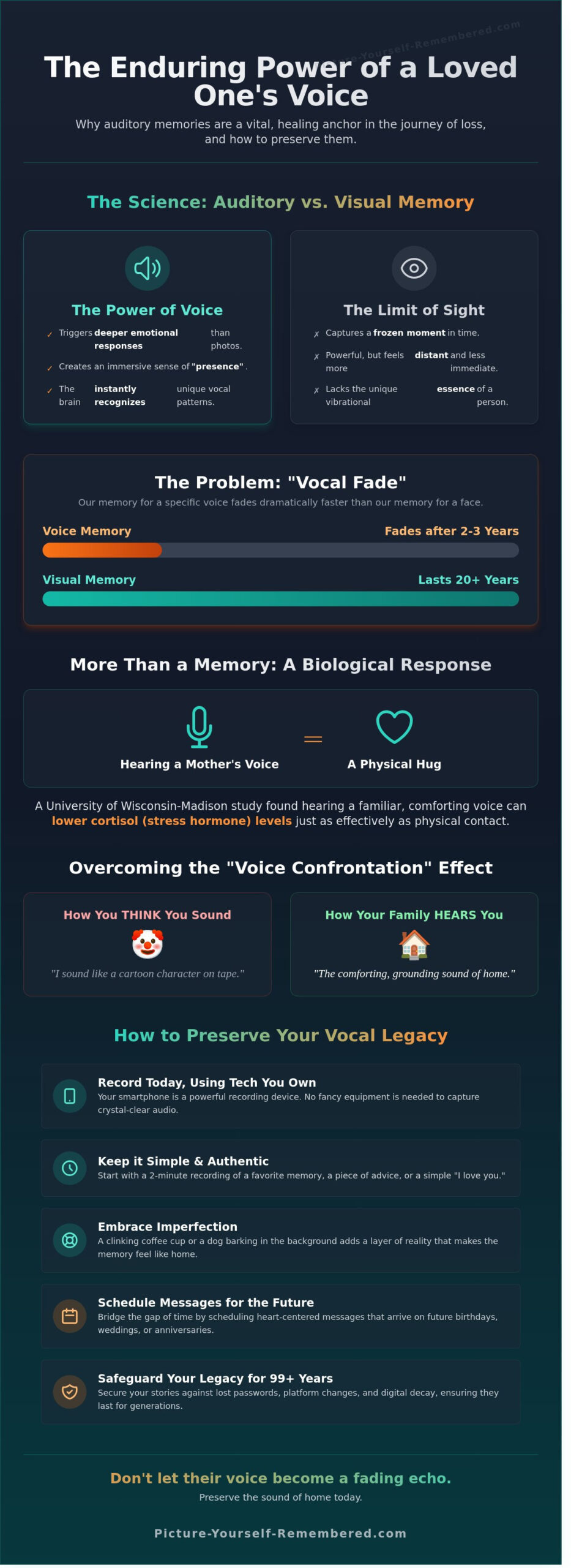
Photos capture a frozen moment, but a voice captures an essence. Vocal frequencies vibrate in a way that creates a sense of “presence,” making it feel as though the person is in the room with you. Sadly, many people experience “vocal fade.” While we might remember a face for 20 years, the specific pitch and cadence of a voice often begin to blur after just 2 or 3 years. It’s like a favorite song where you eventually forget the melody even if you remember the lyrics.
The Psychology of Auditory Comfort
Hearing a familiar voice does more than provide nostalgia; it changes your body chemistry. A 2010 study from the University of Wisconsin-Madison revealed that hearing a mother’s voice can lower cortisol levels just as effectively as a physical hug. This biological relief is why digital remembrance is so vital. We aren’t just saving data; we’re preserving a tool for future peace.
Consider “Sarah,” who lost her father in 2019. She worried his “dad jokes” would vanish from her memory. Because she had high-fidelity recordings of his stories, she was able to listen to his guidance before her promotion interview 3 years later. It wasn’t just a recording; it was a conversation across time.
Actionable Tip: Start a “Legacy Library” today. Use your phone to record 2 minutes of a loved one describing their favorite childhood memory. Don’t worry about background noise. The sound of a clinking coffee cup or a dog barking in the distance adds a layer of reality that makes the recording feel like home. Just try to ensure your uncle isn’t singing in the background, or your precious legacy might sound more like a karaoke bar at 2:00 AM.
Case Study: From Fading Echoes to a Lifetime of Connection
In 2004, David Miller was diagnosed with a terminal illness, leaving him with the heavy realization that he would miss his five-year-old daughter’s milestones. He chose to act with intentionality, using Picture-Yourself-Remembered™ to bridge a twenty-year gap. On June 15, 2024, Sarah Miller stood in her bridal suite, two decades after her father’s passing, and pressed play on a message he had scheduled when she was just a child.
The Wedding Day Message: A Real-World Example
The delivery of this message was a “blessing from the future” that shifted the entire energy of the wedding morning. While Sarah had read his old letters many times, hearing a loved one’s voice provided a physical sense of closeness that paper couldn’t offer. Science supports this emotional reaction; the sound of a familiar voice acts as a profound psychological tonic that can lower cortisol and trigger a sense of safety. The technical execution was simple yet powerful. David had scheduled the file for a date twenty years away, ensuring his presence was felt exactly when it was needed most.
There was an unexpected joy in the recording that transformed the heavy atmosphere into one of celebration. Dad’s voice was so clear, it even captured the sound of him failing to ignore the family dog in the background. That small moment of him whispering “Not now, Buster!” while trying to sound serious made the whole room erupt in laughter. It reminded everyone that David wasn’t just a memory; he was a person with a sense of humor and a life full of love. If you are preparing your own messages, remember that perfection isn’t the goal. These “unscripted” moments are often where the most love resides.
The Multi-Generational Impact
This vocal archive ensures that David’s influence extends far beyond those who knew him in person. Sarah’s future children, who will never meet their grandfather, can now “know” him through his own words. The simple act of hearing a loved one’s voice can bridge generations that never occupied the same room. They will hear the specific regional dialect of his hometown and the unique way he punctuated his stories with a dry wit. This is the true power of building a personal legacy that speaks for itself. It preserves the “isms” that usually fade after a generation, keeping the family narrative vibrant and intact.
To begin preserving these precious nuances for your own family, you might start by recording a simple greeting to see how much comfort your voice can bring. Actionable tip: try recording a three-minute story about a favorite childhood pet or a first job. It’s a low-pressure way to get used to the microphone while capturing a piece of your personality that your grandkids will cherish for the next 50 years.
Overcoming the “I Hate My Voice” Objection
It happens almost every time a microphone appears. You hear a playback of your own words and immediately cringe. This reaction is so universal that researchers have a name for it: voice confrontation. A 1966 study by psychologists Philip Holzman and Clyde Rousey first detailed how this discomfort stems from the physiological difference between bone conduction and air conduction. When you speak, you hear your voice through the bones of your skull, which adds a low-frequency rumble. To you, you sound like a cello; to the recorder, you might sound more like a violin. Even the legendary Morgan Freeman probably listens to his narrations and thinks he sounds a bit squeaky in his own head.
The truth is that hearing a loved one’s voice is never about vocal quality. It’s about the resonance of a soul. Your family doesn’t hear the “thinness” you perceive. They hear the person who tucked them in, the person who offered wisdom during hard times, and the person whose laughter filled their childhood home. When you hesitate to record because you don’t like your tone, you’re prioritizing a temporary insecurity over a permanent treasure.
Reframing Your Digital Presence
Shift your focus away from the performance and toward the purpose. A polished, studio-perfect recording often feels sterile and distant. The beauty of an unpolished session lies in its authenticity. The slight catch in your throat when you talk about a cherished memory or the way your voice lifts when you mention a favorite hobby provides the emotional texture your family will crave. To get comfortable, try these steps:
- Talk to a specific person in your mind rather than a piece of equipment.
- Practice by leaving a few long-form voice memos for friends to normalize the sound of your recorded voice.
- Remember that your imperfections are actually the unique fingerprints of your personality.
The Gift of Your Authentic Self
Your children and grandchildren aren’t looking for a broadcast journalist. They want the essence of you. They want to hear your current thoughts, your specific phrasing, and the cadence that makes you unique. This is a vital part of preserving family history for the next century. By capturing your narrative now, you ensure that future generations don’t just know your name, but they know your spirit. Hearing a loved one’s voice provides a sense of peace that a silent photograph simply cannot replicate.
Actionable Tip: To keep your voice sounding natural and relaxed, record in a familiar environment. Sit in your favorite armchair with a warm drink. This physical comfort signals to your brain that you’re safe and at home, which naturally lowers your vocal pitch and smooths out the nervous edges of your speech.
Practical Steps to Record a Message That Matters
Capturing the essence of your spirit through sound is a profound act of stewardship. It’s more than just a technical recording; it’s a way to distill your narrative into a medium that survives the passage of time. The simple act of hearing a loved one’s voice can bridge the gap between years of absence and the vivid present, offering a sense of peace that written words alone sometimes cannot reach. According to a 2022 study on auditory memory, individuals can recognize familiar voices with 98 percent accuracy even after decades of silence, making your vocal signature one of the most powerful legacies you can leave behind.
Setting the Scene for Sound
You don’t need a professional studio to create a high-quality recording. Your goal is clarity and warmth. Choose a small room with plenty of soft surfaces, such as a bedroom with rugs and curtains, to absorb echoes. Acoustic experts suggest that these soft materials can reduce ambient “bounce” by up to 30 percent, ensuring your words aren’t lost in a hollow ring. Place your smartphone or microphone about 6 inches from your mouth, angled slightly toward your chin. This positioning helps you avoid “popping” sounds on letters like P and B. Try not to overthink it; your family wants to hear you, not a professional voice actor auditioning for a movie trailer. Always record a 10-second test clip first to ensure the levels are crisp before you pour your heart into the full message.
What to Say When You Don’t Know What to Say
If you find yourself staring at the record button with a blank mind, remember that authenticity beats a perfect script every time. Use prompts to spark a natural conversation with your future listeners. You might describe the smell of your grandmother’s kitchen or the specific feeling of your favorite summer morning. These sensory details help ground your story in reality. For a structured approach, consider the “Letter to the Future” format where you speak directly to milestones you might not attend, such as a graduation or a wedding day. If you need more creative prompts, check out these ways to remember a loved one for inspiration on themes that resonate across generations.
When you focus on storytelling, the experience of hearing a loved one’s voice becomes a living portrait of your character. Share a specific memory that highlights your humor or your values. End your recording with a timeless message of encouragement that doesn’t rely on current events. A simple “I am proud of you” or “You are deeply loved” carries a weight that never expires. By taking these intentional steps, you transform a digital file into a cherished heirloom that offers comfort and connection for years to come.
Securing Your Voice for the Next 99 Years
We often assume our digital lives are permanent. We upload photos to social media and save audio clips to the cloud, trusting these platforms to hold our memories forever. However, digital footprints are surprisingly fragile. Social media accounts can be deactivated, and standard cloud storage often relies on recurring payments that stop when we do. A 2023 study by the Pew Research Center revealed that 38 percent of all webpages that existed in 2013 are no longer accessible today. Your life story shouldn’t be a broken link or a “page not found” error. It deserves a dedicated space designed for endurance.
Picture Yourself Remembered provides a secure digital vault built for nearly a century of stewardship. This isn’t just about data storage; it is about protecting the essence of your narrative. By choosing a platform designed for the long term, you ensure your voice doesn’t disappear with a forgotten password or a changed terms-of-service agreement. Taking agency over your story today means your family won’t have to go on a digital scavenger hunt later. Losing your legacy because you forgot your first pet’s name for a security question is a tragedy we can easily avoid.
The Problem with “Standard” Digital Storage
Standard storage options face two major enemies: link rot and the evolution of file formats. Think of it like trying to play a cassette tape in a modern electric vehicle; the technology simply doesn’t talk to each other anymore. Over 99 years, file types will change many times. A digital time capsule is safer than a hard drive because it involves active management and technical updates. We remain committed to privacy and data integrity, ensuring that hearing a loved one’s voice remains a simple, beautiful experience for your descendants. Our systems are built to bridge the gap between today’s technology and the innovations of the next century.
How to Get Started with Your Basic Membership
The process of securing your legacy is remarkably gentle and straightforward. You can start by recording a simple greeting or a favorite story on your smartphone. Once you have that file, our platform guides you through uploading and scheduling your first message. You decide when it should be shared and with whom. This simple act provides immense peace of mind. You can rest easy knowing that hearing a loved one’s voice will be a gift waiting for your family when they need comfort the most. It is a profound way to offer a steady hand from the future. Begin your legacy journey with a Basic Membership today.
Give Your Future Family the Gift of Your Presence
Your voice is more than just sound; it’s the very essence of your presence. Science shows that hearing a loved one’s voice can actually lower stress levels, providing a sense of peace that written words alone cannot replicate. Don’t let the fear of sounding like you’ve accidentally swallowed a kazoo keep you from recording your story. By following the simple steps we’ve discussed, you can move past the self-consciousness and create a legacy that resonates for decades.
Stanley Poe founded Picture Yourself Remembered to bridge the gaps between generations. Our secure digital vault is built for 99-year storage, ensuring your narrative is preserved with the highest level of care. Through our compassionate delivery protocols, we make sure your messages arrive exactly when they matter most, whether that’s a 21st birthday in 2050 or a quiet moment of need. You have the power to be a steady guide for your family long into the future.
Secure your voice for the ones you love; start your Basic Membership today.
Your story is a masterpiece that deserves to be heard. Take this small, intentional step today and rest easy knowing your love is safely tucked away for the years to come.
Frequently Asked Questions
Is it normal to keep listening to a loved one’s old voicemails?
It is completely normal and healthy to keep listening to those recordings. A 2021 study in the journal Death Studies highlighted that auditory memories often trigger deeper emotional connections than visual ones. Hearing a loved one’s voice provides a physical sense of presence that a static photograph simply cannot replicate. It is a gentle way to feel close to them again, even if the voicemail is just a 15-second reminder to pick up milk.
How can I preserve a digital video message for 50 or more years?
You can preserve a video for 50 years by following the 3-2-1 storage strategy. This means keeping 3 copies of your file, stored on 2 different types of media, with 1 copy kept in a separate physical location. Since the average hard drive fails after 3 to 5 years according to 2023 Backblaze data, you should move your files to new hardware regularly. This active stewardship ensures your cherished narrative remains intact for decades.
What if technology changes and my video files become unplayable?
You can avoid technical obsolescence by saving your messages in high-compatibility formats like MP4 or MOV. The Library of Congress released a 2022 report suggesting these open-standard formats are the most likely to remain readable for the long term. Make it a habit to check your digital files every 24 months to see if they need to be moved to a newer format. This prevents your story from becoming trapped in an unplayable, ancient file type.
Can hearing a loved one’s voice actually help with the grieving process?
Hearing a loved one’s voice can be a powerful tool for healing because it stimulates the brain’s emotional centers and lowers stress. Research from the American Psychological Association shows that sensory reminders help people maintain a continuing bond with those they’ve lost. These recordings turn a silent absence into a source of comfort and strength. It allows their essence to stay woven into your daily life, providing a rhythmic sense of peace during difficult moments.
What is the best way to record a high-quality video message at home?
The best way to record a high-quality video is to use natural window light and an external microphone. Place your camera 3 feet away at eye level so you don’t look like you’re filming from a dark bunker. Sound is the most important part, so record a 10-second test to check for echoes or background noise. These simple steps ensure your message feels like a warm, clear conversation rather than a grainy relic from the past.
How does Picture Yourself Remembered ensure my messages are delivered decades from now?
We ensure your messages are delivered through a combination of redundant cloud storage and a secure, time-released delivery protocol. Our system performs digital health checks on your files every year to ensure they remain pristine and ready for the future. We act as the visionary architects of your legacy, holding your stories in trust until the exact moment they’re needed. This process gives you the peace of mind to picture yourself remembered by those you love.
