

Imagine it is the year 2045, and your grandchild finds a silver hard drive from 2024 tucked away in a shoebox. They plug it in, hoping to hear your laughter, but the screen remains blank because the hardware has decayed. This scenario is a quiet tragedy, yet a 2023 report by the Digital Preservation Coalition suggests that without active care, digital records can become unreadable in less than a decade. Long term digital archiving for families is no longer just a technical task; it is a profound way to ensure your essence isn’t lost to a bit rot graveyard. Honestly, trying to organize 12,000 digital photos often feels like trying to herd caffeinated cats into a very small basket.
You likely feel overwhelmed by the mountain of files on your devices, and you are right to worry about who will manage them later. It’s a heavy burden. This guide promises to clear that fog by showing you how to build a 99-year legacy plan that protects your cherished stories. We will explore the practical steps to move from digital clutter to a curated narrative that brings your family emotional peace. It is time to take agency over your story and truly picture yourself remembered by those who haven’t even been born yet.
Key Takeaways
- Discover how to transform your “digital junk drawer” into a curated legacy vault that honors your family’s unique narrative across generations.
- Learn to select “forever” file formats like MP4 and PDF/A so your great-grandchildren won’t need to hire a digital archaeologist just to see your vacation photos.
- Master the “One Hour a Week” rule and the “Keep, Delete, Archive” framework to make long term digital archiving for families a joyful, manageable act of love.
- Explore the difference between standard cloud storage and a living archive that delivers your most cherished stories to your children exactly when they need them most.
- Gain peace of mind by securing your essence with professional-grade encryption designed to safeguard your family’s history for the next 99 years.
What is Long Term Digital Archiving for Families?
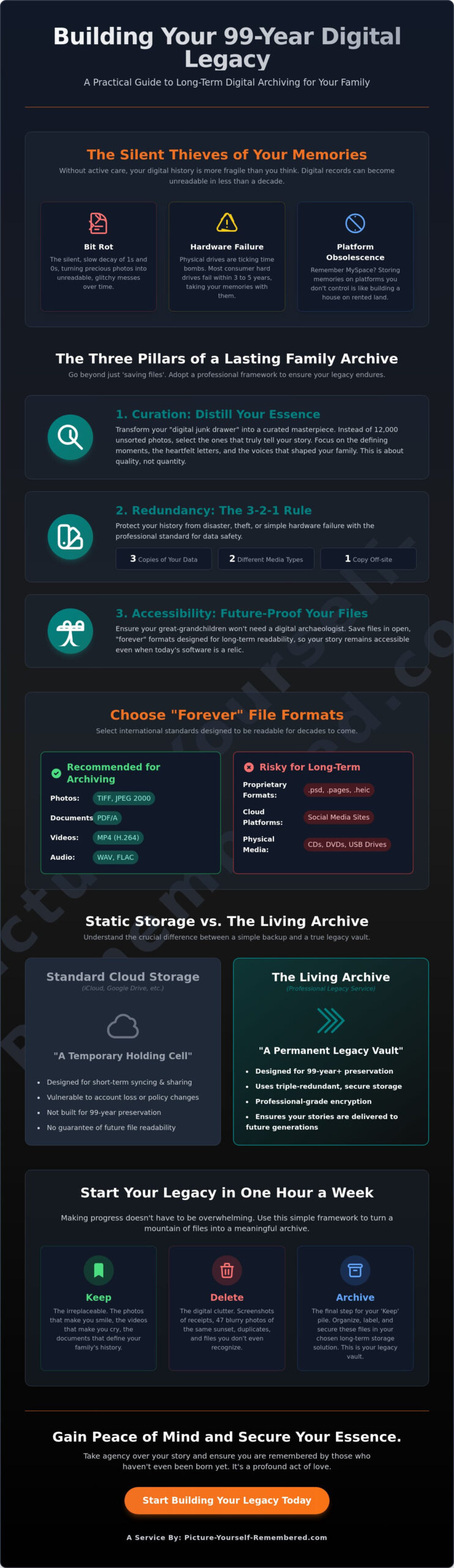
Think of your digital life for a moment. Is it a curated gallery of your most cherished moments, or is it a digital junk drawer? Most of us treat our phones like a bottomless pit of screenshots, blurry receipts, and accidental pocket photos. Real long term digital archiving for families is the intentional act of distilling your life into a masterpiece. It isn’t just about saving files; it’s about stewardship. While services like iCloud or Google Drive are convenient for syncing your phone today, they aren’t designed for 99-year preservation. They are temporary holding cells rather than permanent vaults.
To better understand how to keep your memories safe for a lifetime, watch this helpful video:
By the year 2026, the sheer volume of digital noise will make it nearly impossible to find meaningful stories without a dedicated plan. We are currently living in a digital dark age where our history is often trapped in fragile, proprietary formats. You’ve been chosen as the legacy architect of your family. It sounds like a heavy title, but it’s really just a beautiful way to say you’re the one who makes sure the light of your family story doesn’t go out for future generations. Taking agency over your narrative now ensures that your great-grandchildren will know your voice and your smile.
The Vulnerability of Modern Memories
Memories are more fragile than we like to admit. The practice of digital preservation involves a constant battle against bit rot. This is the silent corruption of data where the 1s and 0s in your files slowly decay over time, eventually turning a precious wedding photo into a glitchy, unreadable mess. Platform obsolescence is another thief of history. Remember MySpace? In 2019, the platform lost 50 million songs uploaded over a 12-year period during a server migration. If your memories live only on a social media site, they’re essentially sitting in a house you don’t own. Physical hard drives aren’t the hero of this story either. Most mechanical drives fail within 3 to 5 years. They are like digital ticking time bombs, but much less exciting than the ones you see in action movies.
The Three Pillars of a Family Archive
Building a lasting archive requires a thoughtful approach that goes beyond clicking a save button. It’s a process of distilling your essence into a format that endures.
- Curation: You don’t need to save 47 photos of your lunch from 2018. Selecting the true essence of your life ensures your descendants aren’t buried in digital clutter. Focus on the stories that define you.
- Redundancy: Follow the 3-2-1 rule for safety. Keep 3 copies of your data on 2 different types of media, with at least 1 copy stored offsite. This protects your history from fire, theft, or simple hardware failure.
- Accessibility: Ensure future technology can actually read your files. Save your most important documents and photos in evergreen, standardized formats like PDF/A or high-resolution TIFFs. This ensures your narrative remains accessible even when today’s software becomes a relic of the past.
The Technical Foundation: Safeguarding Files for 99 Years
To build a bridge that reaches your great-grandchildren, you need a foundation stronger than a simple thumb drive or a standard cloud folder. Long term digital archiving for families isn’t just about saving bits and bytes; it’s about ensuring your essence remains readable as technology shifts through the decades. We recommend choosing open formats like MP4 for your videos and PDF/A for your written letters. These are international standards designed to be readable even when the software of today becomes a distant memory. By selecting these formats, you’re choosing a language that the future will still understand.
True preservation requires more than just a single copy. Professional vaults utilize triple-redundant storage, which means your cherished memories live in three separate, secure locations. If a regional disaster strikes one area, your legacy remains safe in another. This professional approach to Personal Digital Archiving ensures that your family history isn’t dependent on a single piece of hardware. It’s a way of wrapping your story in a digital safety net that spans continents.
Naming Your Legacy: A Simple System
Think of a file name as a gift to a future stranger. When you use a clear naming convention, you’re acting as a guide for those who haven’t met you yet. Use the YYYY-MM-DD format, such as 2026-06-15, so your files automatically sort themselves in chronological order. A file named “2026-06-15_Grandma-Rose_80th-Birthday_Garden-Party.mp4” tells a much richer story than “IMG_4829.mp4”.
- The Who, What, Where: Always include the main subject and the location to help grandkids identify people they may only know through stories.
- Avoid Special Characters: Stay away from symbols like #, % or *. Computers can be a bit sensitive; we don’t want them throwing a digital tantrum when your grandson tries to open a file in fifty years.
- Consistency is Key: Once you pick a system, stick to it. It makes the process feel less like a chore and more like a meaningful act of love for your descendants.
The 99-Year Horizon
How do we ensure the digital flame keeps burning? Subscription models often serve as the fuel that keeps archival servers running for the next century. These models fund the “Archive Stewards” who monitor the health of your data. Digital Stewardship is the active management of data to ensure its long-term viability. It involves a process called future-proofing, where files undergo automatic format migration. As old file types become obsolete, the system quietly transitions your memories into the newest, most stable formats. This proactive care is essential for long term digital archiving for families who want their narrative to survive the rapid pace of technological change. Unless you want your descendants to think you were a professional cryptographer, keeping your files updated and clearly labeled is the best way to be seen and known by the generations to follow.
Static Storage vs. The Living Archive
Think about a dusty attic box versus a beautifully curated photo album. Standard cloud storage is often just a digital attic where files go to be forgotten. Dumping 10,000 unorganized photos on your children isn’t a gift; it’s a digital chore they’ll likely avoid. True long term digital archiving for families requires a shift from passive storage to active stewardship. Instead of a chaotic “data dump,” imagine a scheduled delivery system that presents memories exactly when they’re needed most. It’s the difference between a cluttered basement and a thoughtfully prepared inheritance.
Hearing a loved one’s voice provides a soulful connection that a text caption simply can’t reach. Research into auditory memory suggests that hearing a familiar voice activates emotional centers in the brain more effectively than visual cues alone. When you record a message, you’re preserving your essence. It’s the difference between seeing a static picture of a birthday cake and hearing your mother’s laughter as she sings to you. While you’re organizing these files, consulting a Personal Digital Archiving Guide can help you understand the technical basics of file health and longevity.
Why Social Media Is Not an Archive
It’s tempting to think of your profile as a history book, but it’s actually a billboard. Platforms like Instagram or Facebook compress your files, often stripping away up to 80% of the original video resolution to save space on their servers. Your family’s private history shouldn’t be fodder for ad targeting algorithms. These platforms also lack “future delivery” features for a grandchild’s wedding in 2045. Relying on social media for a legacy is like inviting a telemarketer to your family reunion; it’s intrusive and probably won’t end well.
Creating a Digital Time Capsule
Intentionality transforms a simple file into a digital heirloom. You can bridge the gap between “now” and “then” by scheduling a video for a 21st birthday or a wedding decades away. This isn’t just about saving bits and bytes. It’s about crafting a narrative. Using a digital time capsule allows you to curate specific moments for specific people, ensuring your voice is heard on their most important days.
- Pick five “anchor memories” this week.
- Record a two minute video for each, explaining why that moment mattered.
- Label them with the date and the specific person they’re for.
This simple act ensures your long term digital archiving for families feels like a warm embrace rather than a technical manual. By choosing a living archive over static storage, you’re not just saving data; you’re ensuring your presence remains a steady, loving light for generations to come.
Practical Steps to Start Your Family Archive Today
Starting a journey of a thousand memories begins with a single file. It’s common to feel paralyzed by the sheer volume of photos and videos living on your various devices. To prevent burnout, adopt the “One Hour a Week” rule. By dedicating just 60 minutes every Sunday morning to your archive, you can organize over 500 files a month without feeling the weight of the task. This steady pace transforms a daunting project into a soulful ritual of reflection.
As you sort through your digital life, use the “Keep, Delete, Archive” framework to find clarity. Keep the gems that capture the true essence of a moment. Delete the blurry shots, the accidental pocket videos, or the five nearly identical photos of your dinner. Archive the milestones and the quiet, everyday interactions that define your family’s narrative. This careful stewardship ensures your story stays focused for those who will view it in 2099 or beyond.
The most vital part of long term digital archiving for families is the inclusion of your own voice and perspective. Don’t wait for the perfect moment or a professional camera crew to begin. Recording your first message today is a profound act of love. When you invite other family members to contribute their own stories to the vault, you aren’t just saving data; you’re cultivating a living tapestry of connection that spans generations.
Recording Your First Video Legacy
Begin with a “Why I Love You” message for your closest relative. This simple act distills your heart into a format that time cannot touch. For the best results, sit near a window to let natural light illuminate your face and look directly into the camera lens, not at your own reflection on the screen. Try to avoid recording in front of a pile of laundry, unless your legacy is being the world’s most prolific sock-loser.
Organizing the Past and Present
Your archive should act as a bridge between eras. This involves preserving family history by digitizing physical artifacts like handwritten letters or old recipes. Set up a “Legacy Folder” on your computer to serve as a staging area for these treasures before they move to permanent storage. Finally, write a “Letter of Instruction” for your digital executor. While 67% of adults lacked a formal digital estate plan in 2023, this one document ensures your loved ones have the keys to your cherished digital kingdom.
Ready to secure your story for the next century? Explore how we help you build a 99-year legacy today.
Picture Yourself Remembered: Your Partner in Legacy
Stanley Poe founded this service with a clear, heartfelt mission: to ensure that no story is ever left untold. He recognized that while technology moves fast, the human need for connection remains constant. Our platform simplifies the complex world of long term digital archiving for families by acting as a bridge between the present and the future. We handle the technical updates and storage migrations so you can focus on the message itself. It is a much more reliable plan than hoping your grandkids still have a working DVD player in the year 2075.
The security of your digital vault is our highest priority. We protect your essence with professional-grade encryption, which is the same standard used to secure global financial transactions. This ensures your private reflections remain shielded from the world until their scheduled delivery. This delivery system is the heartbeat of our service. It is the vessel that carries your voice across decades, ensuring that your “hello” from today reaches a loved one exactly when they need it most. By choosing a structured path for long term digital archiving for families, you are practicing a profound form of stewardship over your own narrative.
The Basic Membership: Your Legacy Foundation
Our Basic Membership provides the essential tools to build your digital monument. It includes secure video message storage and delivery protocols designed to last for 99 years. This membership offers the quiet relief that comes from knowing your messages are “set for flight.” You don’t have to worry about expiring links or lost hard drives. For a detailed look at the journey your data takes, read about how picture yourself remembered works and how we maintain the integrity of your files through the decades.
Taking the First Step
The most important part of legacy planning is simply beginning. We offer a gentle invitation to start recording messages for loved ones today, even if it is just a short note to say you are thinking of them. You might also consider gifting a membership to a parent or grandparent. This creates a safe space for them to share the wisdom that only comes with time. Your story is a masterpiece worth preserving, and we are honored to help you keep the colors bright for generations to come. Take a moment today to speak to the future; your family is already waiting to hear from you.
Securing Your Story for the Next Century
Your family story is a living masterpiece, not just a collection of files meant to gather digital dust. By shifting from fragile hardware to long term digital archiving for families, you ensure your essence isn’t lost to a broken link or a forgotten password. We’ve explored how redundant digital vault technology protects your photos against the inevitable failure of physical drives, which typically only last three to five years. You now have the practical steps to move beyond a static storage mindset toward a living archive that breathes with your lineage. Even that one blurry photo of your 1994 perm deserves a secure seat at the table of history.
Our compassionate, human centered support team handles the complex technical heavy lifting for you. With secure 99 year delivery protocols, your great grandchildren will receive your narrative exactly when you intended. It’s about more than just data; it’s about the profound peace of mind that comes from being truly known. Your legacy is ready to be preserved with the same care you used to build it.
Begin your 99-year legacy journey with a Basic Membership today.
Frequently Asked Questions
Is digital archiving different from just using Google Drive or iCloud?
Digital archiving is fundamentally different because it focuses on permanent preservation rather than daily synchronization. Services like Google Drive are designed for active file sharing and can delete data after 24 months of account inactivity. For true long term digital archiving for families, you need a system that performs regular health checks on your files to prevent data decay. Think of the cloud as a temporary backpack and an archive as a secure vault.
How long can a digital archive actually last?
A digital archive can last 99 years or longer if it utilizes proactive data migration and redundant storage. While a standard consumer hard drive often fails within 5 years, professional archiving services use “bit rot” protection to ensure your essence remains intact. By checking file integrity every 12 months, your story stays clear and vibrant for your great-grandchildren. It’s like tending a garden so the narrative never wilts.
What happens to my family archive if the storage company goes out of business?
You protect your legacy by choosing providers that offer a succession plan or use decentralized storage protocols. Ensure your chosen service follows the OAIS model, which is the gold standard used by the Library of Congress. Always maintain one local copy on an external drive stored in a fireproof safe at home. If a company closes, reputable services provide a 90 day window to move your narrative to a new home.
Can I schedule a video message to be delivered 50 years from now?
You can absolutely schedule a video message to be released 50 years into the future using time-locked digital vaults. These systems act as a bridge between generations, releasing your words on a specific date or milestone. Imagine your voice reaching out to a grandchild on their wedding day in the year 2074. It is a profound way to ensure your warmth and wisdom are felt long after today’s conversation ends.
What are the best file formats for long-term video preservation?
The best formats for long-term video are open-standard files like MP4 using the H.264 codec. These formats are currently compatible with 99 percent of modern devices and software. Avoid proprietary formats that belong to a single company. For the best results, save a high-resolution master copy and a smaller access copy for easy viewing. Even your cat’s 4K sneezing fit deserves high-quality preservation for the next century.
Do I need to be a tech expert to set up a digital legacy for my family?
You don’t need to be a tech expert because modern legacy tools are designed with simplicity and quiet dignity. If you can navigate a smartphone or send a text message, you have the skills to curate your history. Most platforms use a drag and drop interface that feels as natural as placing a physical photo into an album. We act as your guide, simplifying the technical bits so you can focus on storytelling.
How much storage space does a typical family digital archive require?
A typical family archive usually requires between 500GB and 2TB of storage space. To put that in perspective, 1TB can hold approximately 250,000 high-resolution photos or 500 hours of HD video. Start by organizing your most cherished 100 videos and 1,000 photos to keep the project manageable. Focusing on quality over quantity ensures that your long term digital archiving for families project doesn’t get lost in a sea of blurry screenshots.
Can multiple family members access and add to the same digital vault?
Most digital vaults allow you to invite multiple contributors to act as co-stewards of your family legacy. You can grant specific permissions to 3 or 4 trusted relatives, allowing them to upload their own cherished memories. This collaborative approach ensures that your family narrative is seen from every beautiful angle. It’s a shared act of intentionality that builds a stronger, more complete picture of your collective journey through time.
