
What if the most vibrant chapters of your life, the sound of your daughter’s first laugh or your father’s wedding toast, simply vanished because of a silent digital glitch? It is a heavy thought, but one that many of us face as we wonder how to share family videos with future generations in an age where technology often moves faster than a toddler on a sugar rush. You likely feel a deep responsibility to protect these echoes of the past, yet the technical talk of encryption and file corruption can feel like a cold barrier to a very warm, human goal.
We believe your personal history is a masterpiece that deserves a secure, lasting home. In this guide, you will discover how to create a digital vault that offers true peace of mind, keeping hackers at bay while ensuring your videos are delivered to the right hands at the perfect time. We are going to walk through the most reliable storage solutions of 2026, breaking down complex security into simple, intentional steps that honor your journey and keep your stories thriving for years to come.
Key Takeaways
- Learn how to transform scattered files into a secure digital sanctuary that outlasts physical hard drives and dusty moving boxes.
- Master the art of how to share family videos with future generations by using encryption and redundancy to keep your stories safe from digital decay.
- Understand why traditional cloud storage might fail your legacy and why a dedicated delivery system is necessary for intergenerational connection.
- Get practical steps to curate your collection, ensuring your descendants see the highlights of your life rather than ten minutes of your pocket’s interior.
- Discover a way to secure and schedule your most heartfelt video messages for delivery decades into the future, keeping your voice present for those you love.
What is Secure Cloud Storage for Family Videos?
Imagine your family stories as more than just files on a screen. A secure digital sanctuary is a place where your most meaningful moments are encrypted and archived for the long haul. It is a decentralized home for your history, one that is designed to outlive physical hard drives and dusty moving boxes. This sanctuary isn’t just about bits and bytes; it is about the quiet dignity of a life well-lived. By choosing a secure path, you ensure that your personal narrative doesn’t get lost in the noise of the digital age. Think of it as a bank vault. Instead of cold bars of gold, this vault holds the warmth of your daughter’s first laugh or the shaky footage of your parents’ golden anniversary.
When you start exploring how to share family videos with future generations, you are actually building a bridge. You are connecting the gadgets in your pocket today with the eyes and hearts of your future great-grandchildren. To better understand how these digital settings work in practice, watch this helpful video:
The Difference Between Backup and Preservation
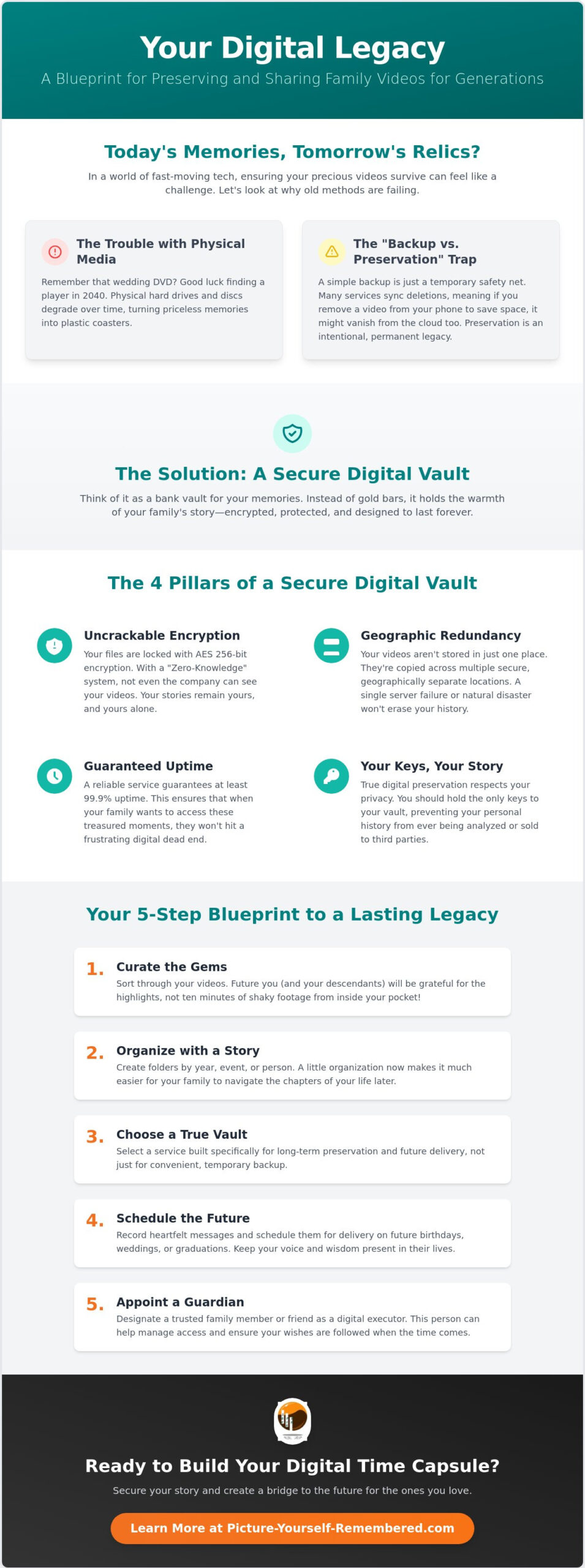
It is easy to confuse a simple backup with true preservation. A backup is a temporary safety net, often used to recover a file if you lose your phone or spill coffee on your laptop. Preservation is an intentional, permanent legacy. Many common syncing services are built for convenience rather than longevity. If you remove a video from your phone to save space, some services might automatically delete it from the cloud too. True digital preservation requires a different mindset. When you archive with intention, you are making a choice to be remembered. You are moving beyond the “set it and forget it” mentality of a phone backup and into a space of active curation by creating a digital time capsule that is designed to stay put, regardless of what happens to your current hardware.
Why Physical Media is No Longer Enough
We have all felt the sting of finding an old wedding DVD only to realize we no longer own a player that can read it. Hardware becomes obsolete almost every decade, turning precious memories into plastic coasters. Think of a physical hard drive as a digital pet; if you don’t feed it attention and plug it in occasionally, it might just stop working right when you want to show it off. Cloud storage is different because it evolves alongside technology. You won’t need to hunt for a vintage USB-Z port in the year 2050. The cloud ensures your videos are transcoded and ready for whatever screens the future brings, so your story never goes dark. This modern approach is the most reliable answer for anyone wondering how to share family videos with future generations without losing them to the march of time.
The Anatomy of a Secure Digital Vault: What to Look For
Building a digital vault is an act of deep intentionality. It requires a structure that is both invisible and invincible, standing as a silent guardian for your most cherished moments. When you are deciding how to share family videos with future generations, you want a sanctuary that guards your privacy as fiercely as you guard your memories. This isn’t just about finding a corner of the internet to put files; it’s about selecting a system that treats your personal history with the quiet dignity it deserves. To ensure your legacy remains untarnished, we look for four essential pillars: encryption, redundancy, uptime, and privacy.
Understanding Encryption Without the Headache
Encryption acts as your first line of defense against unwanted eyes. You’ve likely heard of AES 256-bit encryption. It sounds like technical jargon, but think of it as a lock so complex that it would take a supercomputer a billion years to crack. When a provider offers “Zero-Knowledge” encryption, it means they don’t hold the keys to your vault. Even if they wanted to, the company couldn’t peek at your videos. It’s a level of privacy that ensures your stories remain yours alone, preserved exactly as you intended.
Actionable Tip: Set up a password manager today. It’s the easiest way to ensure you aren’t the one person in 2026 still using “Password123” for your most precious archives. A password manager creates and stores complex keys so you don’t have to rely on memory alone.
Data Centers and Geographic Redundancy
Your memories shouldn’t just live in one place. If a local disaster strikes a single data center, your files could be lost forever. This is why redundancy is so vital. Geographic redundancy is the practice of storing data copies in different physical regions to ensure survival against local outages. By following established digital preservation standards, reputable providers ensure that even if one region faces a fire or flood, your videos remain safe elsewhere. It’s about choosing a provider with a proven track record of stability, ensuring your legacy isn’t tied to the fate of a single building.
Beyond the hardware, you must look for privacy protocols that prevent providers from mining your family stories for advertising data. Your life isn’t a data point to be sold to the highest bidder; it’s a masterpiece worth protecting. High uptime guarantees are also vital. They mean your memories are available whenever nostalgia strikes, whether it’s a rainy Sunday afternoon or three in the morning when you just need to hear a loved one’s voice. If you’re looking for a way to ensure these stories reach the right people at the right time, you might consider exploring how Picture-Yourself-Remembered.com can help you organize your legacy with both heart and structure. Mastering how to share family videos with future generations starts with choosing the right foundation today.
Traditional Cloud Storage vs. Legacy Delivery Systems
Most of us use services like Google Drive or Dropbox every day. They are wonderful for sharing a document with a colleague or syncing photos from last week’s vacation. However, these platforms are built for the living. They thrive on active, monthly engagement and recurring credit card payments. If a payment fails or an account remains dormant for too long, those precious files often vanish into the digital ether. This is the fundamental challenge of how to share family videos with future generations using standard tools. You need a system that doesn’t just store data but actively carries it across the years.
Legacy delivery systems solve the “Dead Man’s Switch” problem. This refers to the heartbreaking reality where family members are locked out of a loved one’s account because they don’t have the password or two-factor authentication. Traditional cloud storage is often a locked room with no key. A legacy system is an open door, specifically designed to ensure your history reaches your family without a legal battle or technical headache. It moves from being a simple storage bin to becoming a vehicle for your life’s narrative.
The 99-Year Horizon: Planning for the Long Term
Standard subscriptions are designed for the “now.” They aren’t built to hold a message for a grandson’s wedding in 2050 or a great-grandchild’s graduation. When you are preserving family history, you are planning for a horizon that stretches far beyond the next billing cycle. Let’s be honest: the cloud sounds like a magical place on a fluffy pillow, but it still runs on servers that need paying for! A dedicated legacy service uses structures that keep the lights on for decades, ensuring your voice remains clear and accessible long after the original device is gone.
Scheduled Delivery: Sending Love Across Time
Imagine setting up a video time capsule for a child’s milestone birthday years in advance. This is the beauty of a scheduled delivery system. There is a profound emotional difference between a shared folder and a meaningful, surprising delivery. One is a storage bin; the other is a gift. Scheduled delivery allows you to be present for the moments you might miss, offering a sense of connection that transcends time. It ensures that your wisdom and your warmth arrive exactly when they are needed most.
Actionable Tip: Record a “just because” message today and schedule it for delivery five years from now. It’s a gift to your future self and a beautiful way to practice how to share family videos with future generations. You’ll be surprised by how much your perspective has changed, and your family will cherish the spontaneity of the moment. It transforms a digital file into a living memory.
5 Steps to Organize and Secure Your Family Video Archive
Organizing a lifetime of memories can feel like trying to fold a fitted sheet alone. It is a bit messy at first, but with a few intentional steps, you can turn that digital junk drawer into a polished legacy. If you are wondering how to share family videos with future generations, the secret lies in moving from saving everything to preserving the best. This process is not a clinical task; it is an act of love that prepares your stories for their journey through time.
- Consolidate your world. Collect every clip from old phones, tablets, and social media accounts into one central staging folder on your computer.
- Curate with love. Be ruthless. Delete the blurry pocket-recordings and those three-minute clips where you accidentally filmed your shoes.
- Name files for the future. Swap generic titles like IMG_4829 for something descriptive, such as Mom_Advice_On_Marriage_2026.
- Upload to a secure vault. Choose a platform that offers automated backup and easy, intentional sharing.
- Share the access. Give a trusted family member the Master Key or clear instructions on how to enter the vault when the time is right.
Curating Your Digital Legacy
Your children don’t want every raw file you’ve ever recorded. They want the highlights that capture your essence and the sound of your voice. Think of yourself as the director of your own life story. By picking hero videos, you ensure the most meaningful stories aren’t buried under a mountain of digital clutter. Less is truly more when it comes to a lasting influence.
Actionable Tip: Set a timer for 30 minutes once a week. Use that time to sort through just one month of old videos. It makes the process feel like a gentle stroll through memory lane rather than a daunting chore.
Best Practices for Naming and Tagging
When naming files, follow the Who, When, Where rule for intuitive organization. A file named Dad_Fishing_LakeTahoe_July2026 tells a story immediately. Avoid using special characters like slashes or hashtags, as these can confuse future operating systems. Descriptive file naming ensures your descendants can identify the significance of a video at a glance without a search engine.
Let’s be honest, your grandchildren probably won’t find deep philosophical meaning in that five-minute accidental recording of your floor mat, no matter how great your carpet looks. To make this process even easier, you can use a Video Message Storage system to ensure your curated masterpieces reach your loved ones exactly when they need them most. Taking these steps today is the most practical way to master how to share family videos with future generations while keeping your sanity intact.
Securing Your Heartfelt Messages with Picture-Yourself-Remembered™
We often think of the cloud as a cold, sterile place for data, but it doesn’t have to be. At Picture-Yourself-Remembered™, we have built a dedicated platform for recording messages for loved ones that feels more like a warm embrace than a simple storage bin. While other services focus on raw file sizes and technical specs, our secure digital vault is engineered with a much higher purpose: to maintain your messages for up to 99 years. We bridge the gap between complex technology and raw human emotion. This ensures your voice is heard through time, allowing you to settle the question of how to share family videos with future generations once and for all.
Your life is a masterpiece worth preserving with the utmost care and artistry. By choosing a platform that values storytelling above all else, you are making an intentional choice to stay connected with those who matter most. A Basic Membership is your first step toward becoming a visionary mentor for your family, providing a safe space where your personal history can be distilled and protected. It is about more than just files; it is about the light of your influence continuing to shine long after the present moment has passed.
How Our Scheduled Delivery Protects Your Story
You can learn how Picture Yourself Remembered works to deliver your heart directly to the future. Our Scheduled Delivery System is the heartbeat of Picture-Yourself-Remembered™. It provides the peace of mind that comes with expert-handled protocols, ensuring your legacy doesn’t just sit on a server but actually arrives at its destination. This mission is deeply personal for our founder, Stanley Poe. He dedicated his life to this mission of intergenerational connection because he understood that a life well-lived is a story that deserves to be told and heard. It’s about making sure your wisdom doesn’t expire with your current hardware.
Taking the First Step Toward a Lasting Legacy
Starting your journey toward preparedness doesn’t require a degree in computer science. Our interface is designed for people and families who value connection over coding. You can get started with a Basic Membership today in just a few clicks, opening a door to a more organized and soulful future. We promise our storage is more secure than that secret hiding spot for the Christmas presents that everyone already found by December 10th. It is a structured home for your history that respects the gravity of your journey.
Actionable Tip: Don’t wait for a major milestone to begin your archive. Record a simple, two-minute video today sharing one piece of advice you would give your younger self. Upload it to your vault and see how fulfilling it feels to take agency over your own narrative. It is the most beautiful way to practice how to share family videos with future generations while the memories are fresh and your heart is full. You are not just saving a video; you are gifting your presence to the future.
Your Story is a Gift for the Future
We have journeyed through the steps of creating a digital sanctuary, moving beyond simple storage to true preservation. By choosing a system built for the long haul, you have solved the riddle of how to share family videos with future generations without the fear of technology leaving your stories behind. Your future family will surely cherish seeing your expressions more than they would enjoy trying to guess which box in the attic contains the VCR player you haven’t touched since 1998.
Founded by Stanley Poe to honor the unique path of every individual, Picture-Yourself-Remembered™ provides a secure digital vault designed for 99-year longevity. We offer compassionate support to ensure your video legacy is both impeccably structured and deeply soulful. Secure your family’s legacy today with a Basic Membership and begin the beautiful process of being remembered exactly as you are. Take agency over your narrative today; your future family is already waiting to hear from you. You have the power to turn today’s moments into tomorrow’s most cherished treasures.
Frequently Asked Questions
Is cloud storage really safer than a physical hard drive?
Cloud storage is generally much safer because it protects your memories from physical damage like fires, floods, or simple hardware failure. Physical hard drives have a limited lifespan and can fail without warning, often taking your entire history with them. By using a secure vault, your videos exist in multiple locations at once. This ensures that a single hardware failure doesn’t end your story.
What happens to my family videos if the storage company goes out of business?
Choosing a provider with a long track record and clear data protocols is the best way to protect your archive. Many established cloud services have contingency plans and data migration agreements in place. If you’re worried about a company vanishing, look for those offering long-term structures or dedicated legacy vaults. These are built to outlast the typical tech startup cycle and keep your stories safe.
Can hackers access my private family videos in the cloud?
Modern encryption makes it nearly impossible for hackers to view your private files if you choose the right provider. When you use Zero-Knowledge encryption, only you hold the keys to your vault. Not even the storage company can see what’s inside. It’s much safer than leaving a USB drive in a kitchen drawer where your tech-savvy teenager might accidentally find your old 80s dance videos.
How much storage space do I actually need for family videos?
Most families find that 500GB to 2TB is plenty of space for a curated collection of high-quality videos. High-definition 4K footage uses about 350MB for every minute of recording, so it adds up quickly. By deleting the clips of your pocket or the sidewalk, you can keep your archive focused on what truly matters. This makes the task of how to share family videos with future generations much more manageable.
How do I ensure my family can access the videos after I pass away?
You ensure access by using a legacy delivery system specifically designed for intergenerational handovers. Standard accounts often become inaccessible if the owner can’t provide a two-factor authentication code. By setting up a trusted contact or a scheduled delivery, you make sure your family receives the digital key exactly when they need it. This avoids stressful legal hurdles and ensures your voice is never locked away.
What is the best video format for long-term preservation?
MP4 is currently the most reliable and universal format for long-term video preservation. It is supported by almost every device and platform available today. Most reputable cloud services also perform background updates to your files, ensuring they remain playable even as new video standards emerge in the coming decades. This background work ensures your family won’t need an ancient computer to watch your favorite memories.
Is there a limit to how long a video can be stored in the cloud?
There is no technical limit to storage duration as long as the underlying service is maintained. Dedicated legacy vaults are specifically engineered to hold your messages for up to 99 years. This long-term focus is essential when you are planning how to share family videos with future generations. It moves beyond the short-term thinking of standard monthly subscriptions and focuses on the endurance of your personal narrative.
Can I schedule a video to be delivered to my child in 20 years?
You absolutely can schedule a video delivery for 20 years into the future using a specialized Scheduled Delivery System. This allows you to record a message today for a wedding, graduation, or milestone birthday that hasn’t happened yet. It is a beautiful way to ensure your voice and wisdom are present for the moments you don’t want to miss. This technology bridges the gap between today and the future.
