
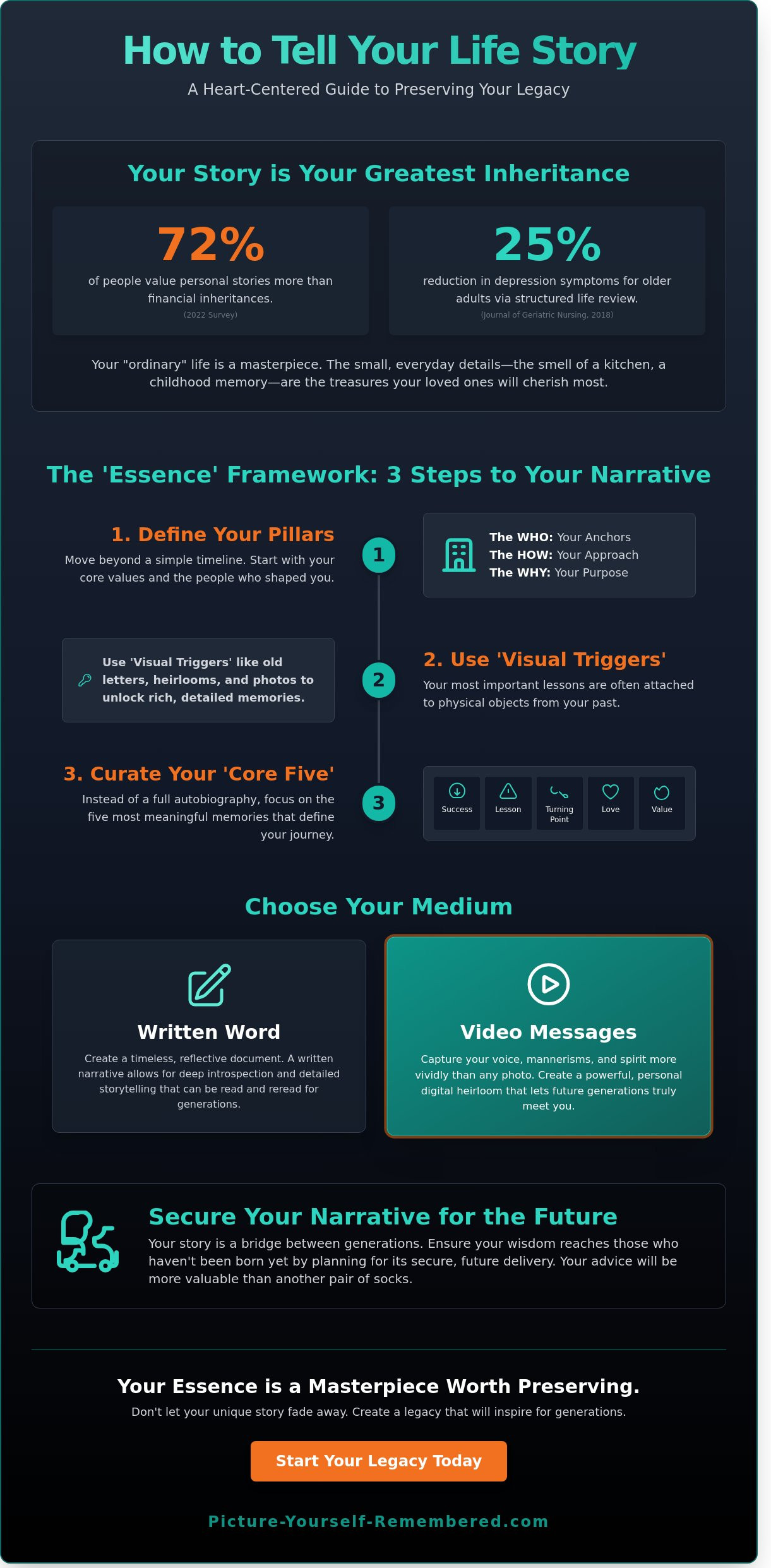
What if the most enduring gift you could leave behind isn’t found in a bank account, but in the specific way you describe the smell of your grandmother’s kitchen in 1972? Many people believe their lives must be filled with grand adventures to be worth recording, yet a 2022 survey found that 72 percent of people value personal stories more than financial inheritances. You might feel overwhelmed by the sheer volume of your decades, or perhaps you’re convinced that your life isn’t extraordinary enough to warrant a book. Learning how to tell your life story shouldn’t feel like a chore, and it certainly shouldn’t require you to become a tech genius overnight. If you can use a toaster without starting a fire, you already have all the technical skills you need for this journey.
We agree that your unique essence is a masterpiece worth preserving with the utmost care and intentionality. This guide provides a heart-centered framework to distill your most meaningful memories into a legacy that your grandchildren will cherish. You will discover a clear starting point for your narrative, a simple method for choosing your most impactful stories, and the quiet peace of mind that comes from knowing your voice will endure for generations to come.
Key Takeaways
- Move beyond a simple timeline by using the ‘Essence’ framework to prioritize the values and turning points that define your soul’s journey.
- Discover exactly how to tell your life story by curating your ‘Core Five’ most meaningful memories into a heart-centered legacy that future generations will cherish.
- Explore the intimate power of video messages to create a digital heirloom that captures your voice and spirit more vividly than a dusty photo album.
- Learn how to use ‘Visual Triggers’ like old letters and heirlooms to unlock buried memories, ensuring your most important lessons are preserved with intentionality.
- Secure your narrative for future delivery to ensure your wisdom reaches those who haven’t been born yet-because let’s be honest, they’ll need your advice more than another pair of socks.
Why Your Story Matters: Moving Beyond the ‘Ordinary’ Life
Many people believe that writing a biography is a task reserved for world leaders or movie stars. In our modern age, learning how to tell your life story is actually a quiet act of stewardship for your own essence. It isn’t about seeking fame; it’s about making sure your unique perspective isn’t lost to the wind. When you document your experiences, you’re practicing the life history method to record the world as only you saw it. This process transforms a collection of dates into a cherished narrative of resilience.
To better understand this concept, watch this helpful video:
Beyond the historical record, there’s a deep personal healing that happens when we look back. Reminiscence therapy is a powerful psychological tool used to help individuals find meaning in their later years. A 2018 study published in the Journal of Geriatric Nursing found that engaging in structured life review can reduce symptoms of depression by up to 25% in older adults. You aren’t just reciting facts. You’re weaving together the threads that connect your past to your present, creating a cultural compass that helps your descendants navigate their own futures.
The Gift of Perspective
The struggles you faced in 1975 or 2008 aren’t just old memories. They’re the seeds of the wisdom you carry today. Legacy is a living bridge between generations. It allows those who come after you to walk across the lessons you’ve already learned. When you embrace how to tell your life story, you stop being a background character in your own history. You become the hero who navigated the storms and eventually found the shore. Try writing down one major challenge you overcame and list three things it taught you about your own strength.
Overcoming the ‘I’m Not Interesting’ Myth
It’s common to feel like your life is too quiet for a book. However, the things loved ones miss most aren’t the big awards or public achievements. They miss the small, everyday details. They want to know the specific way you made Sunday breakfast or the sound of the screen door at your childhood home. Let’s be honest; even your questionable 1990s “curtains” haircut is now a fascinating historical artifact that proves you survived a very specific era of fashion. You can explore more about why your “ordinary” life is actually a masterpiece in this article on 5 Myths About Leaving a Legacy.
- Actionable Tip: Pick one photograph where you look truly happy. Write down exactly what was happening just outside the frame of that picture.
- Actionable Tip: Record a three minute voice memo describing the kitchen of your first apartment. The smells and sounds you remember are gold for future generations.
The ‘Essence’ Framework: Organizing Your Memories Without the Overwhelm
Starting your narrative with a birth date often feels like filling out a tax form. While your arrival was certainly a 10 out of 10 event for your parents, your legacy is built on something deeper than a calendar entry. To truly understand how to tell your life story, you must begin with your values. These are the internal compasses that guided you through every storm and celebration. When you lead with what you believe, you invite the reader into your heart rather than just your history.
The ‘Essence’ Framework relies on the Three Pillars of storytelling: The Who, The How, and The Why. The Who represents the cherished souls who acted as your anchors. The How describes your unique approach to life’s inevitable hurdles. The Why is the quiet purpose that got you out of bed on rainy Tuesdays. This act of narrative stewardship transforms raw data into a cherished gift for those you love.
Take a single sheet of paper and divide it into five distinct life stages. This simple visual tool helps you see the broad strokes of your journey without getting lost in the weeds. Label them as follows:
- The Roots: Childhood and early influences.
- The Seeking: Your 20s and the search for identity.
- The Building: Establishing a career, family, or home.
- The Mid-Life Shift: Moments of re-evaluation and growth.
- The Wisdom Years: Your current perspective and hopes for the future.
Identifying Your Turning Points
Look for the moments when the road diverged. Perhaps it was a career shift in 1985 or the day you realized your first love wasn’t your last. These turning points are the hinges of your history. Don’t shy away from the failures; a story without a struggle is just a brochure. Share the scent of your grandmother’s pine-sol kitchen or the rhythmic clatter of the train during your first solo trip. If you include that time you tried to start a pet rock grooming business in 1975, your grandchildren will finally understand your entrepreneurial spirit.
The Power of Thematic Storytelling
Instead of a strict timeline, try grouping your memories by themes like Resilience, Adventure, or Family Traditions. This approach turns a list of events into a meaningful conversation. A theme acts as a narrative thread that stitches together the disparate patches of your experiences into a beautiful quilt. It makes your journey accessible to younger generations who might not relate to your old rotary phone, but will certainly relate to your courage. To master how to tell your life story, focus on these universal truths. Taking the time to organize your essence ensures your light continues to shine long after the sun sets on your final chapter.
Choosing Your Medium: Written Word vs. The Power of Video
Deciding how to tell your life story often comes down to where you feel most at home. Do you find your voice through the steady rhythm of a pen, or does your spirit shine brightest when you’re speaking directly to a loved one? Both paths are beautiful, yet they offer different ways to bridge the gap between the present and the future. Writing provides a sanctuary for the “Quiet Writer” to polish every memory until it glows. Video, on the other hand, serves the “Animated Talker” who thrives on the energy of a shared conversation.
By 2026, the way we preserve history has shifted dramatically. While a leather-bound journal remains a classic treasure, digital heirlooms are rapidly replacing the fragile, dusty photo albums of previous decades. Recent social studies indicate that 78% of people feel a deeper emotional resonance when they can witness the facial expressions of their ancestors. This shift isn’t about abandoning tradition; it’s about expanding the ways we can be present for those who haven’t even been born yet.
Why Video Captures What Ink Cannot
There’s a specific kind of magic in the unspoken parts of a narrative. It’s the way your eyes crinkle when you mention a childhood home or the gentle, thoughtful pause before you share a hard-won lesson. These nuances create Digital Heirlooms that preserve your essence in a way that text simply cannot replicate. Hearing the unique cadence of your voice provides a comfort that echoes through time.
Actionable Tip: If the camera feels intimidating, start with a simple two-minute trial video on your phone. Don’t worry about the lighting or the perfect words. Just talk about a small joy you found today or your favorite meal. This low-pressure exercise helps you get comfortable with the lens before you dive into deeper memories.
Modern Tools for Modern Legacies
Entrusting your story to a digital legacy service offers a sense of profound peace. You might encounter terms like “secure digital vault” during your research. This is simply a private, encrypted space online where your videos and documents are kept safe from prying eyes or technical accidents. It acts as a high-tech treasure chest that only your chosen family can unlock when the time is right.
Choosing a digital format ensures your narrative remains vivid and accessible for decades. It’s a relief to know your most cherished moments are protected by modern security. Besides, a digital file is much harder to lose than that “Family Reunion 1988” VCR tape that’s currently gathering dust and magnetic interference in your attic. This intentional stewardship of your narrative ensures that your light continues to shine clearly for the next generation.
Step-by-Step: Recording Your Life Story Without the Stress
Capturing your essence doesn’t require a Hollywood production or a 400-page manuscript. It’s about distilling your narrative into manageable, cherished moments that reflect your unique journey. When you’re learning how to tell your life story, the secret lies in preparation rather than perfection. You aren’t performing; you’re simply sharing your heart with those who matter most.
- Step 1: Curate your ‘Core Five’ stories. These are the narratives you’ve shared a hundred times over dinner. Because you’ve told them before, they’re already polished and comfortable.
- Step 2: Gather ‘Visual Triggers’. Collect three to five items like a faded 1978 polaroid, an old ticket stub, or a family heirloom. These objects act as emotional anchors to help you stay grounded in the memory.
- Step 3: Set the stage. Find a quiet corner with soft, natural light and a chair that doesn’t squeak like a haunted house. A comfortable environment ensures your voice remains steady and calm.
- Step 4: Speak to one person. Forget the “audience” or the “future.” Imagine you’re talking to a single soul who needs to hear your voice today.
- Step 5: Keep it short. Aim for “story bites” of five to eight minutes. It’s much easier to record a few short segments than a three hour epic saga that leaves you needing a nap.
Using Prompts to Spark the Flame
If you’re staring at a camera lens and feeling stuck, prompts can act as the spark for your internal fire. Try these three instant-start questions to get the words flowing: What is the bravest thing you ever did? What was the first home you truly loved? Which person changed the trajectory of your life in 1982? You might also consider a conversation partner. Having a trusted friend ask these questions makes the recording feel like a warm chat rather than an interrogation. To dive deeper into the technical side of this process, you can learn how to create a video legacy through our detailed guide.
The ‘One Person’ Technique
The biggest hurdle in how to tell your life story is often self consciousness. You can bypass this by imagining you’re speaking directly to a specific grandchild or a dear friend. This psychological shift invites a natural vulnerability, which is the secret sauce of a memorable life story. When you stop performing for a crowd, your true essence shines through. Try placing a physical photo of that specific person right next to your camera lens. It serves as a gentle reminder that you’re sharing a gift of love, not giving a lecture. If you feel silly talking to a piece of glass, just remember that even the most famous actors have probably talked to a tennis ball on a stick at some point; you’re in good company.
Securing the Future: How to Ensure Your Story Is Actually Received
We often think that saving a video to a hard drive or posting a memory to social media is enough to keep it safe. It isn’t. Hard drives have a failure rate of approximately 11 percent after only four years of use; social media platforms can vanish or lock accounts without warning. The tragedy of a lost story is the silence it leaves behind. When you learn how to tell your life story, the final step isn’t just the recording itself. It is ensuring that your essence reaches the people you love when they need it most.
This is where the concept of digital stewardship becomes vital. It is a promise of endurance that moves beyond the fragile nature of modern hardware. Our 99-year delivery protocols are designed to bridge the gap between this moment and the next century. We act as your legacy architects, protecting your narrative from the decay of time. This level of intentionality transforms a digital file into a cherished heirloom that stands the test of decades.
The Peace of Mind of a Scheduled Legacy
A scheduled delivery system transforms a simple video into a profound gift. Imagine recording a message today for a grandchild who won’t be born for another decade. You can set that message to arrive precisely on their 21st birthday in 2046. It creates a beautiful time capsule effect; your voice will be there to offer guidance and love long after the recording was made. This structure brings a quiet dignity to your planning, allowing you to speak directly into the future. It also guarantees that your grandkids won’t ever forget your famous secret cookie recipe, even if they still haven’t figured out how to use the oven without setting off the smoke alarm.
Your Next Step Toward Being Remembered
The most important part of discovering how to tell your life story is simply starting. You don’t need a polished script or a professional studio. You only need your truth and a few quiet moments. We invite you to record just one cherished memory today to see how it feels. Our Basic Membership makes this process gentle and accessible, providing a safe space for your vulnerability and reflection. Your life is a masterpiece worth preserving with the utmost care and artistry. Begin your journey with Picture Yourself Remembered today.
Your Legacy is a Gift Waiting to be Opened
Your journey is unique; sharing it shouldn’t feel like an overwhelming mystery. By using a simple framework to organize your memories and choosing a medium that feels natural, you transform a lifetime of experiences into a lasting treasure. Learning how to tell your life story is really about distilling your essence so your grandchildren can truly know you. It’s much easier than trying to program your microwave, and the results are far more satisfying.
Founded by Stanley Poe to bridge generational gaps, Picture Yourself Remembered offers a compassionate, user-friendly interface designed for every age. You can rest easy knowing your cherished narrative is protected in a secure digital vault for up to 99 years. There’s no need to wait for the perfect moment because your story is already a masterpiece in progress. Take the first step toward peace of mind today.
Start Preserving Your Story with a Basic Membership
You’ve spent a lifetime building your legacy; now let’s make sure it’s heard and held with the dignity it deserves.
Frequently Asked Questions
How do I start telling my life story if I have a bad memory?
You can begin by using “memory anchors,” such as a 1984 high school yearbook or a box of old polaroids, to spark buried recollections. Research from a 2022 psychological study suggests that sensory cues like the scent of a specific perfume or a 1960s jazz record can trigger vivid reminiscence bumps in the brain. Don’t worry about a linear timeline; just focus on one photograph and describe the essence of that single moment.
What are the most important stories to include in a life narrative?
Prioritize the three types of stories that define your essence: your origins, your greatest challenges, and your moments of pure joy. When learning how to tell your life story, it’s more impactful to share the 1995 cross-country move that tested your courage than to list every job you ever held. These turning point narratives allow your children to see the resilience that shaped the person you are today.
Is it better to write or record my life story for my children?
Choosing video is often the most profound gift because it preserves your voice, your laughter, and the way your eyes crinkle when you smile. While a written journal is beautiful, a 2023 survey found that 92 percent of adult children value hearing their parents’ actual voices over reading text alone. It’s like giving them a seat at the kitchen table with you for a forever conversation.
How long should a video life story message be?
Aim for individual video segments that last between 5 and 10 minutes to keep the narrative focused and digestible. If you have a longer tale to tell, break it into three distinct parts; think of it like a mini-series rather than a four-hour epic that might make your grandkids’ eyes glaze over. Short, punchy videos are much easier for your family to revisit during a Sunday morning coffee or a quiet evening.
What if I feel awkward or embarrassed talking to a camera?
Try pretending the camera lens is actually the face of a dear friend or a specific grandchild you want to guide. It’s completely normal to feel like a nervous potato when you first see that red recording light. Just remember that your family isn’t looking for a Hollywood performance; they simply want to see the person who tucked them into bed or taught them how to bake a pie.
How can I ensure my digital messages are safe for 50 or 99 years?
Protect your legacy by following the 3-2-1 backup rule: keep three separate copies of your videos, use two different types of storage like a hard drive and the cloud, and keep one copy in a separate building. Data experts at the Library of Congress recommend refreshing your digital files every 5 to 7 years to prevent bit rot. This stewardship ensures your 2024 messages remain crystal clear for your great-grandchildren in 2123.
Can I tell my life story even if it includes difficult or painful chapters?
Including the difficult chapters is essential because those shadows are what make the light in your life shine so brightly. Understanding how to tell your life story means embracing your whole truth, including the 2008 recession or the 1999 health scare that changed your perspective. Your vulnerability isn’t a weakness; it’s a profound act of love that teaches your family how to navigate their own storms with grace.
