

The most effective way to capture your mother’s history isn’t by asking for her past; it’s by asking for her guidance for your future. When you start thinking about how to convince parents to record their life story, it’s natural to feel a bit of hesitation. You don’t want the conversation to feel heavy or morbid, like you’re already writing the final chapter of a book that’s still being lived. Most parents are incredibly humble, often insisting their daily lives were far too ordinary to be worth a recording. Plus, there’s always the risk that they’ll look at a smartphone like it’s a piece of alien technology designed to steal their soul.
We understand that this process is a profound act of love, not a technical project. You’ll discover compassionate strategies to help your parents share their wisdom and stories without it feeling like a chore. This guide provides practical steps to transform those quiet moments into a secure, permanent record of their personality through video message storage. We’ll walk you through moving from abstract legacy to concrete actions, like using a scheduled delivery system to ensure their voice reaches future generations. By the end, you’ll have the tools to turn a potentially awkward talk into a beautiful, relaxed connection that honors the masterpiece of their life.
Key Takeaways
- Learn to shift the conversation from a dry history lesson to a heartfelt request for guidance, which is the secret to how to convince parents to record their life story.
- Discover why video is a superior way to preserve a soul’s essence, capturing those fleeting expressions and laughter that written words often miss.
- Use specific, evocative prompts to help your parents move past simple dates and uncover the rich, hidden stories of their most resilient moments.
- Gain peace of mind by organizing these precious memories through video message storage and a scheduled delivery system for future generations.
- Master the art of gentle persuasion for humble parents, even if they’re convinced their most heroic feat was the Great Tupperware Organization of 1992.
Understanding the ‘Why’: The Emotional Barriers to Sharing
When you first consider how to convince parents to record their life story, you might expect them to jump at the chance to be the star of their own movie. Instead, you often meet a wall of quiet, humble resistance. This hesitation usually doesn’t come from a lack of love. It stems from a deep-seated belief that their lives are simply too ordinary to be preserved. They see their journey as a series of chores, commutes, and quiet moments, while we see the very foundation of our own existence.
To better understand the dynamics of these family conversations, watch this helpful video:
The Mortality Myth
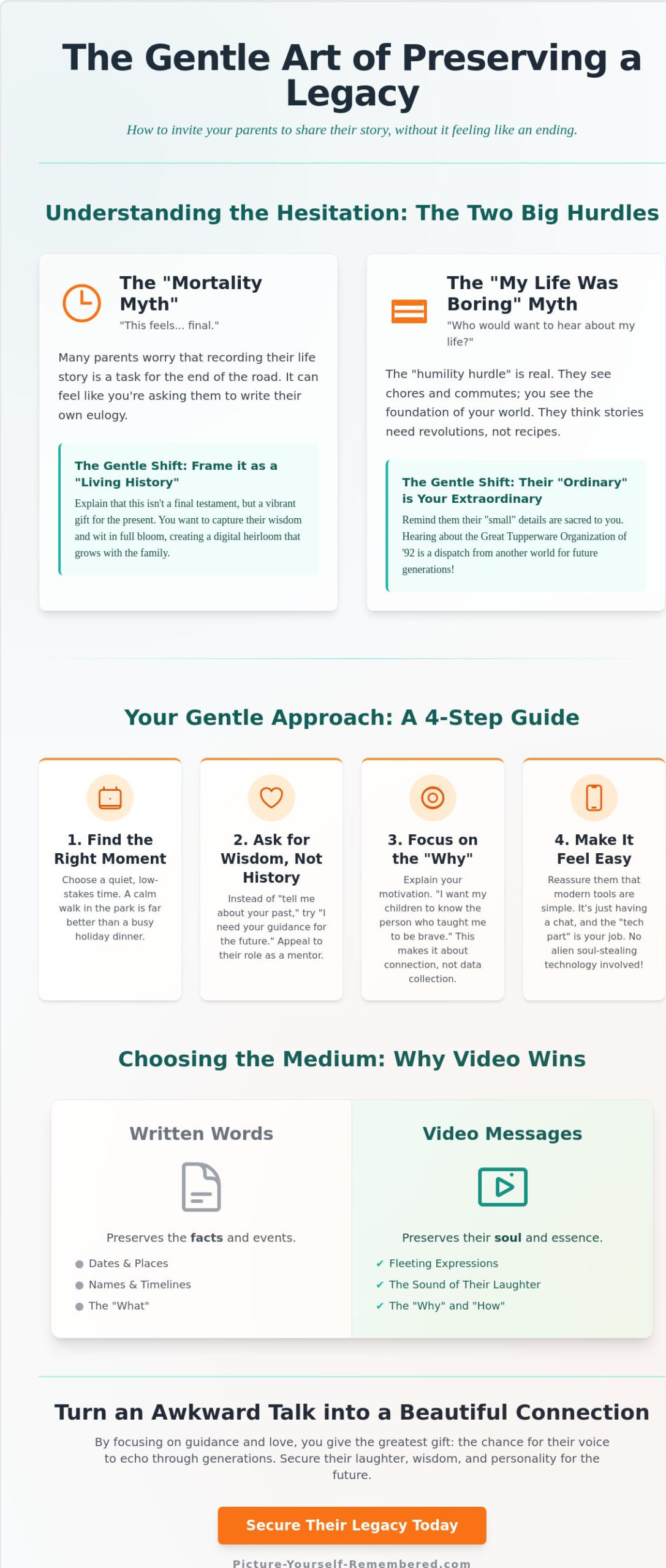
Many parents hesitate because the idea of documenting a legacy feels uncomfortably final. They worry that recording their stories is a task reserved for the very end of the road. You can gently shift this perspective by framing the project as a “living history.” It’s not a final testament; it’s a vibrant gift for the present. By engaging in oral history while their energy and clarity are at their peak, you ensure their wit and personality are captured in full bloom. Think of these as digital heirlooms that will grow alongside the family, rather than a static archive of the past.
The ‘Boring Life’ Misconception
The “humility hurdle” is often the most difficult barrier to clear. Most parents think their life is a documentary about beige, but we see a Technicolor epic. They might assume that because they didn’t win a Nobel Prize or lead a revolution, their story lacks value. Remind them that for a grandchild today, hearing about a typical Saturday in the 1970s is like listening to a dispatch from a different world. We don’t need grand adventures; we want the “small” sacred details. We want to know the specific smell of their first kitchen, the sound of their favorite record, or the story of their first car. These are the threads that weave our family identity together.
You can help them overcome these barriers by using a few intentional strategies:
- Validate their humility: Acknowledge that they feel their life is simple, then explain why that simplicity is exactly what you cherish.
- Focus on the future: Tell them, “I want my children to know the person who taught me how to be brave.”
- Make it accessible: Explain that with modern Video Message Storage, they don’t have to be tech experts to leave a lasting mark.
- Highlight the “why”: Emphasize that their perspective is a roadmap for the generations currently finding their way.
By transforming the process from a daunting historical project into a series of small, loving conversations, you make the task feel manageable. It’s about securing their voice and their laughter in a way that feels natural. When they realize that their stories are the greatest inheritance they can offer, the resistance often melts into a willing, joyful participation.
The Strategy: How to Bring Up the Conversation
Timing is often the invisible bridge between a hesitant “no” and a willing “yes.” While it’s tempting to bring up legacy projects during a bustling Thanksgiving dinner or a milestone birthday, these high-pressure moments can feel overwhelming. Instead, look for a quiet Tuesday afternoon or a calm walk in the park. Figuring out how to convince parents to record their life story is easier when the environment feels safe and unhurried. By choosing a low-stakes moment, you’re overcoming common barriers to recording life stories that often stem from feeling “put on the spot” in front of a large audience.
Once you’ve found the right time, lead with a request for their unique wisdom. Most parents have spent decades being the providers, the fixers, and the guides. Appealing to this role is incredibly effective. Instead of asking for a chronological history, try starting with “Micro-Stories.” Use an old, dusty photograph as a natural bridge. Ask about the person standing next to them or the car in the background. These small, vivid memories are far less daunting than the prospect of a full life review. It’s like looking at a single star instead of trying to map the entire galaxy at once.
Asking for Future Guidance
One of the most powerful ways to shift their perspective is to move the focus from the past to the future. Frame your request around the milestones they might not physically attend. You might say, “I want you to be there for my son’s graduation in ten years,” or “I’d love for your great-grandchildren to hear your advice on their wedding day.” This transforms the project from a backward-looking archive into a forward-facing gift of love. It allows them to provide career tips, parenting wisdom, or marriage advice that will echo through time. This approach ensures they feel like a vital participant in the family’s future, not just a relic of its past.
The Power of the Third Party
If you’re still meeting resistance, remember that grandchildren are the ultimate secret weapon. It is nearly impossible for a grandparent to say no to a child’s curiosity. You can make it a collaborative family project by using a preserving family history guide to show them beautiful examples of what’s possible. They might insist they have nothing interesting to say, right before launching into a forty-minute explanation of why the neighbor’s hedge in 1984 was three inches too tall. To ensure these precious, rambling gems are never lost, you can start small by setting up a secure digital vault for their first few stories. This gentle, structured approach turns a solo performance into a shared masterpiece that honors their journey without the weight of a formal interview.
Choosing the Right Medium: Why Video Wins
When you decide on the best way to preserve a legacy, many people default to the idea of a written memoir. While writing has its own beauty, it’s often a daunting, time-consuming task that feels more like a homework assignment than a celebration. For parents who may struggle with arthritis or simply find the blank page intimidating, writing for ten hours is a high barrier. This is a crucial pivot when learning how to convince parents to record their life story. Talking for ten minutes is much more natural. It’s conversational. It’s warm. Most importantly, it’s accessible.
Video offers something that text and audio simply cannot: the full spectrum of a person’s presence. A written transcript can capture the words, but it misses the mischievous glint in your father’s eye when he tells a joke. It misses the specific way your mother tilts her head when she’s deep in thought. These non-verbal cues, such as a smile, a laugh, or a familiar gesture, are the elements that truly bring a memory to life for future generations. They see not just a story, but the person behind it.
Capturing the Essence
By recording messages for loved ones via video, you are essentially creating a time machine. Eye contact builds a bridge across decades, allowing a great-grandchild to feel as if they are sitting right there in the room. This medium preserves the soul of the narrative. It’s about more than just facts; it’s about the vibration of their voice and the warmth of their spirit. We don’t want a polished performance. We want the real person, pauses and all.
Overcoming Tech-Phobia
The biggest hurdle for many parents is the fear of needing a Hollywood production crew. You can reassure them that modern Video Message Storage doesn’t require professional video editing or a degree in cinematography. A simple smartphone is all you need. Showing them that the technology is a friend, not a foe, is a big part of how to convince parents to record their life story. Here are a few actionable tips to keep it simple:
- Follow the light: Have them sit facing a window during the day. Natural light is the best filter they’ll ever have.
- Keep it quiet: Turn off the TV and the dishwasher. Clear sound is more important than a perfect background.
- Forget the script: Tell them to talk to you, not the camera. The real version of them, complete with the occasional “um” or “ah,” is the version their descendants will want to see.
Remind them that their life isn’t a blockbuster movie; it’s a personal masterpiece. If they can manage to change the channel on the remote without calling you for tech support, they can handle this. By focusing on the ease of the process, you remove the friction and make the journey an act of love rather than a technical chore.
Actionable Prompts to Get the Stories Flowing
Once you’ve navigated the initial conversation of how to convince parents to record their life story, you might encounter a new challenge: the “blank screen” effect. Even the most talkative parents can suddenly feel shy when the camera starts rolling. To avoid a dry recitation of dates and addresses, you need to ask questions that spark sensory memories. Instead of asking “Where were you born?”, try asking “What did a typical Saturday smell like in your childhood home?” These small, tactile details act as keys that unlock much larger chambers of memory. They transform a simple recording into a vivid experience for whoever watches it years from now.
Deepening the connection requires moving into the territory of the heart. Ask about resilience. A prompt like “What was the hardest thing you ever overcame, and what did it teach you about your own strength?” validates their journey and provides a roadmap for your own struggles. Balance these heavy moments with questions about pure joy. Ask them to describe the exact moment they knew they were in love. Your parents might claim their first car was a reliable vehicle, but we all know it was likely a collection of rust held together by hope and AM radio. Asking about that first car often leads to stories of freedom and youthful adventure that no history book could ever capture.
The ‘Firsts’ and ‘Lasts’
Anchoring a life story often works best when you focus on the bookends of experience. Explore the “firsts” that shaped them: their first job, their first heartbreak, or the day they bought their first house. These milestones are the pillars of their personal narrative. To bring the story into the present, ask about “lasts.” When was the last time they felt truly surprised? When was the last time they laughed until they couldn’t breathe? Finish a session by asking them to define their “philosophy of life” in a single, beautiful sentence. This gives them a sense of agency over their own legacy.
The Future Milestone Prompts
The most profound gift a parent can leave is guidance for the days they won’t see. Encourage them to record messages for specific future events. Ask them, “What should I know when I turn 50?” or “What is the secret to a marriage that lasts fifty years?” These recordings become a presence in the room during future weddings or graduations. For more ideas on how to frame these moments, explore our guide on creating a video legacy that feels like a warm, natural conversation. By preparing these prompts in advance, you ensure the process feels intentional and structured. Ready to secure these precious words forever? You can start your family’s video archive today and ensure no story goes untold.
Securing the Legacy: The Peace of Mind Approach
Creating these recordings is only half the journey. The other half is ensuring they actually reach the people who need them. We’ve all experienced the heartbreak of a lost phone or a corrupted hard drive that took years of photos with it. Relying on an old USB drive to hold your life story is a bit like trusting a squirrel to remember where it hid the most important nut in the forest. When you are looking at how to convince parents to record their life story, you can offer them the ultimate peace of mind: a secure, permanent home for their voice that won’t vanish when a laptop inevitably gives up the ghost.
A vital part of this security is the Scheduled Delivery System. This isn’t just about saving a file; it’s about ensuring a message arrives at the exact moment it’s needed most. You can help your parents set up messages to be delivered on future birthdays, wedding anniversaries, or even just random mornings when a grandchild might need a bit of extra encouragement. This turns their Video Message Storage from a static archive into a living, breathing presence that continues to offer love and guidance for decades to come.
Beyond the Cloud
Standard cloud storage folders are often messy, disorganized, and easily forgotten. There is a profound difference between a generic digital folder and a structured legacy. By using digital time capsules, you create an intentional vessel for your family’s history. These digital vaults stay private and protected for up to 99 years, providing a level of security that social media platforms simply cannot match. It allows for the preservation of sensitive stories in a safe space where they are honored rather than just “uploaded.”
Taking the First Step Together
The best way to make this feel manageable is to turn it into a gentle ritual. Suggest setting aside just one hour a month to record a new message together. This consistency builds a rich tapestry of stories without it ever feeling like a burden. Understanding how to convince parents to record their life story becomes much easier when you frame it as a gift of lasting security. You can start this journey today by setting up a Basic Membership, which provides the foundation for your family’s enduring archive. There is a quiet, deep comfort in knowing that your parents’ voices, their laughter, and their unique wisdom are safe and secured. Don’t wait for the “perfect” time to begin. The stories are vibrant now, and the most beautiful time to capture them is today.
Securing the Voices You Love
Preserving a legacy is about more than just dates. It’s about the warmth of a voice and the wisdom of a lifetime. We’ve explored how shifting the focus from the past to the future can help you navigate the delicate task of how to convince parents to record their life story. By starting small with micro-stories and choosing the intimacy of video, you transform a daunting project into a meaningful ritual of connection. Even if your dad insists his most interesting story is about the time he found a particularly round pebble, those are the details your children will cherish.
You can ensure these masterpieces are never lost to time. Our platform offers a compassionate, user-friendly interface designed for every generation. With secure storage for up to 99 years and a scheduled delivery system for future milestones, your parents’ influence will continue to shine. Start building your family’s digital legacy today with a Basic Membership. Take that first gentle step and turn today’s conversation into a gift that lasts forever.
Frequently Asked Questions
What if my parents are camera-shy or refuse to be recorded?
If your parents are camera-shy, start by recording just their voice or focusing the lens on a family photo they are describing. This shift takes the spotlight off their face and places it on the memory itself. When you are exploring how to convince parents to record their life story, reminding them that their presence is a gift for future generations often helps. If they still refuse, even a five-minute audio clip is a masterpiece compared to silence.
How do I organize the stories so they aren’t just random clips?
Organize your stories by theme or milestone rather than trying to capture everything in one long, exhausting session. You can categorize clips into folders like “Early Years,” “Career Wisdom,” or “Advice for the Kids” within your Video Message Storage. This prevents the record from feeling like a random collection of clips. It turns a lifetime of experiences into a structured library that is easy for your family to navigate and cherish for decades.
Is it better to interview them or let them record privately?
Choose the method that makes your parent feel the most relaxed and heard. An interview style provides the energy of a conversation, while private recording allows for deep, quiet reflection. If you’re struggling with how to convince parents to record their life story, try offering both options. Some parents find it easier to talk to a lens when they are alone, while others need your smile to keep the stories flowing.
What are the best questions to ask for a life story?
The best questions are those that spark sensory details and emotional truth rather than just dates. Ask about the specific smell of their childhood kitchen or the song that was playing during their first dance. Move beyond a simple timeline to explore the “why” behind their biggest choices. Instead of asking for a resume, ask what they want their great-grandchildren to know about being brave. These prompts turn a dry history into a vibrant legacy.
How do I store these videos so they don’t get lost in 20 years?
Avoid the trap of local hard drives or social media accounts that can be easily lost, corrupted, or deleted. Professional Video Message Storage acts as a secure digital vault that stays private and protected for decades. Unlike a USB drive that might end up in a junk drawer next to a mysterious charging cable from 2004, this system ensures the files are maintained. It provides a permanent, reliable home for your family’s most precious narrative.
Can I schedule a message to be delivered to my child on their 18th birthday?
Yes, you can absolutely schedule a message to be delivered on a specific future date using a Scheduled Delivery System. This feature allows your parents to “be there” for milestones they might not physically attend. It is a powerful way to bridge the gap between generations. Imagine your child receiving a video of their grandfather’s wisdom exactly when they are stepping into adulthood. It is an intentional act of enduring, organized love.
What if my parent starts talking about a ‘challenging’ or painful memory?
When a parent touches on a challenging memory, honor the moment with silence and deep respect. Give them full permission to stop, skip the topic, or keep that specific recording private. Vulnerability is a sacred part of any life story, but it should never feel like an interrogation. Remind them that they are the authors of their own narrative. They get to decide which parts of the journey are shared and which stay tucked away in the heart.
