

Last Sunday, Sarah discovered that while she knew her father’s stories by heart, she couldn’t quite replicate the gentle rasp of his laugh or the way he pauses before a punchline. This realization often brings a wave of anxiety about the technical hurdles of preserving a parent’s voice before time slips away. It’s a deeply personal mission, yet the fear of staged awkwardness or a tech failure can make us hesitate. And let’s be real, we want to capture their soul, not a ten-minute recording of your dad’s heavy breathing while he tries to find his reading glasses.
We understand that you want more than just a file; you want a bridge to the past that your own children can cross one day. This article promises to show you how to capture the true essence of your parent’s personality and ensure those precious memories are protected for generations. We’ll walk through meaningful conversation starters, the best ways to keep your recordings pristine, and how to create a digital legacy that carries your family’s heart into the future.
Key Takeaways
- Understand why the “music” of a parent’s personality is the ultimate heirloom that photos simply cannot replace.
- Learn how to turn your smartphone into a recording studio by choosing environments with soft surfaces to capture every whisper and laugh.
- Discover how to ease the awkwardness of preserving a parent’s voice by framing the conversation as a timeless gift for future generations.
- Protect your digital legacy from “digital decay” by using storage solutions that ensure your files remain playable for decades to come.
- Start today so you don’t miss a single story; after all, your dad isn’t getting any younger, and his jokes probably aren’t getting any better either.
Why a Parent’s Voice is the Ultimate Heirloom
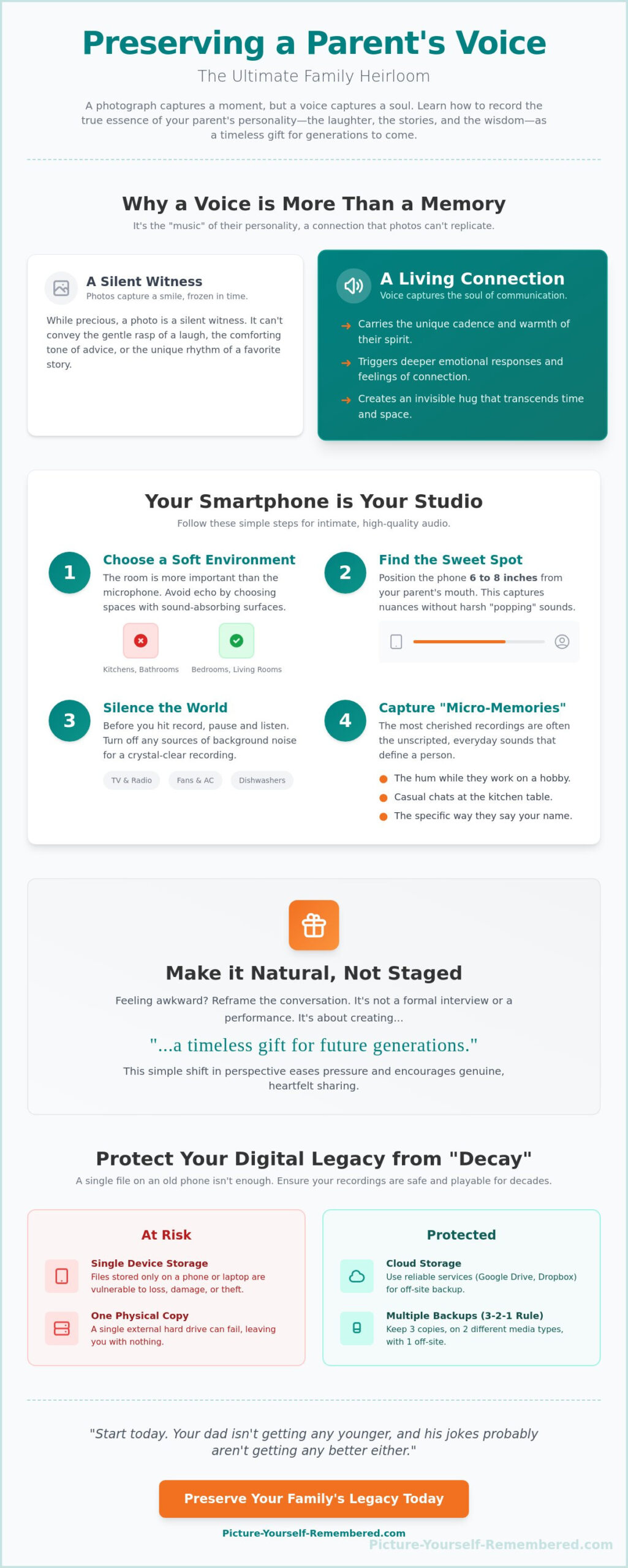
A photograph captures a smile, but it’s a silent witness. It doesn’t tell you how your mother’s voice lifts at the end of a favorite joke or the way your father’s tone settles into a low, comforting rumble when he’s sharing advice. A voice carries the “music” of a personality, the unique rhythm and warmth that a still image simply cannot replicate. This is why preserving a parent’s voice is such a vital act of love. It’s about more than just sound; it’s about capturing the soul of their communication and the very cadence of their spirit.
When we talk about this process, we’re really looking at what is oral history in its most intimate, family-centered form. It is the intentional act of archiving personal wisdom and life stories so they don’t fade into the background of time. Think of it as a bridge for grandchildren who might never have the chance to sit at the kitchen table and hear these tales firsthand. It ensures they don’t just know about their grandparents, but they actually get to know them through the sound of their laughter and the weight of their words. Plus, it’s the only way to prove to your kids that Grandpa actually did have a sense of humor, even if his jokes were 90 percent puns.
To better understand the power of these recordings, watch this helpful video about the impact of saving family stories:
The Science of Sound and Memory
Hearing a familiar voice does something truly magical to the human brain. Scientific studies suggest that auditory triggers can activate our emotional centers much more deeply than visual images alone. When you hear a loved one’s voice, your body often responds by lowering cortisol levels and increasing feelings of safety and connection. It’s like an invisible hug that transcends time. While a photo shows a moment frozen in the past, a voice tells the story of that moment, allowing the listener to feel the speaker’s physical presence in the room even years later.
Capturing the “Boring” Moments That Matter
We often think we need a grand, formal interview for preserving a parent’s voice, but the most cherished recordings are often the “micro-memories.” This includes the sound of them humming while they potter around the kitchen, the specific way they say your name, or even their habitual sigh of contentment after a long day. These everyday sounds are the delicate threads that make up the fabric of a life. They represent the person in their most natural state, free from the pressure of a staged performance. To capture these gems, consider the following:
- The Kitchen Table Tapes: Leave your recorder running during a casual family meal or while you’re working on a puzzle together.
- The Hobbyist’s Hum: Record them while they are engaged in a favorite activity, like gardening or woodworking, to catch the unscripted sounds of their joy.
- The Namesake: Specifically ask them to record a short message using your name or your children’s names, as the way they say those words is a unique signature of their affection.
These unscripted, “boring” moments often hold the most emotional weight years down the line because they capture the simple essence of being together.
Practical Tips for Capturing High-Quality Audio
You don’t need a professional studio to create a masterpiece. The phone in your pocket is already a sophisticated recording device. For preserving a parent’s voice, this tool is more than enough if you follow a few simple steps. You’re holding a portable studio; you just need to set the stage.
The secret to a great recording isn’t the price of the microphone, but the room around it. Hard surfaces like tile and granite in a kitchen cause sound to bounce, creating a hollow, metallic echo. Instead, head for the living room or a bedroom. Soft surfaces such as heavy curtains, plush carpets, and even bookshelves act as natural sound absorbers. They cradle the voice, making the final playback feel intimate and warm. Aim to keep the phone about 6 to 8 inches from your parent’s mouth. This distance is the sweet spot; it’s close enough to catch the subtle nuances of their breath but far enough to avoid the harsh popping sounds of certain consonants.
Before you begin, take a moment to silence the world. Turn off the television, pause the dishwasher, and ask everyone to put their phones on airplane mode. As you gather these precious files, consider how you’ll organize them so they remain accessible for years to come. You can explore a Basic Membership to help structure this beautiful collection of memories within Picture-Yourself-Remembered™.
The “Airplane Mode” Checklist
Preparation creates a safe space for the heart to open. Always start with a 10-second test recording. Play it back immediately to ensure you aren’t catching a low-level hum from an air conditioner or a distant lawnmower. These background noises are easy to ignore in person, but they can be incredibly distracting when you’re listening back years later. Also, check that battery level before you start. Nothing ruins a poignant moment like a phone dying right as your mother is about to reveal a hidden family scandal or the secret ingredient in her famous pie.
Heart-Centered Prompts to Start the Conversation
Getting started can feel a bit like a first date; it can be a little awkward but full of potential. Use gentle, sensory prompts to spark their memory. Try asking: “What is a sound from your childhood you can still hear if you close your eyes?” or “Tell me about the day you felt most proud of the person you became.” If the conversation hits a lull, use the “Tell me more” technique to keep the flow natural. If things still feel a bit stiff, lighten the mood. Ask them about their most embarrassing fashion choice from the 1970s. Nothing breaks the ice like a vivid description of lime-green polyester bell-bottoms and a perm that defied the laws of physics.
Overcoming Camera Shyness and Resistance
It’s perfectly normal for a parent to feel a bit like they’re being interrogated when you pull out a recording device. Most of us share a common trait: we dislike the sound of our own voices and the way we look on camera. This resistance often stems from a place of vulnerability, a fear that we aren’t “interesting” enough or that we look “too old” for a permanent record. When you approach the task of preserving a parent’s voice, your first job is to gently shift the focus. Remind them that this recording isn’t for the person they are today; it’s a profound gift for the person their grandchild will become in twenty years.
Start by normalizing the process. Share a story of your own, perhaps a funny memory from your childhood or a lesson you’ve recently learned. When you lead with your own history, you create a safe space for them to follow. If the camera feels like an uninvited guest, choose an audio-only approach first. Microphones are far less intimidating than lenses. They allow the speaker to close their eyes, lean back, and focus entirely on the narrative without worrying if their hair is behaving or if they have a piece of spinach in their teeth from lunch.
Making it a Collaborative Project
Instead of making the session about them, frame it as a shared mission for preserving family history. This simple shift in language removes the spotlight and replaces it with a sense of purpose. One of the best ways to spark natural, un-staged commentary is to pull out an old photo album. As you flip through the pages together, the conversation will flow naturally. You aren’t asking for a formal speech; you’re simply asking for the story behind the grainy black-and-white photo of that legendary 1964 family road trip.
When to Use Video vs. Audio
Video is a beautiful tool for capturing gestures, the twinkle in an eye, or the way someone uses their hands to describe the scale of a memory. However, audio often allows for a deeper, more meditative focus on the words themselves. If your parent remains very shy, try recording them while they are busy with their hands. Capture their voice while they are gardening, knitting, or even just tinkering in the garage. These “active” recordings feel much less like a performance and more like a conversation. Remind them that a grandchild won’t care about “messy” hair or a few extra wrinkles. Only the love in their eyes will matter. Besides, by the time your grandkids see this, they’ll probably be too busy trying to figure out how we lived without telepathy to notice a bad hair day.
Beyond the Smartphone: Ensuring Your Recordings Last Decades
The recording is finished. You’ve captured the gentle rise and fall of your mother’s stories and the distinct, rhythmic cadence of her laughter. It feels like a victory, and in many ways, it is. However, the true challenge of preserving a parent’s voice begins the moment you press stop. Where will that sound live in twenty, forty, or even sixty years? If it remains on a smartphone, it is only one accidental drop or a spilled cup of coffee away from being lost forever. Digital fragility is a quiet thief, and we must be intentional about how we lock our treasures away.
Digital decay is another hurdle we rarely consider in the heat of the moment. File formats that seem universal today may become unplayable as software evolves over the next few decades. Think of it like trying to play a cassette tape in a modern electric car; the data is there, but the bridge to reach it has been burned. We need a secure digital vault that acts as a living archive, one that is actively managed to ensure the technology never outpaces the memory. Storing your legacy on a random USB stick is like trusting a squirrel to remember where it buried its favorite nut; eventually, someone is going to end up hungry and disappointed.
Why “Saving to the Cloud” Isn’t a Strategy
It is a common mistake to assume that a folder in a standard cloud account is a permanent solution. When a user passes away, these accounts often become inaccessible due to strict privacy protocols. The digital gates slam shut, and without the right credentials, those precious files remain trapped in a void. While you can create a digital will to share passwords, these documents often fail to address the long-term maintenance of the media itself. You can explore the heart of this issue by reading about how to build a digital time capsule that truly stands the test of time.
The 99-Year Storage Solution
At Picture-Yourself-Remembered, we believe that a legacy shouldn’t require you to be a full-time IT professional. We offer a system that moves beyond passive storage. Instead of a file sitting silently in a forgotten folder, we focus on active delivery. This means your recordings are part of a Scheduled Delivery System, ensuring they reach the right person at the exact moment they need to hear them. We handle the file maintenance and future-proofing, so you don’t have to worry about whether a file format from 2026 will work in 2076. This isn’t just about saving data; it’s about securing a connection. You can begin this journey today by visiting Picture-Yourself-Remembered.com to see how we can help you safeguard your family’s most precious sounds.
Your Voice, Their Future: Taking the First Step Today
There is a quiet urgency in the act of preserving a parent’s voice. We often tell ourselves that we have plenty of time, that there will be another holiday or another quiet Sunday afternoon to capture those stories. Yet, the most profound regret isn’t usually about the things we did; it’s about the sounds we let fade into silence. The best time to start this journey was yesterday. The second best time is right now, while the stories are still fresh and the laughter is still ringing through the hallways. Your parent’s voice is a masterpiece, a living heirloom that holds more value than any physical inheritance ever could.
Taking that first step doesn’t have to be a monumental task. You can easily integrate these precious recordings into a Basic Membership, which provides a structured home for your family’s narrative. One of the most beautiful features of this process is our Scheduled Delivery System. It allows you to record a message today and ensure it reaches a loved one at a specific milestone in the future. Imagine your daughter hearing her grandfather’s encouragement on her wedding day or your son receiving a birthday wish from a grandmother who knew him when he was just a toddler. These are the bridges across time that turn a simple recording into a lasting legacy.
Starting Your Digital Legacy
If you’re feeling a bit overwhelmed, start small. Tonight, try a two-minute practice run. Record a simple “Thinking of you” message or a quick story about a shared memory. This helps you get comfortable with the technology and breaks the ice for your parent. Once you have that first file, you can upload it to our platform and set a delivery date. We encourage you to make recording messages for loved ones a regular habit. It doesn’t always have to be a grand life lesson. Sometimes, the most cherished messages are the ones where they simply describe their favorite way to spend a Tuesday. Even if that story involves twenty minutes of explaining why the neighbor’s cat is suspicious, it’s a piece of them that stays with you.
A Message Across Time
The founder’s vision for this project was born from a desire to bridge the gap between generations. It’s about the profound experience of a child receiving a message from a grandparent they never had the chance to meet. When they hear that voice, they aren’t just learning facts; they are feeling the warmth and the love that was intended for them decades before. By preserving a parent’s voice, you are giving the future a voice to listen to. You are ensuring that the light of their influence never truly goes out. Don’t wait for the “perfect” moment because the most perfect moment is the one you create today. Start preserving your family’s voices with Picture-Yourself-Remembered today.
Secure the Echo of Their Love
Capturing the stories that shaped your life is one of the most intentional acts of love you can perform. By preserving a parent’s voice, you ensure that the rhythm of their laughter and the warmth of their advice remain a living presence for decades. You’ve learned that you don’t need a professional studio to begin; a quiet room and a sincere conversation are the only tools required to build this bridge across time. And let’s be honest, capturing your mom’s actual voice is much better than trying to decode her mysterious shorthand in that old recipe book.
This mission is about more than just storage. It is about the peace of mind that comes with knowing your family’s history is protected in a compassionate, secure environment. Founded by Stanley Poe to bridge generational gaps, Picture-Yourself-Remembered offers secure storage for up to 99 years. Your recordings won’t just sit in a digital void; they will be delivered exactly when they are needed most. Begin your family’s journey into digital legacy today and turn those fleeting moments into an endurance of spirit. Your future self, and your children’s children, will thank you for taking this first step.
Frequently Asked Questions
How do I record my parent’s voice if they live far away?
You can use video call recording features or ask them to record a voice memo on their own phone while you talk on a separate line. This ensures the audio is captured locally, avoiding the glitchy sound of a poor internet connection. Once they finish, they can simply send the file to you for safe keeping within your Picture-Yourself-Remembered™ account.
What are the best questions to ask a parent for a legacy video?
Focus on questions that spark vivid, sensory memories rather than just dates or names. When you’re focused on preserving a parent’s voice, ask about their first car, the best meal they ever ate, or a lesson they learned from their own grandparents. These specific prompts help their true personality shine through the recording.
Is it better to record audio-only or a full video message?
The best choice depends entirely on your parent’s comfort level. Video is wonderful for capturing expressions and gestures, but audio often feels more intimate and less like a performance. If they’re worried about how they look, start with audio to keep the conversation relaxed and unforced.
How can I ensure my digital recordings won’t be lost if technology changes?
You can protect your memories by using a service that actively manages file formats as technology evolves. Unlike a basic USB drive or a standard cloud folder, Picture-Yourself-Remembered™ is designed for multi-generational storage. We ensure your files remain playable and accessible even as software and hardware change over the next several decades.
What should I do if my parent refuses to be recorded?
The process of preserving a parent’s voice can be intimidating, so try shifting the focus to the future. Remind them that these stories aren’t for today; they are a vital gift for the grandchildren who will want to hear their voice years from now. Just remind them that if they don’t tell their side of the story, you’ll be forced to let your sibling’s exaggerated version become the official family history.
Can I schedule a message to be delivered 50 years from now?
Yes, you can absolutely schedule a message for a milestone half a century away. Our Scheduled Delivery System allows you to pick a specific date, such as a future wedding or a 50th birthday, for the message to arrive. This ensures your parent’s love and wisdom reach the next generation at the perfect moment.
How do I handle the emotional weight of recording these messages?
Take things slowly and remember that it’s okay to be vulnerable during these sessions. You don’t have to record everything in one day; instead, aim for short, twenty-minute conversations that feel natural. If you get emotional, just let the recorder run. Those moments of genuine connection are often the most meaningful parts of the entire legacy.
What technical settings should I use on my phone for the best audio?
Check your settings to ensure you’re recording in the highest possible quality. On most smartphones, you can select a lossless or high-quality format in the voice recording app settings. Turn on Do Not Disturb mode to prevent a sudden telemarketing call from interrupting your dad’s most poignant story about his childhood dog.
