

Imagine sitting across from your mother, watching the light catch her eyes, and suddenly realizing that while you know her coffee order, you have no idea what her first car was named or what she felt the day you were born. It is a quiet, sometimes startling realization that hits many of us during a Sunday dinner. You want to bridge that gap, but the fear of sounding morbid or the sheer awkwardness of where to start often keeps the most beautiful stories locked away. Finding the right questions to ask your parents before they die is not about preparing for an end; it is about celebrating the richness of their journey.
We all want to believe there is plenty of time, yet memories can be as fragile as old polaroids. This guide provides a curated list of 50 heartfelt questions to help you transform a simple chat into a permanent family treasure. You will learn how to initiate these talks with grace and discover stress free ways to preserve their answers for the future. We promise to make this process feel like a meaningful act of love rather than a stiff interview. Besides, you really need to get the official story on why they thought those neon tracksuits in the eighties were peak fashion. We will also look at how simple tools like video message storage can keep their laughter alive for your own children one day.
Key Takeaways
- Reframe the “Legacy Interview” as an invitation to connection that honors your parent’s journey and provides them with a profound sense of purpose.
- Master the “Soft Entry” technique by using a cherished family heirloom or an old photograph to naturally unlock stories that might otherwise go untold.
- Explore our curated list of 50 questions to ask your parents before they die, designed to navigate the path from playful childhood memories to deep life lessons.
- Capture the magic of their voice and expression by following simple recording tips, like propping your phone at eye level to ensure the focus stays on their smile and not the living room ceiling.
- Secure your family’s narrative against the passage of time by learning how to build a digital time capsule that protects these precious recordings for generations.
The Weight of the Unspoken: Why These Questions Matter Now
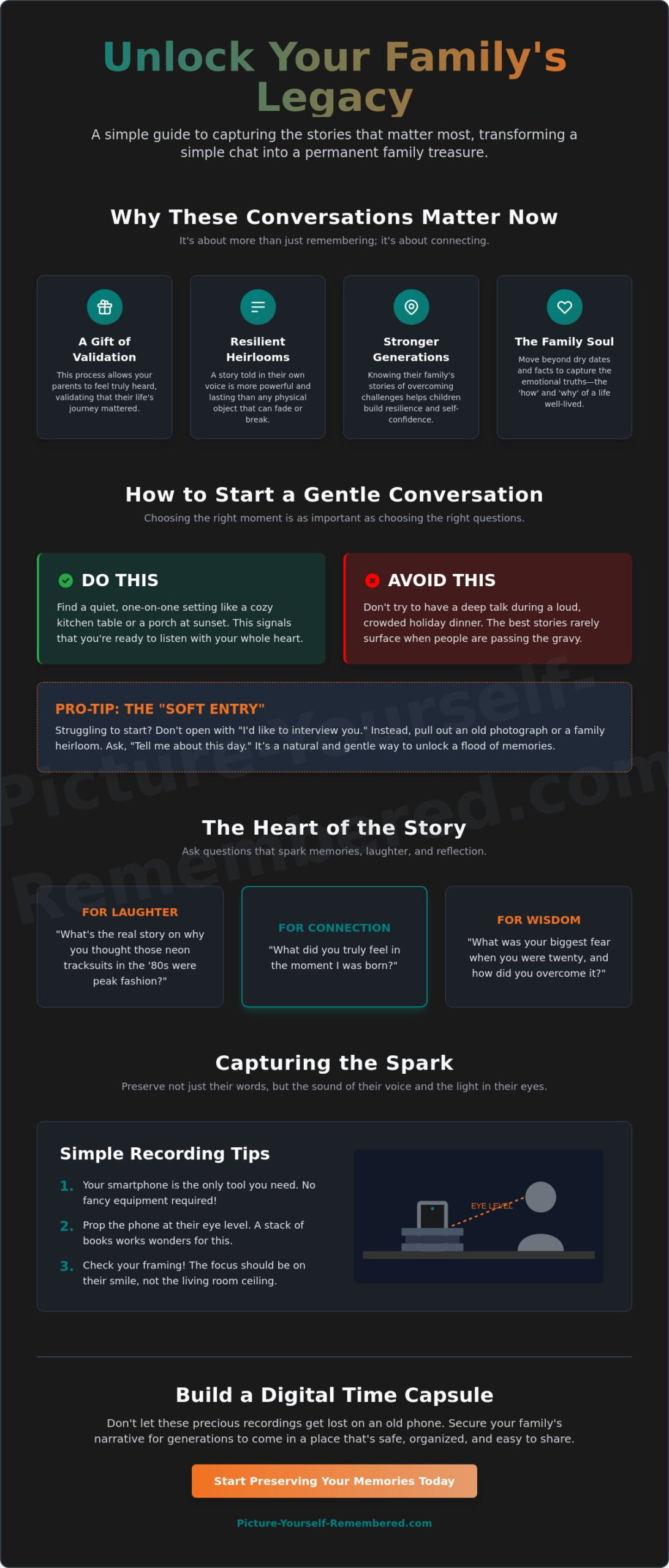
We often treat our parents’ stories like old books on a high shelf; we know they’re there, but we rarely reach for them until the library lights begin to flicker. A “Legacy Interview” isn’t a somber checklist or a preparation for an end. It’s a vibrant, living celebration of the person who shaped your world. By taking the time to find the right questions to ask your parents before they die, you aren’t just recording facts. You’re giving them the ultimate psychological gift. This process allows them to feel truly heard, validating that their journey mattered and their wisdom is worth keeping. It transforms a standard Sunday visit into a profound act of intentionality.
Most of us live in the “regret gap.” This is that hollow space where we realize we know our father’s phone number but not his greatest fear at age twenty. Oral histories are far more resilient than physical heirlooms. A porcelain vase can shatter and a photo can fade, but a story told in a parent’s own voice carries an emotional resonance that outlasts any object. When you focus on recording messages for loved ones, you preserve the cadence of their laughter and the specific way they emphasize a punchline. These digital treasures stay vivid long after physical mementos have gathered dust.
To better understand how these conversations can transform your relationship, watch this helpful video:
Bridging the Generational Gap
Sharing these narratives does more than just fill an afternoon; it builds a sturdier sense of identity for everyone involved. Research, including a 2015 study highlighted by the New York Times, shows that children who understand their family’s “intergenerational self” tend to have higher self-confidence. They face life’s challenges with more resilience because they know they belong to a long line of people who also faced and overcame obstacles. These stories act as the glue between our past and their future. Plus, it’s the only way to ensure your kids know that Grandpa wasn’t always a dignified elder; he once tried to jump a bicycle over a moving lawn sprinkler and failed spectacularly.
Moving Beyond Basic Genealogy
Genealogy often feels like a collection of dry dates and dusty census records. While knowing your mother was born in 1952 is a fact, knowing how she felt in 1952 is a legacy. A family tree shows the branches, but these conversations reveal the family soul. We should focus on emotional truths rather than just chronological order. It doesn’t matter if the wedding was on a Tuesday or a Saturday. It matters what the air smelled like and why they chose to say “I do.” Moving beyond the “what” and “when” allows you to capture the “how” and “why” of a life well lived. If you feel stuck, try asking about a single photograph. It is a practical way to bypass the “I don’t have anything to say” hurdle and jump straight into the heart of the matter.
Setting the Stage: How to Start a Gentle Legacy Conversation
Choosing the right questions to ask your parents before they die is only half the battle; the other half is creating a space where those answers can breathe. While some suggest turning these moments into a family game during a holiday dinner, deep stories rarely surface in a crowd. A loud table filled with clinking silverware and overlapping voices often leads to surface level anecdotes. To reach the heart of a person’s journey, you need a quiet, one on one setting. Find a porch at sunset or a cozy kitchen table where the only thing on the agenda is connection. This stillness signals that you are ready to listen with your whole heart.
If the idea of a formal interview feels too heavy, try the “Soft Entry” approach. Instead of opening a notebook, open an old jewelry box or pull out a single, unlabeled photograph. Physical objects act as anchors for memory, pulling specific details from the past into the present. Ask about the watch your father always wears or the locket your mother keeps tucked away. These tactile prompts often unlock more vivid details than a direct question ever could. If they insist their memory is failing, gently remind them that you are the one who currently can’t find your car keys in the driveway. A little laughter softens the weight of the task and reminds everyone that this is a celebration, not an interrogation.
Timing and Permission
Approaching this conversation requires the grace of a confidant rather than the cold efficiency of an insurance agent. Start by asking for permission. You might say, “I’ve realized there is so much about your early life I don’t know, and I’d love to sit with you and hear some stories.” For parents who tire easily, avoid the marathon session. Use the “One Question a Day” method instead. This keeps the energy light and gives them something to look forward to. Practice active listening by leaning into the silences. Sometimes the most profound realizations happen in the quiet moments between the words.
Overcoming the Awkwardness
It is natural to feel a bit of hesitation before diving into deep waters. To ease the tension, use phrases like “I’ve been thinking about…” rather than “I need to know.” This shifts the focus from a demand for information to a shared experience of curiosity. You might find your own emotions rising as they speak, and that is perfectly okay. Managing your presence means staying grounded so they feel safe to be vulnerable. If tears come, let them. Acknowledge that a life well lived is worth a few tears of both joy and sorrow. To help you feel more prepared, you can explore how to create a video legacy that feels both professional and deeply personal.
The Heart of the Matter: 50 Questions to Uncover Their Story
Now that the room is quiet and the coffee is poured, it is time to move into the heart of the conversation. Having a curated list of questions to ask your parents before they die ensures that you don’t get stuck on surface level facts. You already know they were born in a hospital; you want to know if they ever actually liked that floral wallpaper in the guest bathroom or if it was just a strange trend they felt forced to follow. To truly capture a life, we must move from the “what” to the “why.” This shift allows you to uncover the emotional truths and values that shaped who they are today.
The secret to a great interview lies in sensory details. Instead of asking for a general description, ask about the smells, sounds, and feelings of a specific moment. What did the front door sound like when it clicked shut? What was the specific scent of their mother’s kitchen on a Sunday morning? These small, tactile memories act as a bridge to the past. Use the “Magic Question” to find the turning points: “What was a moment that changed everything for you, but you rarely talk about?” This often reveals the hidden chapters of their narrative that never made it into the family lore.
Early Years and Innocence
Childhood stories provide the foundation of a person’s identity. These questions help you visualize a world you never got to see firsthand. Try asking:
- What was the house you grew up in like, and what was your favorite corner of it?
- Who was the first person who made you feel like you could achieve anything?
- What did your parents’ hands look like when they were working?
- What was the most rebellious thing you did as a teenager that you never told your own parents?
- Is there a sound or a song that instantly takes you back to being ten years old?
Love, Loss, and Resilience
Adulthood is often defined by the storms we weather and the people who stand beside us. These prompts explore the grit and grace of their middle years:
- What is the hardest decision you ever made, and would you make it again today?
- When did you first feel like an adult, and what happened to trigger that realization?
- What is a secret to a long-lasting friendship that most people seem to forget?
- How did you handle your very first heartbreak, and what did it teach you about yourself?
- What was the most unexpected challenge of parenthood that no one warned you about?
Legacy and Hopes for the Future
As the conversation winds down, look toward the horizon. This is where wisdom is distilled into its purest form:
- What do you want your great-grandchildren to know about our family name?
- If you could leave me one piece of advice for my hardest day, what would it be?
- What is the one thing you’re most proud of that isn’t on your resume?
- What do you hope people say about you when you aren’t in the room?
- If you could go back and tell your twenty year old self one thing, what would it be?
Remember to keep your pace steady and allow for pauses. Actionable tip: if a specific answer feels particularly moving, that is the perfect moment to ensure you are utilizing Video Message Storage to keep the visual and auditory memory of that wisdom secure for the future.
Capturing the Spark: Practical Tips for Recording the Interview
You have gathered your questions to ask your parents before they die, but now you face the practical task of preserving those answers. While a written journal is beautiful, video remains the gold standard for recording messages for loved ones. There is a specific magic in seeing a parent’s expressions and hearing the unique cadence of their voice. It is the difference between reading a script and watching a masterpiece. Video captures the subtle pauses, the sudden smiles, and the way their hands move when they describe a memory that still feels close enough to touch.
To get the best result, use a tripod or prop your phone at eye level. This keeps the focus entirely on their face rather than the ceiling or a shaky hand. Audio is just as important as the image. If the room feels echoey, try the “blanket trick” by placing a heavy quilt just out of camera range to absorb sound. This simple step transforms a hollow room into a warm, intimate space. Don’t forget to capture the “B-roll” of their life; record a few seconds of just their laugh, the way they hold a pen, or how they look at you when they think the camera is off. These small details often become the most cherished parts of the record.
The Technical Setup for Non-Techies
Setting up doesn’t require a film degree. Follow the simplest lighting rule: always face a window. Natural light is soft and flattering, but if the window is behind your parent, they will look like a mysterious silhouette in a witness protection program. Always check your device’s storage space before you begin. A long session can take up significant room, and you don’t want to be interrupted by a “Storage Full” alert during a pivotal story. Above all, remember that “good enough” is better than “perfect.” A slightly grainy video with a heartfelt story is far more valuable than a high-definition recording that never happened because the tech felt too intimidating.
Interviewing for the Camera
To help the story flow, ask your parent to repeat your question within their answer. If you ask what their first car was, they should start with, “My first car was a…” This makes the final video feel like a self-contained narrative. Encourage them to show physical objects like old medals or faded photos directly to the lens. These tactile moments bring the history to life. Finally, keep the energy high by suggesting frequent breaks. If you see them getting tired, pause for a snack or a stretch. If your tech skills are still a work in progress, don’t worry; you’re doing great. To keep these memories safe once the recording is done, explore our secure Video Message Storage options.
Securing the Narrative: Building a Digital Time Capsule
Once you have finished recording the answers to those meaningful questions to ask your parents before they die, the final step is ensuring they don’t simply vanish into the digital ether. We often assume that a file saved on a laptop or a video posted to social media is permanent, but this is a quiet misconception known as “Digital Decay.” Hard drives eventually fail and social media accounts can be locked or deleted. In fact, research from early 2026 shows that cloud storage bills often exceed forecasts by 30 to 40 percent due to hidden access and transfer fees. Your family’s soul deserves a more stable home than a temporary folder on a device that might be obsolete in five years.
Taking agency over your story means moving beyond fragile physical media and unpredictable cloud subscriptions. By choosing to create a video legacy, you are building a bridge that connects the present to a future you may never see. Digital files have a habit of vanishing more mysteriously than a single sock in a laundry load; besides, trying to remember a password from 2012 is a special kind of torture. Professional Video Message Storage provides a sanctuary for your parent’s voice. This ensures that their laughter and wisdom remain as clear in fifty years as they are today. This isn’t just about saving data; it is about preserving family history with the same care one would give to a masterpiece.
The 99-Year Promise
A Scheduled Delivery System transforms a simple recording into a timeless gift. Imagine your parent’s voice arriving on the day of a grandchild’s wedding or the birth of a great-grandchild. This “set it and forget it” approach ensures that their influence continues to ripple through time. By using a digital time capsule, you are securing a promise that your family’s most important stories will be heard by generations they will never meet. It provides an enduring sense of peace, knowing the legacy is held in an encrypted, secure vault designed for longevity.
Your Next Step Toward Peace
The journey toward a secure legacy starts with a single conversation. Don’t feel overwhelmed by the need to record everything at once. Start small; record the answer to just one of your questions to ask your parents before they die today and see how the connection deepens. This archive isn’t just a gift for the future; it is a comfort for you to hold onto when you need their guidance most. We invite you to join Picture-Yourself-Remembered™ and explore our Basic Membership to begin securing these precious moments forever. Your parents’ stories are the masterpiece of their lives. Let’s make sure the gallery stays open forever.
Your Next Step Toward a Lasting Legacy
Taking the time to find the right questions to ask your parents before they die is more than just an interview; it is a profound act of intentionality that honors their journey. You have learned how to use a “soft entry” with old photos to ease into deep stories and how to capture the sensory magic of their laughter through video. You might even finally discover the truth about that mysterious dent in the 1974 station wagon that your dad still claims was caused by a “rogue shopping cart.”
These stories are the masterpiece of your family’s soul, and they deserve a home that stands the test of time. Founded by Stanley Poe to bridge the gap between generations, our platform offers a secure digital vault for your most precious memories. With our scheduled delivery system, you can ensure these messages reach future generations exactly when they need them most. Secure your family’s stories for 99 years with a Basic Membership today. Your parent’s voice is a gift that should never fade; take the first step to ensure it stays vivid forever.
Frequently Asked Questions
Is it too morbid to ask my parents these questions?
Approaching these conversations is an act of deep love and celebration rather than a somber preparation for the end. Most parents feel a profound sense of purpose when they realize their children value their wisdom and journey. By choosing thoughtful questions to ask your parents before they die, you are telling them that their life is a masterpiece worth preserving. It is a gift of being truly heard and remembered.
What if my parents don’t want to talk about their past?
Respect their boundaries while gently using the “Soft Entry” method we discussed earlier. Start with a physical object like an old recipe or a piece of jewelry to spark memory naturally. If they still feel shy, share a story of your own first to build a bridge of vulnerability. Sometimes they just need to know that you aren’t looking for perfection, just the truth of their experience.
How long should a legacy interview session last?
Aim for forty five to sixty minutes to keep the energy high and the focus sharp. Long sessions can be physically and emotionally draining for both of you. If you notice their eyes glazing over, it is time for a tea break or to save the rest for another day. Remind them that even if they think their life was “ordinary,” your kids will find their lack of a smartphone in the seventies absolutely prehistoric.
What is the best way to record a parent’s life story?
Video is the gold standard because it captures the nuance of their expressions and the warmth of their laughter. Use a tripod or a stable surface to keep the camera at eye level so the focus remains on their face. This visual record combined with specific questions to ask your parents before they die creates a multi-dimensional legacy that a written transcript simply cannot match. It preserves the spark behind the story.
Can I do this interview over Zoom or FaceTime if we live far apart?
You can certainly record these sessions digitally if you live in different cities. Most video call platforms have a built in recording feature that makes the process simple. Just be sure to check your internet connection beforehand to avoid the “frozen screen” look. While in person is ideal for the tactile “Soft Entry” approach, the most important thing is that the conversation happens, regardless of the distance.
What are the most important questions to ask if I only have a few minutes?
Focus on the “Legacy and Hopes” category if time is limited. Ask them what they are most proud of that isn’t on a resume or what single piece of advice they would give you for a difficult day. These high impact questions get straight to the core of their values. You can always return later to fill in the details about their first car or childhood home when you have more time.
How do I store these video files so they don’t get lost or corrupted over decades?
Avoid relying solely on social media or a single hard drive, as these are vulnerable to “Digital Decay.” Use a professional Video Message Storage service that offers encryption and long term security. This ensures your files are protected from hardware failure or accidental deletion. A secure digital vault provides the peace of mind that these stories will be available for your grandchildren to watch on their own wedding days.
Should I share the recording with the whole family right away?
Always ask your parent for their permission before sharing the interview with others. Some stories might be intended only for you, while others are meant for the whole family tree. Respecting their privacy builds the trust necessary for them to be truly open in future sessions. Once they give the green light, sharing these moments can be a beautiful way to strengthen bonds across the entire family.
