

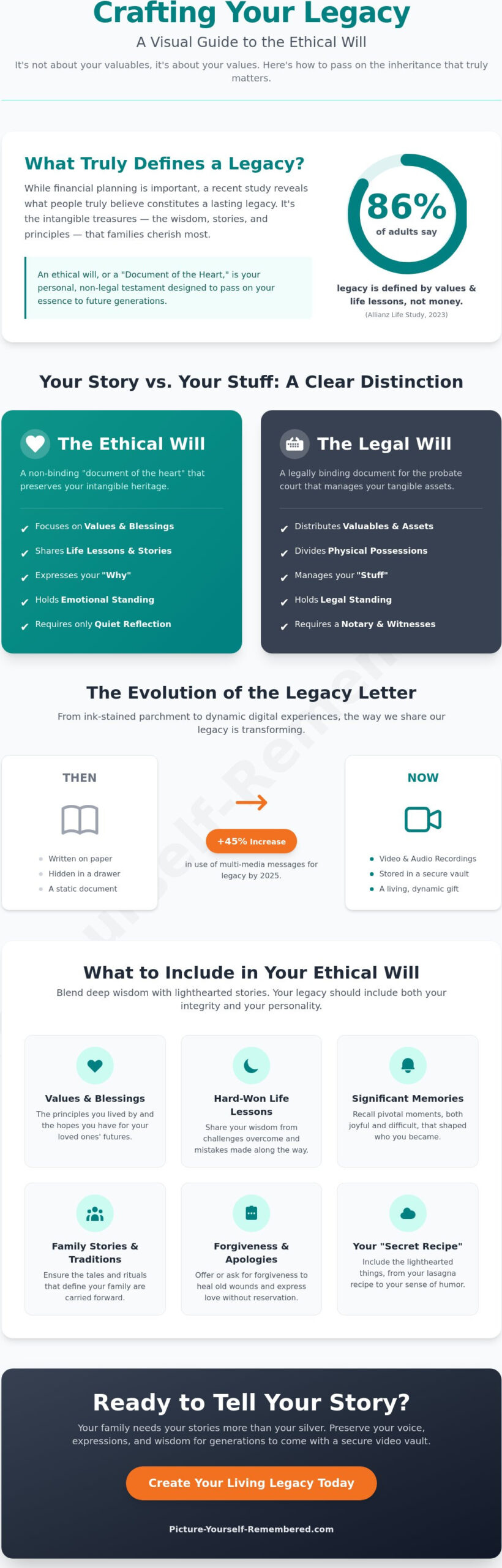
What if the most valuable treasure you bequeath to your family isn’t found in a safety deposit box or a real estate portfolio? While a 2023 study from Allianz Life revealed that 86% of adults believe a legacy is defined by values and life lessons rather than money, many of us still feel a wave of anxiety when we try to put those feelings into words. You might worry about sounding too preachy or struggle with a stubborn case of writer’s block that makes a blank page look like a snowstorm. Let’s be honest; trying to summarize your entire existence is a lot more pressure than writing a grocery list, even if both occasionally involve a few regrets about unfulfilled resolutions.
You likely agree that your story deserves to be told with the same care you gave to building your life. We promise to help you bridge the gap between your heart and the page. By exploring our curated ethical will examples and templates, you’ll gain the confidence to create a finished legacy piece that your family will cherish forever. This article provides a clear framework to help you distinguish your legal documents from your soulful ones, ensuring your voice is never lost to time.
Key Takeaways
- Understand how an ethical will serves as a “document of the heart,” allowing you to pass down your values and blessings rather than just your physical possessions.
- Utilize our practical ethical will examples and templates to find the perfect structure for your story, whether you are guiding young children or reflecting on a long career.
- Get step-by-step guidance on setting the scene and choosing the best medium to capture your essence, from traditional writing to soulful video messages.
- Discover how to blend deep wisdom with lighthearted family stories—because your legacy should include both your integrity and your “secret” lasagna recipe (even if you still keep one ingredient a mystery).
- Learn how to use a secure video vault to preserve your voice and expressions, ensuring your future family can truly see and hear the heart behind the history.
What is an Ethical Will? The Document of the Heart
When we think about what we leave behind, our minds often drift to bank accounts or the family home. But there’s a different kind of inheritance that carries the weight of your soul. Historically known as a Zevat HaLev, or a “Commandment of the Heart,” an ethical will is a non-legal document designed to pass on your values, blessings, and hard-won life lessons. It’s a way to ensure your essence isn’t lost in the shuffle of estate paperwork. If you are searching for What is an Ethical Will?, you’ll find it’s a tradition that spans centuries, helping ancestors guide their descendants through the simple power of the written word.
To better understand how this beautiful tradition fits into your life, watch this helpful video:
Values vs. Valuables: Understanding the Difference
A lawyer handles your house, but only you can handle your heritage. While a Last Will and Testament is vital for the probate court, an ethical will has no legal standing there. Instead, it holds immense standing in the heart. You don’t need a notary or a witness to sign it; you just need a moment of quiet reflection and a desire to be known. Think of it this way: your legal will distributes your stuff, but your ethical will distributes your “why.” It’s the difference between leaving your granddaughter your silver tea set and leaving her the secret to your resilient spirit. When looking at ethical will examples and templates, you’ll see they focus on the stewardship of a life well-lived rather than the division of assets.
The Modern Evolution of Legacy
The “legacy letter” has come a long way since the days of parchment and ink. As we move through 2026, digital tools have transformed these documents into a vibrant “legacy experience.” Recent data from 2025 suggests a 45 percent increase in people using multi-media messages, such as video and audio recordings, to create a “living legacy.” These modern ethical will examples and templates now include everything from digital scrapbooks to voice-recorded blessings. It’s no longer just a dry paper hidden in a drawer; it’s a dynamic gift that keeps your voice alive for generations. This shift allows you to be a visionary architect of your own memory, ensuring your narrative is told in your own words.
Your family needs your stories more than your silver. Silver can be polished, sold, or even lost in a move, but a story about how you overcame a challenge in 1994 stays with them forever. Plus, let’s be honest, your kids probably won’t polish that silver anyway, so you might as well give them something they’ll actually use. To start your journey, try this actionable tip: set a timer for ten minutes and write down the single most important piece of advice you ever received. That one paragraph is the first brick in your legacy wall.
3 Essential Ethical Will Templates for Every Life Stage
Staring at a blank page when trying to summarize your life’s wisdom feels overwhelming. You want to capture your essence, but where do you start? Using ethical will examples and templates provides a gentle map for your thoughts, allowing your heart to speak without the pressure of perfect prose. These frameworks help you organize your narrative, ensuring that your most cherished values aren’t lost to time. Whether you are just starting a family or looking back on a long career, there is a structure that fits your current season.
Template 1: The Parent’s Guide to the Future
This “Foundation” template is designed for those in the thick of raising children or guiding young adults. The focus here is on stewardship and character. Instead of listing achievements, focus on the qualities you hope they cultivate. Share the family traditions you want them to carry forward, like the specific way your family celebrates small wins or the secret ingredient in a holiday recipe. Tell them the one thing you want them to always remember when life gets difficult.
Actionable tip: Write this as if you are sitting across the kitchen table from them, sharing a quiet moment. It makes the tone more intimate and less like a lecture. Also, remember that while you are passing on the wisdom of the ages, you are still not responsible for their mysterious inability to find matching socks in a clean laundry basket.
Template 2: The Retiree’s Wisdom Journal
The “Reflection” template serves those who have reached a vantage point of looking back. This is your opportunity to share the philosophy that guided your work and your marriage. Don’t just share the highlights; share the lessons learned from failure. Your resilience in the face of a 2008-style market crash or a career pivot at age 45 is a gift to the next generation. You can find inspiration by looking at historical and personal ethical will examples to see how others have distilled decades of experience into a few pages.
Actionable tip: Use a “What I Know for Sure” list format. This keeps the writing process simple and prevents you from feeling like you must write an entire memoir. Distilling your life into these truths is a beautiful way of preserving family history for those who will never get to meet you in person.
Template 3: The Blessing Framework
If you prefer something short and punchy, the “Blessing” template is ideal. This isn’t about long stories; it’s about specific, heart-centered hopes. It functions like a spiritual hug. You might focus on three core areas: your hope for their relationships, your hope for their contribution to the world, and your hope for their internal peace. It is a concise way to offer your blessing to the future.
The most important part of any template is your unique voice. The best framework is the one that sounds like you, quirks and all. If you are ready to begin capturing these moments, Picture Yourself Remembered can help you organize your story with the dignity it deserves.
Ethical Will Examples: Real Stories of Legacy
Watching someone else’s heart unfold on paper can be the spark you need to begin your own narrative. Consider Arthur, who in 1954 worked his first job at a dusty grain elevator in Kansas. He didn’t just tell his grandkids to work hard; he described the 105-degree heat and the grit in his teeth. This story turned a vague concept like “diligence” into a tangible memory his family could almost touch. It’s a beautiful way to ensure your ethical will examples and templates feel personal rather than clinical.
Then there is Elena, who used her document to share her famous lasagna recipe. She revealed that the secret ingredient wasn’t the extra garlic, but the resilience she found while feeding her family during the 2008 recession. She explained that the meal represented how they stayed together when things felt precarious. Her legacy became a blend of comfort food and emotional strength. Honestly, her family was probably just relieved to find out the secret ingredient wasn’t something like kale.
Mentors also find great value in this practice. In 2012, a business leader named David wrote to his protege about the time he walked away from a million-dollar deal because it required him to hide a product flaw. By sharing that specific crossroads, he provided a moral compass for a young professional’s future. These stories work because they lean into honesty and vulnerability. They don’t offer a polished, perfect image; they offer the messy, beautiful truth of a life well-lived.
The Power of the Specific
General advice like “be kind” is a lovely sentiment, but it often lacks staying power. It’s much better to say, “Remember how we spent four hours helping the neighbor clear branches after the May 2024 storm.” These small anecdotes illustrate your values in high definition. Your essence is found in the tiny snapshots of your life. Look for the small moments where you felt most like yourself, as those are the stories that will carry your influence forward through the years.
Learning from the Past
A legacy document isn’t just a highlight reel of your greatest hits. Addressing mistakes provides a vital roadmap for those you love, showing them that growth is a lifelong stewardship. Words like “I’m sorry” or “I forgive you” carry immense weight in these pages. They offer closure and grant permission for the next generation to be beautifully imperfect too. Sharing your regrets is an act of love that prevents your descendants from repeating the same patterns.
- Actionable Tip: Choose one mistake you made at least five years ago.
- Write down the specific lesson that stumble taught you.
- Explain how that lesson changed the way you treated people or made decisions afterward.
Using ethical will examples and templates helps you organize these thoughts, but your unique voice is what gives them life. Don’t worry about being a perfect writer. Just focus on being a present one. Your family doesn’t need a literary masterpiece; they simply need to hear your heart in every word.
Practical Tips for Creating Your Ethical Will Today
Creating an ethical will is an invitation to pause and reflect on the beauty of your journey. It isn’t a legal chore; it’s a gift of your essence. You don’t need to be a professional writer to share your heart. You just need to be yourself. Think of it as a love letter to the future, one that hopefully doesn’t get buried under a pile of old takeout menus and expired coupons.
To begin this meaningful process, follow these five gentle steps:
- Step 1: Set the scene. Find a quiet space where you feel most like yourself. This might be a sun-drenched porch or a favorite armchair with a cup of tea.
- Step 2: Choose your medium. Decide how you want to share your story. Some prefer the scratch of a pen on paper, while others find it easier to record a message for your loved ones using a phone or camera.
- Step 3: Start with love. Begin with a blessing or a simple statement of affection. This sets a warm tone and reminds you why you’re doing this.
- Step 4: Use a guide. Banish the “blank page” anxiety by looking at ethical will examples and templates. They provide a structure so you can focus on the sentiment.
- Step 5: Review and store. Read through your words to ensure they reflect your truth, then place the document where it will actually be found.
Overcoming Writer’s Block with Prompts
If you find yourself staring at a blinking cursor, prompts can act as a bridge to your memories. Try finishing the sentence: “If I could only leave you with one piece of advice, it would be…” or “The time I felt most proud of our family was when…” To get the momentum going, set a timer for 10 minutes and do a “braindump” of your core values. Don’t worry about grammar or flow; just let the words spill out. You can use ethical will examples and templates later to polish these raw thoughts into a cherished narrative.
Where to Store Your Legacy
A legacy is only impactful if it reaches its destination. Physical paper carries a certain charm, yet it faces risks like fire, water damage, or simply being forgotten in a dusty drawer. For long-term security, consider a digital time capsule. This ensures your message is preserved in a secure, accessible format for 2026 and beyond. Make sure your recipients know how to access the message when the time comes; a legacy shouldn’t be a scavenger hunt.
Ready to ensure your story is told with the dignity it deserves? Explore our legacy planning services to begin your journey today.
Beyond the Page: The Future of the Video Ethical Will
While traditional ethical will examples and templates offer a sturdy foundation for your thoughts, the digital age allows us to go much deeper. A letter can describe your love, but it cannot transmit the specific, musical lilt of your laughter or the gentle way your eyes crinkle when you’re proud. Video captures the essence of who you are in a way that static text never will. It is the difference between someone reading a recipe and actually sitting down to share a meal with you. By choosing video, you aren’t just leaving instructions; you’re leaving your presence.
Picture Yourself Remembered serves as a secure vault for this digital legacy. We understand that your life story is a masterpiece that deserves careful stewardship. Instead of leaving a file on a dusty hard drive that might fail in five years, you can entrust your narrative to a platform designed for endurance. This transition from paper to pixels ensures that your wisdom remains as vibrant as the day you recorded it.
The Intimacy of Video
There is a profound power in the human voice. A simple three minute recording can communicate more comfort than a hundred pages of text. When your grandchildren hear your tone and see your expressions, they connect with your soul, not just your handwriting. If you’re feeling unsure about where to start, see our guide on how to create a video legacy for a gentle path forward. It doesn’t have to be perfect to be precious.
- Actionable Tip: Don’t worry about professional lighting or high end cameras. Your family doesn’t want a Hollywood production; they just want to see you. Think of it as a FaceTime call for the future, hopefully without those accidental chin-angle shots we all struggle with today.
- Focus on Feeling: Speak from the heart rather than reading from a script. The pauses and sighs are just as important as the words.
Securing Your Story for 99 Years
One of the biggest hurdles in legacy planning is the fear of technology becoming obsolete. We solve this through our Basic Membership, which safeguards your vault against the passage of time. You can schedule your ethical will for a future date, reaching as far as 99 years into the future. This ensures your message arrives exactly when it’s needed most, whether that’s a wedding day in 2045 or a graduation in 2070.
This “set it and forget it” delivery system provides a unique form of peace of mind. You can record your thoughts today, knowing the logistics are handled by a dedicated legacy architect. Your life is a beautiful narrative; we simply make sure the gallery stays open for those you love. By moving beyond basic ethical will examples and templates into the world of video, you give your descendants the greatest gift possible: the chance to see your smile one more time.
Securing the Essence of Your Story
Your life story is a living narrative that deserves a safe home. By exploring these ethical will examples and templates, you’ve started the vital work of distilling your wisdom for those who follow. A legacy shouldn’t be a mystery left in a junk drawer full of expired coupons and keys that don’t fit any known locks. It’s an intentional gift of love. Stanley Poe founded this platform to bridge generational gaps, giving you the tools to act as a visionary architect for your family’s future.
You can now safeguard your most cherished reflections in a secure digital vault for up to 99 years. This system uses scheduled delivery to ensure your voice arrives at the perfect moment, even decades from now. It’s about more than just planning; it’s about the peace of mind that comes from being truly understood. Start your living legacy today with a Picture Yourself Remembered membership.
Take a deep breath and smile. You’re building something beautiful that will light the way for generations.
Frequently Asked Questions
Is an ethical will legally binding?
An ethical will is not a legally binding document; it focuses on your values rather than your financial assets. Unlike a last will and testament, which must follow strict state guidelines like the Uniform Probate Code, this is a gift of your essence. You don’t need witnesses or a notary to make it valid. It’s simply a heartfelt narrative that sits alongside your legal papers to provide emotional context for your life’s work.
How long should an ethical will be?
Your ethical will can be as brief as a single page or as long as a 50 page memoir. Most people find that 2 to 4 pages is the sweet spot for capturing their core beliefs without overwhelming the reader. Think of it as a highlight reel of your soul. If you find yourself writing a trilogy that rivals Tolstoy, you might want to break it into smaller pieces for specific family members.
When is the best time to write an ethical will?
The best time to start is right now, especially during milestone years like a 50th birthday or the birth of a first grandchild. Statistics from legacy planning experts suggest that 80 percent of people wait until a health crisis to document their stories. Don’t be part of that group. Writing while you are vibrant allows your voice to feel celebratory, ensuring your ethical will examples and templates reflect a life well lived.
Can I update my ethical will over time?
You absolutely can and should update your ethical will as your perspective shifts over the years. Many people choose to revisit their words every 5 years or after major life events like retirement. Your wisdom at age 40 will likely look different than your reflections at age 70. Think of it as a living portrait of your character that grows more detailed and beautiful with every passing decade of stewardship.
What is the difference between a legacy letter and an ethical will?
A legacy letter is typically a private note written to one specific person, while an ethical will is a broader statement intended for your entire family or community. While they both share the goal of passing on values, the ethical will serves as a comprehensive roadmap of your spirit. You might write one ethical will for everyone and then include 3 or 4 specific legacy letters for your children to add a personal touch.
How do I introduce the idea of an ethical will to my family?
Start the conversation during a relaxed family dinner by explaining that you want to share more than just heirlooms. You might say, “I’ve been thinking about the lessons that shaped me, and I want to make sure you have those stories forever.” It helps to mention that this isn’t about saying goodbye, but about staying connected. If they look at you like you’ve grown a second head, just remind them it’s cheaper than a therapy bill.
Should I include my funeral wishes in an ethical will?
It is better to keep your funeral wishes in a separate document called a Letter of Instruction rather than in your ethical will. The ethical will is meant to be a timeless piece of your narrative, while funeral logistics are practical and immediate. By keeping these separate, your family can focus on your life lessons during the reading without getting distracted by whether you wanted 10 or 20 dozen lilies at the service.
Do I need a lawyer to help me with an ethical will?
You do not need a lawyer or a legal degree to create this document. Because it carries no legal weight in a courtroom, you are free to use ethical will examples and templates that resonate with your personal style. Your only requirement is to be honest and speak from the heart. However, it is a smart move to tell your executor where the document is kept so it doesn’t end up lost in a junk drawer.
