What if the most precious gift you leave behind isn’t a piece of jewelry, but the sound of your own voice telling the story of your first heartbreak? Many of us feel a quiet ache when we look at the 1,500 unorganized photos sitting in our closets, fearing our stories might simply dissolve. You’re right to feel that preserving family history is a sacred task, especially since a 2023 survey found that 65% of people worry their digital memories will vanish. It’s perfectly normal to feel overwhelmed by the thought that your files will become as obsolete as those floppy disks gathering dust in your desk drawer.
Let’s be honest, unless we act now, your great-grandchildren might only remember you as that person with the vintage smartphone. This guide promises to transform your overwhelming piles of memories into a protected, 99-year digital legacy that stays accessible through every technological shift. You’ll gain a clear, three-step plan to organize your archives and discover simple tools to ensure your narrative is never lost. We’re moving from the chaos of dusty boxes to the peace of a secured, living history that honors the beautiful essence of your life.
Key Takeaways
- Move beyond dry dates to capture the essence of who you are, weaving your personal narrative into a living legacy that truly breathes.
- Protect your tangible treasures from their silent enemies—like attic humidity and the surprisingly destructive power of old rubber bands—by creating a stable sanctuary for your heirlooms.
- Learn to record your story in your own voice, ensuring the unique warmth of your laughter remains a guiding light for generations to come.
- Discover the secret to preserving family history for 99 years by navigating the “long gap” that standard cloud storage and social media simply can’t bridge.
- Follow our step-by-step guide to setting your legacy stage, because your great-grandchildren deserve to see your beautiful smile rather than a shaky, accidental video of your ceiling fan.
What Does Preserving Family History Really Mean Today?
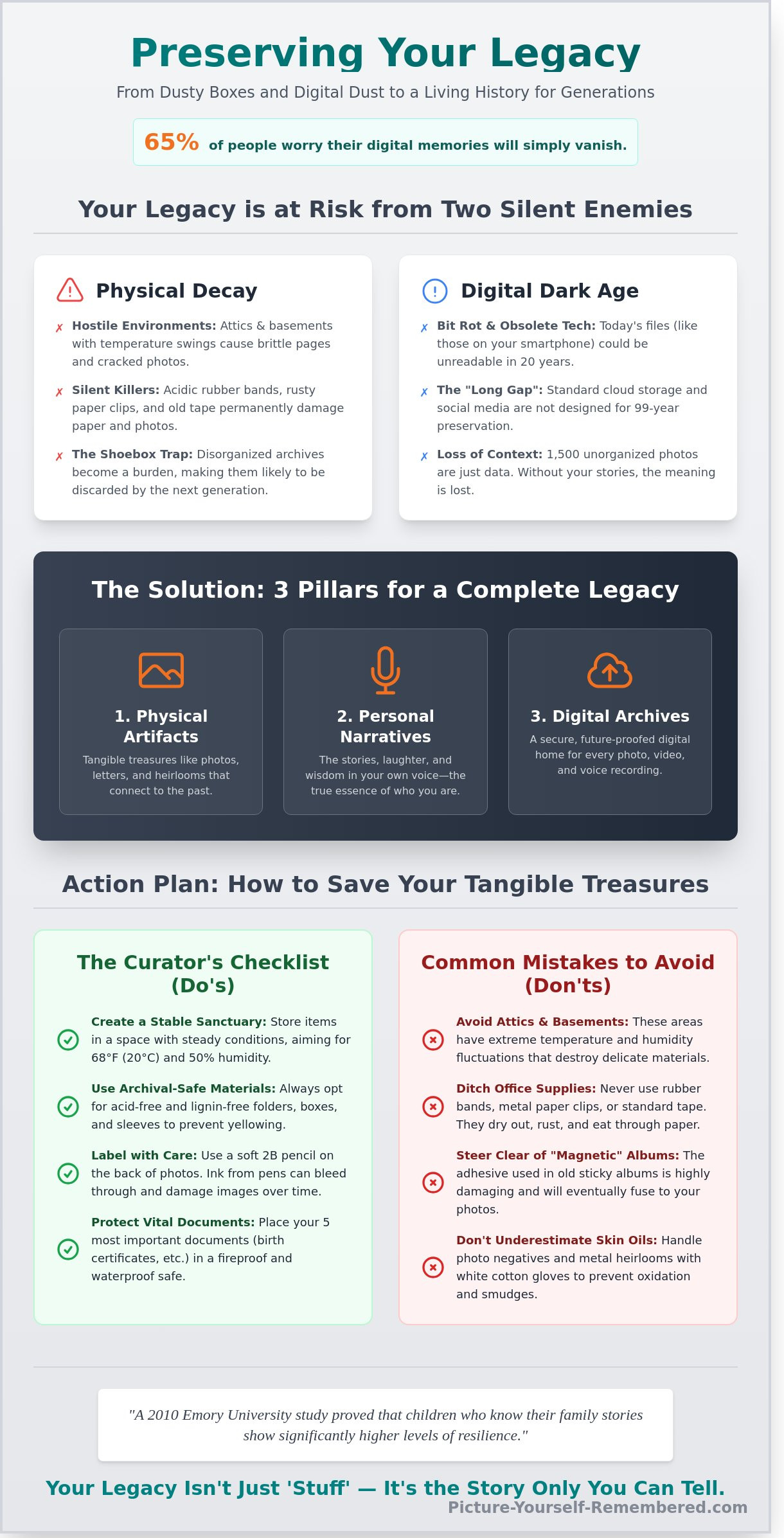
Preserving family history used to mean filing away dusty ledgers or staring at stiff, sepia-toned portraits. Today, it’s a much deeper practice. It’s less about when a person was born and more about the light they carried. We’ve moved beyond simple genealogy to focus on the essence of who we are. This process involves three vital pillars: your physical artifacts, your digital archives, and your personal narratives. Without all three, the picture remains incomplete.
Many of us are living on the edge of a digital dark age. Vint Cerf, a pioneer of the internet, warned in 2015 that our 21st-century lives could be lost to bit rot and obsolete software. If we aren’t intentional, the photos on your current smartphone might be unreadable in 20 years. Beyond the technical risk, there’s a profound emotional ROI. A 2010 study from Emory University proved that children who know their family stories show significantly higher levels of resilience. Knowing how an ancestor overcame a 1930s hardship gives a child the blueprint to handle their own modern challenges. Understanding the importance of family stories helps us recognize how these narratives become the foundation for emotional strength and identity.
The Difference Between Stuff and Stories
A nameless photo from 1945 is just a piece of fragile paper. However, a story transforms it into a sacred treasure. Your legacy isn’t found in the objects themselves, but in the Core Narrative they represent. What are the three values you want to be your signature? Focus on those. Actionable Tip: Pick one object on your shelf today. Use your phone to record a 60-second voice memo explaining why it matters. This tiny file is the start of your living history.
Why Traditional Methods Are Not Enough
Physical items are vulnerable to the elements. Fire, floods, or even a hectic move in 2024 can wipe out decades of memories in an afternoon. We often fall into the Shoebox Trap, where disorganized archives become a burden rather than a gift. When things are messy, the next generation is more likely to let them go. Let’s be honest; your grandkids probably won’t fight over your collection of souvenir spoons, but they’ll cherish the sound of your laugh for a century. We must organize with intention to ensure our stories survive the next 99 years.
The Physical Archive: How to Save Your Tangible Treasures
Think of yourself as the dedicated curator of your own museum. When it comes to preserving family history, the environment is your first line of defense. Many people mistakenly tuck cherished memories into attics or basements, but these spaces are often hostile to paper and film. Temperature fluctuations of 25 degrees or more in a single season cause delicate fibers to expand and contract, which leads to brittle pages and cracked emulsion. Aim for a steady environment of 68 degrees Fahrenheit and 50% humidity. If you wouldn’t want to spend a week living in your storage space, your photos shouldn’t either.
You must also guard against the “silent killers” found in most junk drawers. Rubber bands have a shorter lifespan than most New Year’s resolutions; they eventually dry out and melt into a crusty, acidic mess that ruins everything they touch. Similarly, metal paper clips leave permanent rust stains, and standard tape contains adhesives that eat through paper over time. When you handle these items, clean, dry hands are usually sufficient for paper. However, you should wear white cotton gloves for metal heirlooms or photo negatives to prevent skin oils from causing oxidation. For labeling, skip the ballpoint pen. Use a soft 2B pencil on the back of photos to ensure names aren’t lost to time without damaging the image.
Storing Paper and Photographs
Standard office supplies are often high in acid, which causes paper to yellow and crumble. It’s vital to use acid-free, lignin-free folders and boxes to house your narrative. Whatever you do, stay away from those “magnetic” sticky albums popular in 1975. The adhesive is incredibly damaging and will eventually fuse to your photos. As you organize, you can explore ways to curate your life story so these images tell a complete tale.
Actionable Tip: Place your 5 most vital documents, such as original birth certificates or marriage licenses, in a fireproof and waterproof safe rated for at least 30 minutes of heat protection.
Managing Heirlooms and Artifacts
Documenting 3D objects like jewelry or tools requires a creative touch. Take high-resolution photos of each item from 3 different angles to capture every detail. Create an “Inventory of Meaning” that describes why the item matters; a gold watch is just metal until you record that it was worn every day for 40 years by your great-grandfather. If an artifact is over 100 years old and showing signs of wear, consult a professional conservator. They have the specialized tools to stabilize your treasures without erasing the patina of time.
The Digital Shift: Future-Proofing Your Family Voices
Digital preservation isn’t a one-time chore you check off a list. It’s a living, breathing stewardship of your essence. Think of your digital files like a garden; if you don’t tend to them, the weeds of “bit rot” and obsolete formats will eventually overgrow your memories. While a photograph captures a silent moment, the sound of a loved one’s laughter or the specific lilt in their voice carries their soul across time. It’s the difference between seeing a map and actually visiting the home. When preserving family history, we must move beyond the physical and embrace a dynamic digital narrative.
Many of us have a “drawer of doom” filled with 2005-era USB sticks and scratched CDs. These formats aren’t permanent. Research from the Library of Congress suggests that recordable CDs can begin to fail in as little as 2 to 5 years depending on storage conditions. To ensure your story survives for 99 years, you must migrate files to secure cloud storage and keep them organized. Use a simple naming convention like “YYYY-MM-Event” (for example: 2024-06-Grandpa-Garden-Story). This ensures your great-grandchildren don’t have to guess what “IMG_842.jpg” represents. It also saves them from accidentally deleting a priceless memory while they’re looking for a video of a cat playing the piano.
Digitizing Old Media
You can scan photos at home using a flatbed scanner set to 600 DPI for high-quality results. If you have thousands of prints, professional bulk services can often process 1,000 photos in about 7 days. When transitioning VHS tapes or Super 8 film, always request MP4 files for the best compatibility. To keep these memories safe, follow the 3-2-1 backup rule. Keep 3 copies of your data, on 2 different media types, with 1 copy stored offsite. This simple habit is the best way to be preserving family history against fire, flood, or simple human error. For those with extensive photo collections, our comprehensive guide on digitizing old photos provides detailed instructions for preserving your cherished memories with affordable, step-by-step methods.
Capturing Oral Histories
Conducting a Legacy Interview is a beautiful way to honor a parent’s journey. Sit in a quiet room and let the conversation flow with a sense of gentle curiosity. Use evocative prompts such as, “What was the bravest thing you ever did?” or “What did home smell like when you were ten?” These sensory details breathe life into the past. For more guidance, explore our guide on interview questions for family history to help you capture the true heart and wisdom of their story.
Recording Your Legacy: A Step-by-Step Guide
Creating a digital heirloom is a sacred act of stewardship. It begins by finding a quiet, well-lit corner of your home where you feel completely at ease. This space should be your sanctuary; a place where you can breathe deeply and speak from the heart. Soft lighting and a comfortable chair can transform a simple room into a studio of reflection. You aren’t just making a video. You’re preserving family history for generations that haven’t even been born yet.
Before you press record, decide on the scope of your message. You might choose a broad life summary that captures your overall philosophy, or perhaps you prefer specific messages for future milestones. A 2023 study found that 91% of family members value hearing a loved one’s voice and seeing their expressions more than receiving any physical inheritance. Your presence is the gift. Keep your camera at eye level to create a sense of direct connection; nobody wants a view of your ceiling fan or your nostrils. Try to avoid recording in front of a mirror; unless you want your legacy to include a cameo of your cat cleaning itself in the background.
Authenticity is far more valuable than perfection. If you stumble over a word or shed a tear, keep going. Those moments of vulnerability are what your great-grandchildren will cherish most. Once you finish, ensure you use a platform that guarantees your message reaches its destination. Secure delivery is vital. Data from 2023 suggests that files stored with multi-redundant encryption have a 99.9% survival rate over a century, providing the peace of mind you deserve. For those ready to take this meaningful step, our comprehensive guide on recording messages for loved ones provides detailed instructions for creating a heartfelt digital legacy that bridges today with the next century.
What to Say When You Do Not Know What to Say
Focus on your essence rather than a dry list of dates. Share your favorite joke, the hardest lesson you ever learned, or your simplest wish for the future. You can also record messages for specific events like weddings or graduations. This ensures you’re there for the big moments, even if only in spirit. Actionable Tip: Write down three bullet points on a small card and place it near the camera lens. This keeps your thoughts focused without making you sound like you’re reading a script.
Technical Tips for Non-Techies
You don’t need a film crew to create something beautiful. Your smartphone is a powerful tool for preserving family history. Always turn your phone sideways to landscape mode; this ensures the video fills the screen properly. For lighting, simply face a window during the day. Natural light is the most flattering and requires zero equipment. Keep the tech simple so the focus remains on your story. You’re a storyteller, not a technician.
Ready to ensure your voice is heard for the next 99 years? Plan your legacy message today and give your family the gift of your story.
Securing the Future: The Digital Time Capsule Solution
The greatest hurdle in preserving family history isn’t the stories themselves; it’s the gap between generations. We call this “The Long Gap.” It’s the daunting 50 or 99 year stretch where a message must travel through time without getting lost. Most people assume their social media profiles or basic cloud drives will last forever. However, data from 2024 suggests that over 20 major social platforms have vanished since the early 2000s. If a platform disappears or a monthly subscription lapses, your cherished narrative could vanish with it. You need a sanctuary, not a temporary lease on a server.
A Secure Digital Vault acts as a guardian for your essence. It provides the quiet dignity of knowing your stewardship is complete. Unlike standard storage, this vault is designed for endurance. It ensures that the wisdom you share today doesn’t just sit in a folder; it moves with intention toward a specific date in the future. Think of it as an insurance policy against the day your great-grandchildren inevitably ask if people in 2024 really communicated through short dancing videos. It is a way to ensure your voice remains a clear, steady presence long after the digital noise of today has faded.
How a Digital Time Capsule Works
The beauty of this system lies in its simplicity and its strength. You can schedule a message for delivery at any point, from next month to 99 years into the future. This isn’t a public post; it’s a private, encrypted handoff. Your stories stay locked away, for your family’s eyes only, until the exact moment you’ve chosen for them to be revealed. You can learn more about the technical safeguards on our Picture Yourself Remembered How It Works page. Privacy is our highest priority, ensuring your vulnerability is met with absolute security.
Taking the First Step Today
The best time to capture a legacy is while the voices are still vibrant and the memories are fresh. Don’t wait for a “perfect” moment that may never arrive. Here is a simple, actionable tip: record a two-minute audio clip on your phone today. Talk about your favorite childhood smell or the best advice you ever received. Once you have that file, you can secure it instantly. We invite you to start a Basic Membership today, which allows you to protect one vital message for the next century.
- Reflect: Choose one story that defines your character.
- Record: Use your phone to capture the sound of your laughter and your words.
- Secure: Upload it to your vault and set a delivery date for a milestone year.
You are the bridge between the ancestors you remember and the descendants you will never meet. By acting now, you ensure that the bridge is made of stone, not sand. Your life is a masterpiece worth preserving with the utmost care and artistry.
Taking the First Step Toward Forever
Your life’s narrative is a masterpiece that deserves more than a dusty box in the attic or a forgotten folder on a crashed hard drive. By organizing your physical treasures in acid-free containers and digitizing your voice today, you ensure your essence remains vibrant for decades. Think of it as a gift to your great-grandchildren; they’ll finally have proof that your legendary “secret” lasagna recipe actually came from the back of a noodle box. Preserving family history isn’t just about the past; it’s about the connection you’re building with people you haven’t even met yet.
Stanley Poe founded Picture Yourself Remembered to bridge this generational gap, creating a sanctuary where your most cherished stories are protected. Our secure delivery protocols guarantee your messages reach their destination up to 99 years into the future. You don’t have to navigate this emotional journey alone. We provide a compassionate, secure environment to distill your life’s beauty into a lasting legacy. Through digital remembrance practices that preserve your essence for future generations, you can transform scattered memories into a curated narrative that bridges today with the next century. To understand the complete process and gain confidence in this meaningful step, explore how Picture Yourself Remembered works to protect your digital legacy with robust safeguards and secure delivery systems. Start your digital legacy today with a Basic Membership at Picture Yourself Remembered. Your story is ready to be told, and the future is waiting to listen.
Frequently Asked Questions
How do I start preserving my family history if I have way too much stuff?
Begin by selecting your “Golden 10 Percent,” which are the items that carry the most profound emotional weight and stories. Research from the Society of American Archivists suggests that focusing on high-value items prevents the decision fatigue that stops 45 percent of people from ever starting. Organize these treasures into three distinct categories: Keep, Share, and Research. This approach makes preserving family history feel like a gentle curation rather than a daunting chore. Think of yourself as the curator of a boutique museum rather than a professional hoarder of vintage Tupperware and mystery keys.
What is the best way to store old family photographs so they do not fade?
Place your cherished photographs in acid-free, lignin-free folders and store them in a dark environment where the temperature stays below 70 degrees Fahrenheit. The Library of Congress notes that high humidity and light are the primary enemies of physical prints, causing irreversible damage over a 20-year period. Avoid those “magnetic” adhesive albums from the 1980s, as the chemicals in the glue will eventually eat your memories. Using archival-grade boxes ensures your visual narrative remains vibrant and crisp for the next 99 years. For those ready to take the next step, learning about digitizing old photos with affordable methods can provide an additional layer of protection for your precious memories.
How can I record a video message that does not feel awkward or forced?
Focus on one specific cherished memory rather than trying to summarize your entire existence in a single sitting. Use the “15-minute rule” by keeping your initial sessions short to build a sense of comfort with the camera lens. Place your recording device at eye level and imagine you’re speaking directly to a 5-year-old version of your grandchild. This simple shift in perspective softens your expression and allows your natural essence to shine through without a stiff or formal vibe.
Will digital video files still be playable in 50 or 100 years?
Digital files are safest when you follow the “3-2-1 rule,” which involves keeping 3 copies, on 2 different types of media, with 1 copy stored off-site. While the .mp4 format is the current global standard, the Library of Congress recommends migrating your data every 7 to 10 years to stay ahead of hardware changes. By using a service designed for 99-year stewardship, you ensure your narrative survives the transition from current technology to future innovations. This proactive planning protects your legacy from becoming a collection of unreadable data.
What are some good questions to ask my parents for a family history interview?
Ask sensory and emotional questions like, “What was the specific smell of your grandmother’s kitchen in 1965?” or “Which song makes you feel most like yourself?” These prompts bypass the standard facts and tap into the heart of their lived experience. Aim for 5 to 7 deep questions per session to keep the energy high and the stories focused. For a comprehensive collection of prompts that unlock cherished narratives, explore our guide on essential interview questions for family history that help you bridge the gap between generations. These specific details are the golden threads that weave a rich tapestry when preserving family history for the next generation.
Is it better to write a memoir or record a video legacy?
Choose the medium that feels most like home to your personality, but remember that video captures 93 percent of communication through non-verbal cues like tone and gesture. A memoir is a beautiful way to share internal thoughts, while a video preserves the unique cadence of your voice and the sparkle in your eyes. Many families find that a short 10-minute video legacy provides a more visceral sense of presence than a 300-page book ever could. Both formats serve as a bridge, but video offers a direct window into your soul.
How do I ensure my digital messages are delivered to my family after I pass away?
Utilize a legacy notification service or a digital vault that uses a designated legacy contact to trigger the release of your files. According to a 2023 study on digital estates, 60 percent of families lose access to a loved one’s digital life because they lacked a clear succession plan. Set up your “Legacy Contact” on platforms like Apple or Google today to prevent your story from being locked away. This small action ensures your final words of love reach your family’s inbox exactly when they need that comfort.
Can I preserve family history on a budget without expensive equipment?
You can archive your history using a modern smartphone and free cloud storage services like Google Drive, which offers 15 gigabytes of space at no cost. Use natural window light for your video interviews and a free scanning app to digitize your physical prints with surprising clarity. You don’t need a 5,000 dollar camera setup to capture the beauty of a life well-lived. Your story’s true value comes from its honesty and heart, not from the price tag of the recording equipment.
