

What if the most precious inheritance you ever receive isn’t a piece of jewelry, but the sound of a loved one’s laughter as they recount a forgotten summer? We often feel a quiet ache when we realize how many chapters of our family’s story remain unread. You want to capture those memories before they fade, yet the thought of starting can feel overwhelming. Perhaps you’re worried about the tech or just don’t want to sound like a cold investigator. It’s completely normal to feel a bit of interview stage fright when the stakes are this high. By using the right family history interview questions, you can transform a simple chat into a sacred act of preservation.
This guide is your gentle companion. We’ll show you how to navigate the practical side of recording, including the basics of consent laws, while keeping the atmosphere warm and light. You’ll discover a curated list of 101 questions designed to uncover the beauty of a life well-lived. Don’t worry, you don’t need a degree in cinematography to create a digital heirloom; even your grandpa’s stories about walking uphill both ways in the snow deserve a high-quality home. Let’s explore how to turn these fleeting moments into a lasting legacy that your family will cherish for generations.
Key Takeaways
- Move beyond names and dates on a family tree to capture the living rhythm and wisdom of your relative’s unique life journey.
- Learn how to extend a gentle invitation and choose a sanctuary-like setting that makes your loved one feel safe and celebrated.
- Access a curated list of 101 family history interview questions that explore everything from childhood scents to the deep lessons of adulthood and love.
- Master the art of the “Golden Silence” and sensory prompts to help your relative unearth vivid memories they might have forgotten.
- Discover how to move your recordings from a risky hard drive to a secure digital vault, ensuring your family legacy doesn’t accidentally end up in the “lost sock” dimension of the internet.
What is a Family History Interview and Why Does It Matter?
A family history interview is a guided conversation designed to capture the unique life experiences and wisdom of a relative. While historians might use the formal term Oral History to describe this process, we see it as something much more intimate. It is a bridge between hearts. This process moves beyond the dry names and dates of a family tree, focusing instead on the living rhythm of a voice and the sparkle in an eye. By asking thoughtful family history interview questions, you transform a simple Sunday afternoon into the creation of a digital heirloom.
To better understand how these conversations can unfold and the impact they have, watch this helpful video:
Starting today is the greatest gift you can give your future self. Memories are beautiful but fragile; they can fade like old photographs left in the sun if we don’t take the time to anchor them. Capturing these stories now ensures that grandchildren yet to be born will know exactly who their ancestors were. They won’t just see names on a census record. They will know living, breathing people who laughed, struggled, and loved with all their might.
Connecting Generations Through Storytelling
Hearing a life story does more than just fill an afternoon. It builds deep resilience and a sense of identity in younger family members. When a child learns how their grandfather overcame a hardship, they realize that they come from a line of survivors. For the elderly, this process often serves as a form of reminiscence therapy. This is a gentle way of reflecting on one’s life to find meaning and peace. It turns distant ancestors into relatable, living characters. Think of it as a family superhero origin story, minus the questionable spandex and capes.
The Difference Between Genealogy and Legacy
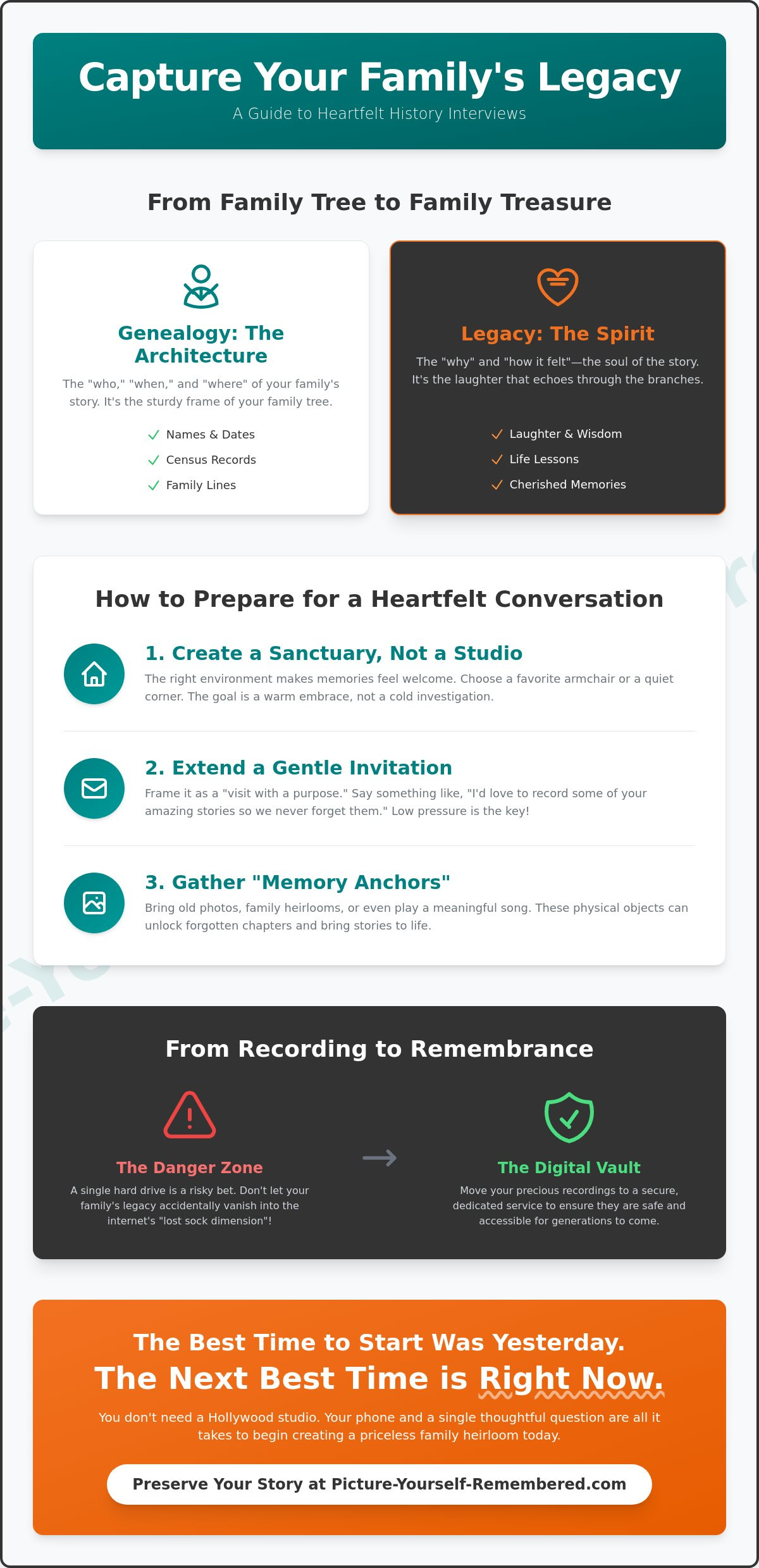
Genealogy is the architecture of your family, tracking the sturdy branches and deep roots. Legacy, however, is the sap and the spirit that keeps the tree alive. It’s the difference between knowing where someone was born and knowing how it felt to leave their home for the first time. While a written transcript is valuable, a video recording captures the pauses, the sighs, and the specific way a grandmother’s hands move when she describes her wedding day. Using targeted family history interview questions allows you to move beyond “where” and “when” to “how it felt” and “why it mattered.”
Actionable Tip: Don’t wait for the “perfect” camera or a professional studio. Grab your phone, find a quiet corner, and ask one simple question today. The best time to start was years ago, but the second best time is this very moment.
Preparing for a Heartfelt Conversation
Creating the right environment is the first step in honoring your loved one’s journey. Think of the setting as a sanctuary rather than a studio. You want a place where the air feels light and the memories feel welcome to surface. A favorite armchair, a sun-drenched kitchen table, or a quiet corner of the garden can all serve as the perfect backdrop. Avoid rooms with harsh fluorescent lighting or the constant hum of a refrigerator. The goal is to make the space feel like a warm embrace, allowing your relative to relax into their narrative without the pressure of “performing” for a lens.
When you extend the invitation, keep it gentle. Instead of asking for a formal interview, suggest a “visit with a purpose.” You might say, “I’ve always loved the way you tell stories about the old house, and I’d love to record a few of them so we never forget them.” This low-pressure approach helps dissolve any initial anxiety. If you’re worried about the structure, you can find a Step-by-Step Guide to Oral History to help you organize your thoughts, but remember that the most important element is your presence. Having a few family history interview questions tucked away in a notebook can act as a safety net, but let the conversation flow naturally.
To help the stories along, gather a few “memory anchors.” These are physical objects that bridge the gap between the present and the past. An old wedding photograph, a tattered recipe card, or even the scent of a specific spice can unlock vivid details that have been tucked away for decades. If the family cat decides to make a cameo by walking across the frame, don’t sweat it; sometimes the most authentic memories include a tail in the shot. Your goal isn’t a Hollywood production; it’s a masterpiece of connection.
Creating a Safe Space for Vulnerability
Before you press record, have a “pre-interview” chat over a cup of tea. This builds comfort and sets the stage for a deeper connection. Remind your relative that they are in control of the story. It’s perfectly okay to skip a question, pause for a long moment, or even shed a tear. These pauses aren’t “dead air”; they are the moments where the heart is speaking. Position your camera at eye level to capture the subtle expressions and the twinkle in their eye that a written transcript simply cannot convey.
Practical Tech Tips for Beginners
You don’t need expensive equipment to create a beautiful digital heirloom. A modern smartphone is often more than enough to capture high-quality video and audio. Place your phone on a steady surface or a simple tripod to avoid a shaky “found footage” look. Once the recording starts, practice the “silent listener” rule. This means nodding and smiling instead of saying “mm-hmm” or “wow,” which can clutter the audio later.
Actionable Tip: Use a simple lapel microphone if you have one, but if not, just ensure the room is free of background noise like fans or ticking clocks. Testing the audio for thirty seconds before you dive in can save you from the heartbreak of a silent recording. By taking these small steps, you are securing your own story and the stories of those you love with the care they deserve.
The Ultimate List of Family History Interview Questions
The heart of any legacy project lies in the depth of the inquiry. While names and birthdates provide the skeleton of a family story, these family history interview questions are designed to provide the flesh, the blood, and the soul. We want to move past the “what” and “where” to reach the “how” and “why.” When you sit down with your loved one, remember that you aren’t just checking boxes. You’re inviting them to walk through the hallways of their own memory, and that journey deserves a patient guide.
Childhood and Family Roots
Begin by grounding the conversation in the sensory details of the past. Ask, “What did the air smell like in your childhood home?” This might trigger memories of fresh-baked bread, coal smoke, or perhaps the scent of pine needles. Inquire about the legendary stories that were whispered at holiday gatherings or the secret nicknames siblings had for one another. You might ask, “Who did you think you would become when you were ten years old?” These questions help bridge the gap between the person sitting in front of you and the child they once were.
Actionable Tip: Ask your relative to describe the games they played that didn’t involve a screen. You’ll likely hear about elaborate “make-believe” worlds or street games that required nothing more than a ball and a bit of imagination. It’s a great way to highlight how much the world has changed while celebrating the timeless nature of play.
Adulthood, Love, and Resilience
As the conversation moves into adulthood, explore the pivotal moments of choice. Ask, “How did you know you were ready to build a life with someone?” or “What was a moment that tested your spirit, and how did you find your way back?” These stories of resilience are often the most valuable for future generations. They serve as a roadmap for navigating their own challenges. Don’t be afraid of the quiet moments that follow these questions; let the weight of their experience settle in the room. It’s in these pauses that the most honest reflections often emerge.
It is often fascinating to compare these historical accounts with how modern families are formed today. In an increasingly connected world, many new family chapters begin through international platforms where Asian dating credit packages allow people to find meaningful connections across borders, creating the very origin stories that will be archived by future generations of genealogists.
Lessons, Values, and the Human Spirit
This is where we distill the essence of a life. Ask about their proudest triumphs and even their greatest regrets with a spirit of compassion. You might ask, “What is the one truth you’ve learned that you want to pass on to your great-grandchildren?” This “Legacy Question” often yields the most profound insights. To keep things light, you can always ask if they really did walk five miles to school in the snow every day, or if it was actually only three miles and mostly flat. Humor is a vital part of any family history interview questions list, as it honors the joy that exists alongside the struggle. Finally, ask what they hope the future generations never forget about the family’s core values.
Mastering the Art of the Follow-Up
While having a curated list of family history interview questions is essential, the magic often happens in the spaces between the answers. The most profound stories rarely emerge on the first try; they require a patient, attentive listener who knows how to gently nudge the narrative forward. Think of yourself as a witness to their journey. Your role is to provide a safe harbor where memories can dock and unfold at their own pace without the pressure of a ticking clock.
One of the most powerful tools in your kit is the “Golden Silence.” After your relative finishes a sentence, resist the urge to jump in with the next question immediately. Count to five or even ten in your head. Often, this quiet pause allows them to reach deeper into their memory to share a detail they hadn’t thought of in years. If the conversation gets stuck on dry facts like dates or addresses, use sensory prompts to bring the story back to life. Instead of asking what year they moved, ask what the wood floor felt like under their feet or what the neighborhood sounded like on a Saturday morning.
Emotional moments are a natural part of this process. If your loved one becomes misty-eyed while sharing a difficult memory, meet them with quiet dignity. You don’t need to fix the sadness; your presence is enough. Have a box of tissues nearby and offer a gentle touch or a moment to pause the recording. These vulnerable chapters are often where the most significant life lessons are hidden, and they deserve to be treated with the utmost reverence.
Listening with Your Whole Heart
Your body language speaks as loudly as your words. Lean in, maintain soft eye contact, and use the “Tell me more about…” technique to expand on brief answers. This simple phrase is far more effective than a standard follow-up because it invites elaboration without feeling like an interrogation. Validate their journey by acknowledging the courage it took to live through their experiences. Remember to keep the focus on them; this isn’t the time to share your own similar stories, unless it serves to build a bridge of comfort.
What to Do if They Get Shy
If your relative becomes self-conscious or “forgets” how to tell a story once the camera is rolling, use old photographs as a third party. Looking at a picture together shifts the focus away from the lens and back to the memory. You can also prime the storytelling pump by sharing a brief, joyful memory you have of them. Knowing when to end the session is just as important as knowing how to start. It’s always better to have three short, joyful talks than one long, exhausting marathon. Finding that one specific photo in a shoebox can sometimes feel like a professional archaeological dig, but the payoff is worth the dust. Once you’ve captured these precious moments, you can begin the process of securing your family’s video legacy for the long term.
Actionable Tip: Keep a small notepad handy during the interview. If they mention a name or a place you want to revisit later, jot it down quietly so you don’t interrupt their current flow. This allows you to circle back to those details once the main story has been told.
From Recording to Remembrance: Safeguarding the Story
You’ve done the beautiful, soul-stirring work. You’ve sat in the quiet light of a shared afternoon, asked the right family history interview questions, and witnessed the unfolding of a loved one’s journey. But once the recording ends, a new responsibility begins. Many people make the mistake of leaving these precious files on a laptop or a thumb drive tucked away in a junk drawer. This is the tragedy of the “lost hard drive.” Digital files are fragile; they can be corrupted, lost, or simply forgotten as technology evolves. Leaving your legacy on a piece of aging hardware is like writing your family’s history in the sand right before the tide comes in.
To truly honor the stories you’ve gathered, you must think beyond the present moment. Local storage isn’t enough for a legacy meant to last a lifetime. Instead, consider the peace of mind that comes from a digital vault designed for endurance. By using Video Message Storage, you ensure that these voices are not just saved, but protected in a sanctuary that understands the weight of a century. You can even use a Scheduled Delivery System to ensure a specific story reaches a grandchild on their wedding day or a child on a milestone birthday years from now. It’s like being a time traveler, but without the confusing paradoxes or the need for a dusty, unreliable DeLorean.
The 99-Year Vision for Your Family History
Truly preserving family history requires a specialized approach that bridges the gap between today and the 22nd century. Standard cloud services often delete accounts after a period of inactivity, which is the last thing you want for a permanent family heirloom. A 99-year vision treats your family’s history as a masterpiece worth guarding with the utmost intentionality. When you secure these recordings in a dedicated vault, you aren’t just saving data; you’re securing the essence of a person’s spirit for generations you may never meet.
Next Steps: Starting Your Legacy Today
Now is the time to take agency over your narrative before the opportunity fades into the background of a busy life. Start by organizing your interview clips into meaningful themes, such as “Childhood Wisdom” or “Lessons in Love.” This makes the content more accessible and impactful for those who will watch it later. Don’t let the fear of technical perfection stop you from finishing the journey you started with your family history interview questions. The most important step is simply ensuring the story has a safe place to live. If you’re ready to secure your family’s voice and ensure their light never dims, explore our Basic Membership options to begin your preservation journey today. Your future family will thank you for the foresight and the love you’ve woven into this digital heirloom.
Actionable Tip: Once you’ve uploaded your videos, create a simple “legacy map” for your family. Tell them where the messages are stored and how they can access them. A legacy is only powerful if the people who need it know where to find it.
Honoring the Past by Securing the Future
You now have the tools to transform a simple visit into a sacred act of remembrance. By using our list of family history interview questions and mastering the art of the follow-up, you’ve taken the first step in witnessing a soul’s journey. Remember that the environment you create is just as important as the questions you ask. A comfortable chair and a listening heart are the true keys to unlocking those hidden chapters of your family’s story.
The final piece of the puzzle is ensuring these memories don’t accidentally vanish into the digital abyss of a broken hard drive. Stanley Poe founded our community to bridge generational gaps, providing a secure digital vault that protects your essence. With our scheduled delivery system, you can send messages up to 99 years into the future, ensuring your voice reaches your descendants even if they’ve finally traded their minivans for teleportation pods. It’s time to secure your family’s voice for the next 99 years with Picture-Yourself-Remembered™. Your story is a masterpiece; let’s make sure it’s preserved with the care and artistry it deserves.
Frequently Asked Questions
What is the best way to record a family history interview?
The best way is to use a high-quality smartphone or tablet mounted on a stable tripod to ensure a steady, professional look. While audio is the most critical element, capturing the visual nuances of a loved one’s expression adds a layer of depth that audio-only recordings lack. Make sure you are in a quiet room with soft, natural lighting. Testing your setup for a few minutes before the real talk begins can save you from the heartbreak of a silent or blurry masterpiece.
How many questions should I ask in one sitting?
Aim for about 5 to 10 meaningful questions per session to avoid overwhelming your relative. It’s better to have several short, vibrant conversations than one long marathon that leaves everyone exhausted. Pay close attention to their energy levels; if they start to flag, it’s time to pause. Remember, you aren’t trying to win a speed-dating record for genealogy. Quality always triumphs over quantity when you’re exploring deep family history interview questions.
What if my relative doesn’t think their life is interesting enough to record?
Remind them that the “ordinary” details of their daily life are exactly what future generations will find most fascinating. Explain that you aren’t looking for a list of world-changing achievements, but rather the small, beautiful rhythms of their personal journey. Share a specific memory you have of them to show how much their influence has already shaped your own life. Sometimes a little bit of sincere flattery is the best key to unlocking a closed door.
How do I ensure the video quality is good enough for future generations?
Ensure your device is recording in at least 1080p resolution and that the light source is in front of your subject, not behind them. Avoid “backlighting,” which turns your loved one into a mysterious silhouette from a witness protection program. Keep the camera at eye level and use a simple external microphone if possible. These small technical adjustments ensure that your digital heirloom remains clear and vibrant as the decades pass.
Where should I store the video so it doesn’t get lost in 20 or 50 years?
Storing your video in a dedicated, long-term digital vault is the most reliable way to safeguard it for the next 50 years or more. Local hard drives and basic cloud services often fail or expire, but specialized Video Message Storage is designed for endurance. This approach ensures that your hard work isn’t lost to a spilled cup of coffee or a forgotten password. It provides a permanent home for the answers to your family history interview questions.
Can I interview a family member remotely over a video call?
Yes, you can conduct a remote interview using video conferencing tools that have a built-in recording feature. While the intimacy of an in-person visit is special, remote calls allow you to connect across great distances. Just make sure both parties have a stable internet connection to avoid the dreaded “frozen face” mid-story. You can still use sensory prompts to help them feel present in the conversation, even if you’re miles apart.
What are some good ‘icebreaker’ questions for a shy grandparent?
Start with light, sensory memories like “What was your favorite meal that your mother used to cook?” or “What was the name of your first pet?” These low-pressure questions are easy to answer and naturally lead into deeper storytelling. Avoid jumping into heavy topics like “What is your greatest regret?” within the first five minutes. Give them time to warm up to the camera’s presence, much like a cat deciding if a new cardboard box is safe to enter.
Should I prepare a script or keep the interview spontaneous?
The most successful interviews use a “guided spontaneity” approach, where you have a list of questions ready but allow the conversation to wander. A rigid script can make the talk feel like a stiff corporate deposition, while no plan at all might lead to aimless rambling. Use your prepared questions as a roadmap, but don’t be afraid to take a scenic detour if they share an unexpected, sparkling memory. This balance keeps the talk feeling natural and heartfelt.
