

What if the most powerful medicine you could offer isn’t found in a pharmacy, but in the simple, quiet act of listening? When a terminal diagnosis enters the room, it often brings a heavy silence that makes even the most confident person feel paralyzed. You want to be a pillar of strength, yet you might feel unsure of how to help a loved one record their life story without it feeling heavy or awkward. It’s a delicate dance; honestly, most of us feel like we have two left feet and are wearing lead boots during these moments.
We understand that deep desire to do more than just “check in” or offer vague platitudes. This guide will help you move past the anxiety of “what do I say” and provide meaningful, legacy-focused support that honors their unique journey. We will walk through practical ways to help with daily needs, strategies for finding confidence in emotional conversations, and methods to celebrate their essence while they are still here to share it. Think of this as your roadmap to becoming a steady, compassionate presence, even if your current version of “support” mostly involves aggressively fluffing pillows that were already perfectly fine.
Key Takeaways
- Learn to navigate the heavy silence with quiet dignity by choosing honesty and warmth over the urge to look away from the diagnosis.
- Understand why witnessing a person’s life is more healing than trying to fix their condition, a shift that transforms fear into meaningful presence.
- Gain practical, low-pressure strategies on how to help a loved one record their life story through collaborative legacy projects that celebrate their journey.
- Discover how to use secure video message storage to preserve the light of their influence for 99 years, ensuring their voice resonates for generations to come.
- Master the “no-ask” method of practical help, showing up as a steady guide rather than a manager, and proving you can be helpful without asking where the extra trash bags are every five minutes.
The First Step: Navigating the Silence with Quiet Dignity
When the word “terminal” enters a conversation, the air in the room often feels like it’s been replaced with something much heavier. It’s completely natural for your brain to freeze. Psychologists often point out that our fight-or-flight response kicks in, but when there’s nothing to fight and nowhere to run, we simply go silent. This silence isn’t a sign that you don’t care; it’s a sign that you’re human. The first step toward learning how to help a loved one record their life story isn’t finding the perfect opening line, but rather acknowledging the elephant in the room with a gentle, honest heart.
To better understand this concept, watch this helpful video:
Accepting the Awkwardness
Trying to find the “right” thing to say in these moments is a lot like trying to fold a fitted sheet. You start with good intentions, but you usually end up frustrated, confused, and eventually just rolling the whole thing into a ball and shoving it in a closet. It’s okay to be clumsy. In fact, saying, “I honestly don’t know what to say right now, but I’m so glad to be here with you,” is often the most profound thing a person can hear. Your presence is the masterpiece, not your vocabulary.
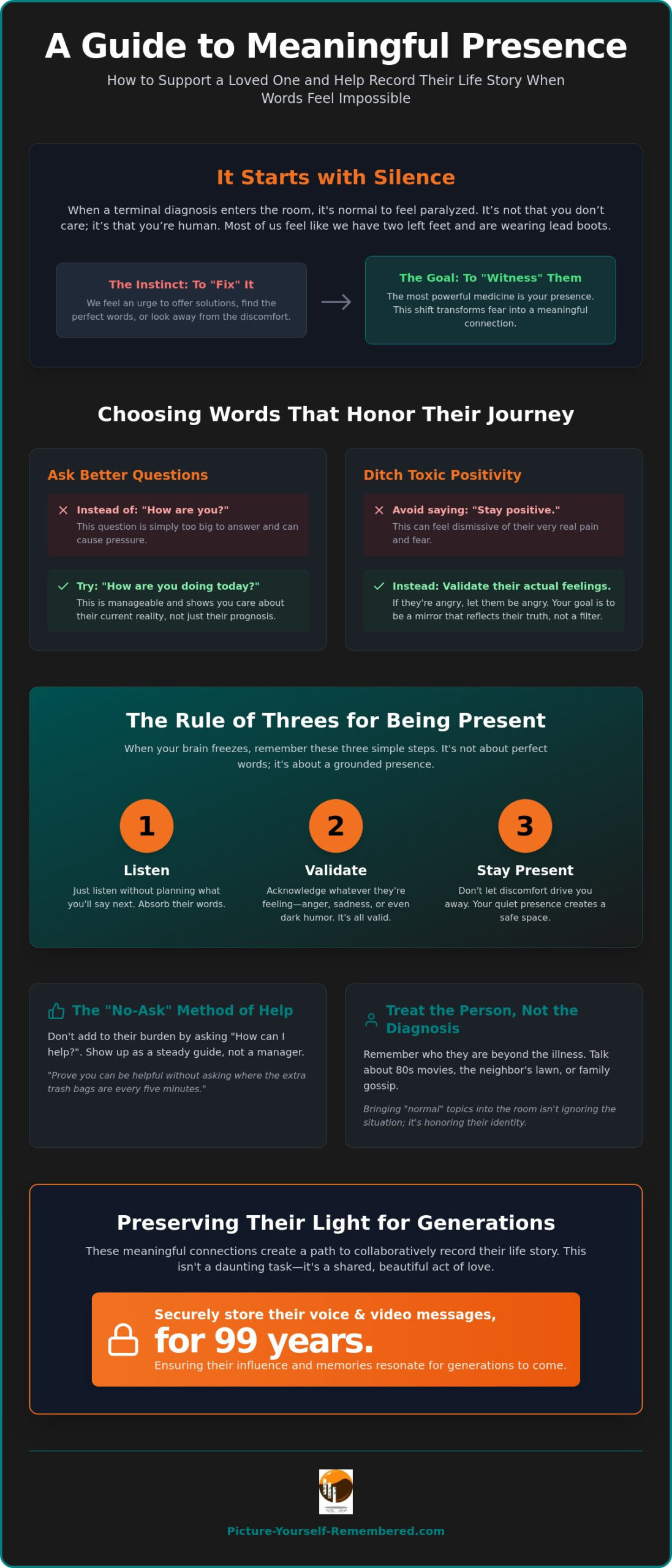
When you feel that familiar “brain freeze” coming on, try the Rule of Threes. First, just listen without planning your next sentence. Second, validate whatever they’re feeling, whether it’s anger, sadness, or even a sudden urge to talk about the weather. Third, stay present. Don’t let the discomfort drive you out of the room. This groundedness creates a safe space where the idea of how to help a loved one record their life story can eventually grow from a daunting task into a shared, beautiful act of love.
Treating the Person, Not the Diagnosis
It’s easy to accidentally turn a loved one into a “patient” the moment a diagnosis is shared. We start focusing on end-of-life care and medical updates, but what they often need most is to simply feel like themselves. They are still the person who loves 80s movies, has strong opinions about the neighbor’s lawn, and knows all the family gossip. Bringing these “normal” topics into the room isn’t ignoring the situation; it’s honoring their identity beyond the illness.
A simple way to navigate this is by asking permission before diving into medical talk. You might say, “I’d love to hear how your appointment went, but only if you feel like talking about it. Otherwise, did you see what happened on that show last night?” This gives them the agency to decide how they want to be seen in that moment. By treating them as a whole person, you’re not just providing support; you’re safeguarding the essence of who they are, which is the very thing you’ll eventually want to capture and celebrate.
Choosing Words That Honor Their Journey
Words are the threads we use to weave our connections. When someone is facing a terminal diagnosis, those threads can feel frayed or dangerously thin. We often default to the standard “How are you?”, but for someone in the midst of a significant life transition, that question is simply too big to answer. It asks them to summarize their entire existence, medical status, and emotional state in a single breath. Instead, try asking, “How are you doing today?” or even “How are you doing in this moment?” These smaller questions are manageable. They signal that you’re interested in their current reality, not just their prognosis.
It’s also vital to sidestep the trap of toxic positivity. Telling someone “everything will be fine” or “you just need to stay positive” can feel dismissive of their very real pain. In these moments, “fine” is usually just the universal code for “I’m currently falling apart but don’t have the energy to explain the physics of it to you.” Validating their anger, fear, or even their dark humor is a much higher form of love. If they’re angry, let them be angry. If they’re cracking jokes about their hospital gown, laugh with them. Your goal is to be a mirror that reflects their truth, not a filter that tries to brighten it.
Phrases That Build Bridges
Connection often thrives in the space between the notes. “I love you” is a phrase that never loses its luster, but “Tell me more about…” is a powerful tool for those wondering how to help a loved one record their life story. This simple prompt invites them to take the lead. It transforms a medical report into a narrative. Learning how to capture and preserve stories is often about mastering the art of the pause. Don’t be afraid of silence. Sometimes, the most profound things are said just after you’ve resisted the urge to fill the quiet.
What to Avoid Saying
While intentions are usually good, certain clichés can unintentionally create distance. Phrases like “God has a plan” or “everything happens for a reason” can backfire if they don’t align with the person’s own beliefs. Similarly, be cautious with battle metaphors. Not everyone feels like they’re “fighting a war” or “losing a battle.” For many, the journey is about finding peace and dignity, not combat. Avoid the urge to share stories about other people’s illnesses; this is their unique path, and they deserve the full focus of your presence.
If you’re looking for a gentle way to transition into these deeper conversations, you might suggest starting a small legacy project. Capturing these memories doesn’t have to be a formal or exhausting interview process. It can be as simple as recording a few video messages that capture the sound of their laughter and the wisdom of their experiences. When you focus on how to help a loved one record their life story, you’re helping them reclaim their narrative from the diagnosis and ensuring their essence remains vivid for years to come.
Moving from ‘Fixing’ to ‘Witnessing’
We naturally want to fix things. It’s in our DNA. If a faucet leaks, we grab a wrench; if a computer freezes, we try the old “turn it off and on again” trick. When a loved one receives a terminal diagnosis, that “fixer-upper” instinct often goes into overdrive. You might feel like you’re giving up if you aren’t constantly researching new clinical trials or suggesting the latest alternative therapies. However, there comes a point where the drive to fix can actually create a wall between you. Witnessing a life, rather than trying to repair it, is the highest form of support you can offer. It’s about saying, “I see you, I honor you, and I am here for all of it.”
Helplessness is a heavy cloak to wear, and it’s easy to become overbearing when we’re trying to feel useful. The key is to balance hope for the present with a quiet, steady preparation for the legacy they’ll leave behind. This isn’t a betrayal of hope. It’s a way of ensuring that their essence isn’t lost in the noise of medical updates. Honestly, your loved one probably has enough doctors; what they really need is a witness to the person they’ve always been, even if that person is currently a little grumpier than usual because of the hospital’s questionable choice in wallpaper.
The Art of Holding Space
Holding space is the practice of being a non-judgmental container for someone else’s emotions. It means allowing them to lead the conversation on their own terms. To do this effectively, consider these small but powerful shifts:
- Release the agenda: Don’t enter the room with a list of things you think they “should” talk about.
- Validate the messy stuff: If they’re angry or grieving, don’t try to talk them out of it. Just be there.
- Protect their identity: Remind them they are still a parent, a friend, or a gardener. They need breaks from being “the patient.”
Addressing the Fear of the Future
Approaching the topic of “what comes next” requires a soft, intentional touch. It’s okay to be sad and scared together. In fact, admitting your own fears can often give them the permission they need to share theirs. When the conversation shifts toward the future, try to focus on the “light” of their influence. This is where the practical side of legacy comes in. When you look at how to help a loved one record their life story, you’re helping them take agency over their own narrative. To make this feel less like a task and more like a celebration, you can follow specific steps for starting the interview process. These tools help keep the focus on their values and memories, ensuring the conversation stays grounded in the beauty of their journey rather than the clinical details of their diagnosis.
Practical Acts of Love: How to Help a Loved One Record Their Life Story
When someone you love is navigating a terminal diagnosis, the desire to help is often overwhelming, yet we frequently stumble over the execution. We say, “Let me know what I can do,” which actually hands the person a new job: managing you. Instead, embrace the “No-Ask” method. This means taking care of the laundry, running to the grocery store, or organizing a rotating meal schedule without requiring them to make a single decision. If one more well-meaning neighbor brings over a lukewarm tuna casserole without a label, your loved one might just lose it. Taking over the “Information Chain” by updating friends and family also preserves their precious energy for more meaningful things.
When you are looking for ways how to help a loved one record their life story, start by clearing the path of these daily distractions. By handling the mundane chores, you create a sanctuary where storytelling can actually happen. You can transform the daunting concept of “legacy” into a shared, celebratory activity. Encourage them to create a video legacy that captures not just facts, but the unique rhythm of their voice and the twinkle in their eyes when they tell a favorite joke.
The Tangible Help Checklist
Practical support often looks like the things that go unnoticed when they are done well. Helping with digital organization is a profound act of service in our modern world. This might include sorting through old digital photos, organizing passwords, or simply backing up precious memories. You are essentially acting as a curator for their history. In this light, preserving family history becomes a deeply practical act of love that ensures their influence remains a steady presence for future generations.
Starting the Storytelling Process
To begin the narrative journey, use gentle prompts rather than broad questions. Instead of “Tell me about your life,” try “What was the first car you ever owned?” or “Who was the teacher who changed everything for you?” These specific questions act like keys that unlock vast rooms of memory. Hearing their voice is a gift that will be cherished long after today. If you’re unsure where to start, you can help them record a video message that feels as natural and warm as a kitchen-table conversation.
Taking agency over one’s own narrative is a powerful way to reclaim a sense of self during a difficult time. To provide a secure and lasting home for these stories, consider setting up video message storage that ensures their wisdom is delivered to the right hands at the right time.
Preserving the Essence: How Picture-Yourself-Remembered Bridges the Gap
Supporting someone through a terminal diagnosis is often about the quiet, tender moments in the present, but it is also about the echoes they will leave in the future. We have talked about the importance of listening and the value of practical chores, but there is a final, vital piece to this journey: ensuring their voice doesn’t fade with time. Picture-Yourself-Remembered serves as a sanctuary for this very purpose. It is a place where the sound of a laugh, the cadence of a favorite story, and the warmth of a simple “I love you” are held in a secure vault, ready to be delivered exactly when they are needed most.
One of the most beautiful aspects of this process is the “99-Year Promise.” Through our Scheduled Delivery System, messages can be set to arrive decades into the future. Imagine a grandchild receiving a video message from a grandparent they never met, hearing firsthand about the family’s history or receiving a blessing on their wedding day. This isn’t just about digital storage; it’s about staying present in the lives of those we love. By choosing digital remembrance, you are helping your loved one bridge the gap between today and a future they will still influence.
A Journey into Digital Legacy
Founded by Stanley Poe, Picture-Yourself-Remembered was born from a deep desire to bridge generational gaps and preserve the light of a person’s influence. It transforms the often-scary process of “saying goodbye” into a structured, celebratory act of love. When you explore how to help a loved one record their life story, having a clear framework makes all the difference. A Basic Membership provides that necessary structure, turning a vague intention into a concrete legacy project. It’s a bit like a gym membership for your soul, except there’s no heavy lifting and you don’t have to worry about anyone judging your choice of sweatpants. Knowing that these stories are archived in a secure digital vault brings a profound sense of peace to everyone involved.
Taking Agency Over the Narrative
There is a quiet, steady power in taking charge of how your story is told. It is a way to reclaim agency when so much else in life feels out of control. We encourage you to help your loved one take this step today. Don’t wait for the “perfect” moment to start; the perfect moment is simply the one where you are together. Help them record their first message, perhaps something simple for a date far in the future. The emotional relief of saying what needs to be said is a gift that provides comfort now and endurance later. By focusing on how to help a loved one record their life story, you aren’t just preserving the past; you’re illuminating the future. Take agency over your narrative today and ensure your masterpiece is preserved for the generations to come.
A Living Legacy: Your Presence as a Masterpiece
Supporting a loved one through a terminal diagnosis is one of the most profound roles you’ll ever play. It’s about shifting from the urge to “fix” toward the grace of simply “witnessing.” By choosing words that honor their daily reality and offering practical help that doesn’t require them to manage you, you create a safe space for them to simply be. You’ve learned that your presence is the greatest gift, and that finding how to help a loved one record their life story is a beautiful way to celebrate the light they bring to the world. Honestly, even if you still can’t fold that fitted sheet we mentioned earlier, your willingness to stay in the room is what matters most.
Now is the time to ensure those stories have a permanent home. Our compassionate, founder-led service provides a secure vault where video messages can be archived for up to 99 years, allowing you to celebrate a life’s journey through scheduled delivery. Begin your legacy journey with a Basic Membership today and give your family the enduring gift of hearing their voice again. You have the power to turn this transition into a masterpiece of connection that spans generations. Trust in the beauty of the story you are helping to preserve.
Frequently Asked Questions
What is the best thing to say to someone who just got a terminal diagnosis?
The best thing to say is simply the truth of your presence. You don’t need a poetic script; saying “I don’t have the right words, but I love you and I’m not going anywhere” is incredibly powerful. It acknowledges the gravity of the news without trying to “fix” it. Most people just want to know they won’t be abandoned in the silence that follows a diagnosis. Your honesty creates a safe space for their truth.
How can I help someone with a terminal illness without being annoying?
You can help most effectively by taking action without asking for permission or direction. Instead of saying “Let me know if you need anything,” try “I’m heading to the grocery store, what are three things I can pick up for you?” or “I’m coming over to mow the lawn on Tuesday.” This removes the burden of decision-making from them, which is a huge relief when their mental energy is low.
Is it okay to cry in front of someone who is terminally ill?
It is absolutely okay to show emotion, as it validates the weight of what you are both experiencing. Crying together can be a profound moment of connection and honesty. However, try to ensure they don’t feel the need to comfort you. If you find yourself becoming the one who needs care, it’s okay to step out for a moment, take a breath, and return when you can be a steady presence again.
How do I start a conversation about leaving a legacy or recording messages?
Start by expressing how much their specific stories and voice mean to you. You might say, “I’ve always loved the way you tell the story of your first job, and I’d love to find a way to preserve that for the kids.” When you focus on how to help a loved one record their life story, it should feel like an invitation to share a gift rather than a chore on a checklist.
What are some practical chores I can do for a family dealing with a serious illness?
Practical help often looks like the mundane tasks that keep a household running. You could offer to handle the laundry, walk the dog, or manage the information chain by sending out updates to friends. Even better, organize a rotating meal schedule so they don’t have to think about dinner. If you can do the dishes without asking where the soap is, you’ve officially reached supportive superhero status.
How do I handle my own caregiver burnout while supporting a friend?
You cannot pour from an empty cup, so prioritize your own rest and emotional health. Set specific “off-duty” times where you step away from the situation to recharge. It’s also helpful to have your own person to talk to, whether that’s a friend or a professional, who isn’t directly involved in the situation. Remember that being a steady presence requires you to be well enough to stand on your own feet.
What if the person doesn’t want to talk about their diagnosis at all?
If they choose not to discuss the illness, respect that boundary completely. Sometimes, the best support is providing a “diagnosis-free zone” where you talk about sports, movies, or neighborhood gossip. They need to feel like themselves, not just a patient. By following their lead, you show that you value their personhood above their medical status. Your presence alone is a powerful form of witnessing their life and honoring their journey.
How can digital tools help in the grieving and remembrance process?
Digital tools allow us to bridge the gap between the present and the future. By using secure video message storage, you can ensure that their wisdom and laughter are preserved for generations. These tools transform the fear of being forgotten into the peace of knowing a legacy is safe. It gives family members a way to hear their voice again on significant days, and learning how to help a loved one record their life story becomes a lasting comfort.
