
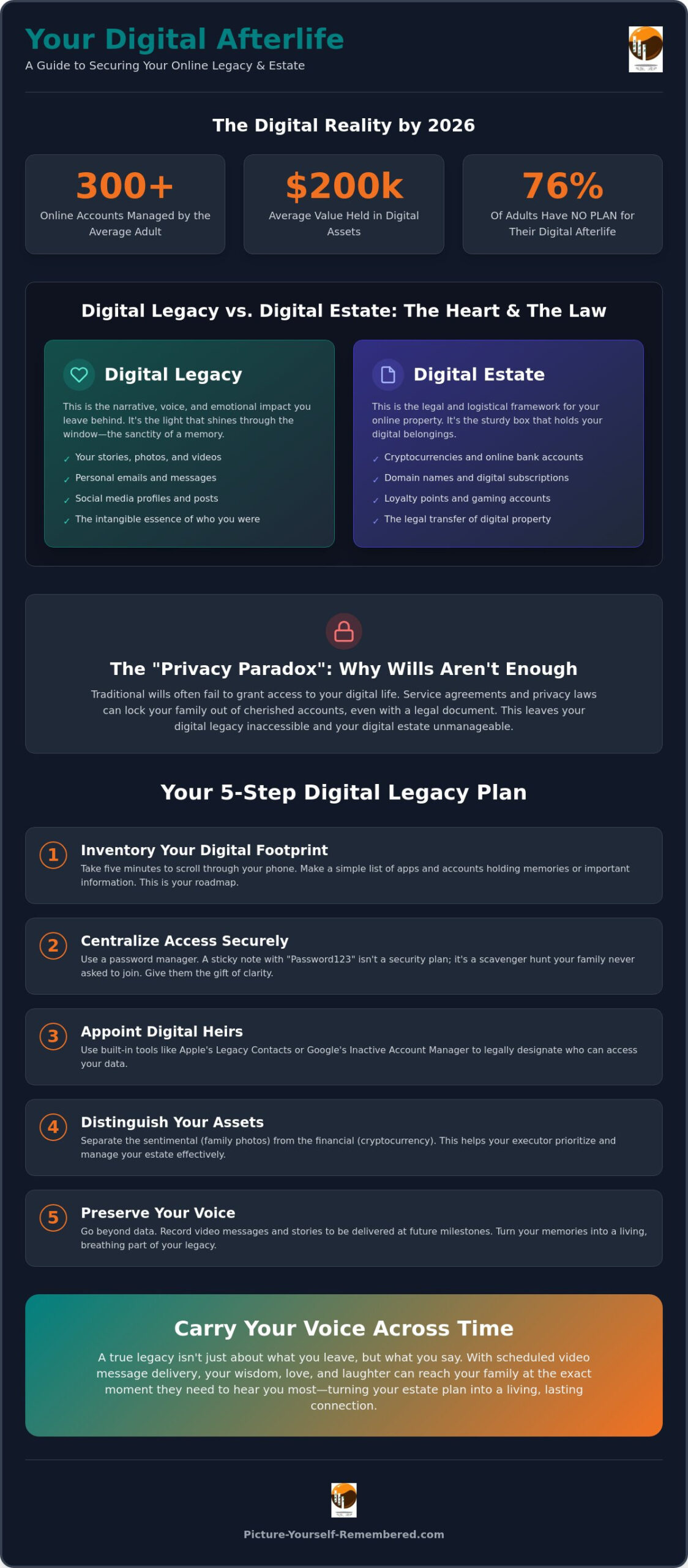
Did you know the average adult in 2026 manages over 300 distinct online accounts, holding nearly $200,000 in digital value? It’s a staggering amount of life lived behind a screen, yet 76% of us have no plan for what happens to those accounts when we’re gone. It’s easy to feel overwhelmed by the sheer volume of passwords and cloud folders we leave behind. You likely want your family to have your photos, but the thought of legal red tape feels a bit like trying to teach a cat to knit. Understanding the nuances of a digital legacy vs digital estate is the first step in turning that technological clutter into a meaningful inheritance.
You deserve the peace of mind that comes with knowing your messages will be delivered and your stories will endure. In this guide, you’ll learn the vital difference between managing your data and preserving your soul, with a practical roadmap to securing your digital footprint for generations. We’ll look at how to navigate modern laws like RUFADAA and platform tools like Apple’s Legacy Contacts while keeping the focus on the beautiful life you’ve built. By the end, you’ll have a simple, non-technical plan to ensure your essence is never forgotten.
Key Takeaways
- Recognize that your digital footprint acts as a modern breadcrumb trail, carefully preserving the stories and moments that define your unique journey.
- Distinguish between a digital legacy vs digital estate to ensure your legal assets are managed while your emotional essence remains beautifully intact.
- Uncover the “Privacy Paradox” and learn why a traditional will might not be enough to grant your loved ones access to your most cherished cloud accounts.
- Secure your footprint with five practical steps that provide a gift of clarity for your family, even if your current password choices lack a bit of creative flair.
- Explore how video message storage and a scheduled delivery system can carry your voice across time, reaching your family at the exact moment they need it most.
Defining the Digital Footprint: What Counts as a Digital Asset?
Think of your digital footprint as the modern version of a breadcrumb trail, leading back to the very heart of your life story. A digital asset is simply any piece of information or content you own or control in the digital world. While you can’t physically hold a JPEG or an email, these items carry the profound weight of your personal history. Understanding the balance between your digital legacy vs digital estate begins with identifying what you’re actually leaving behind. Digital assets are the modern equivalent of an attic trunk, filled with letters and photos, but stored in the cloud.
Grasping the scope of Digital inheritance is essential for anyone looking to bridge the gap between their daily online habits and their lasting influence. It’s about recognizing that your presence online isn’t just data; it’s a reflection of your soul’s journey in a connected age.
To help visualize how these tools work within your life story, watch this helpful video:
From Cryptocurrencies to Cloud Photos
The variety of what we leave behind is vast, ranging from social media profiles and personal domain names to thousands of cloud-stored media files. It’s helpful to view these assets in two ways. Some have market value, like cryptocurrency. Others have intrinsic, sentimental value, like family photos. You don’t need a tech-heavy lifestyle to have a meaningful digital estate. Even a small collection of emails can be a treasure for those you love.
The Invisible Assets You Might Overlook
Many of us forget about “invisible” assets that heirs might need to manage. These include loyalty points, gaming accounts, or online subscriptions. They also include intellectual property like personal blogs, secret family recipes saved in an app, or digital journals. Let’s be honest, your heirs will probably be grateful for the recipes but might wonder why you have 14 different streaming subscriptions for “research.” When we weigh the value of a digital legacy vs digital estate, we see that the “stuff” matters because of the memories it holds.
Actionable Tip: Take five minutes today to scroll through your phone. Note which apps hold memories or information you’d hate to lose. This simple list is the beginning of your roadmap to clarity.
Digital Legacy vs. Digital Estate: The Heart and the Law
When we explore the difference between a digital legacy vs digital estate, we’re really looking at the difference between the structure of a life and its substance. A digital estate is the legal and logistical framework for your online accounts. It’s the sturdy box that holds your belongings, ensuring that your digital property is accounted for. In contrast, your digital legacy is the narrative, the voice, and the emotional impact you leave behind. It’s the light that shines through the window long after the sun has set. One is about the safety of a bank account; the other is about the sanctity of a memory. Essentially, preserving family history is the bridge between these two concepts, turning cold data into a warm, lasting connection.
The Digital Estate: Managing the Logistics
This side of the coin is all about the “how-to.” It involves account access, password management, and the legal transfer of ownership. Managing these financial and business assets is vital for preventing identity theft, which can be a distressing burden for grieving families to navigate. A standard will often misses these digital details, leaving heirs locked out of important accounts.
Actionable tip: Use a secure password manager rather than a notebook or a sticky note hidden under your keyboard. Let’s be honest, “Password123” written on a post-it isn’t a security plan; it’s a scavenger hunt your family never asked to join. By centralizing your access, you give your heirs the gift of clarity.
The Digital Legacy: Preserving the Essence
While the estate handles the logistics, the legacy focuses on the “sentimental pillar.” This includes your photos, your videos, and the quiet stories behind them. We believe recording messages for loved ones is the most proactive way to secure this legacy. It transforms a static digital file into a living, breathing presence that your family can revisit whenever they need your guidance.
If your digital life was a book, would your estate plan just be the index, or would it include the story? You have the power to write those chapters today. Setting up video message storage allows you to be there for the moments you might otherwise miss, ensuring your wisdom and warmth are part of your family’s future for decades to come.
Why Traditional Wills Often Fail Your Digital Life
Many people believe that a standard will is the final word on their worldly possessions. While a traditional will might successfully pass down your grandmother’s antique clock, it often stumbles when faced with the encrypted walls of a digital life. We call this the Privacy vs. Access Paradox. Privacy laws are designed to protect your data with fierce loyalty, but those same laws can block your grieving heirs even when a legal will exists. It’s a frustrating hurdle during a time that should be focused on honoring your journey. When we look at the balance of a digital legacy vs digital estate, we see that a will says “who gets what,” but your digital plan must explain “how they get in.”
There’s also a practical safety concern to consider. A standard will eventually becomes a public document once it enters probate. Putting sensitive passwords or pin codes directly into your will is a bit like shouting your credit card number in a crowded elevator. It’s simply not safe. Putting your Netflix password in a public will is essentially inviting the entire county to finish your favorite series on your dime. Instead, we recommend creating a “Digital Memorandum.” This is a private, informal document that acts as a quiet guide for your executor, kept safely away from public records.
Understanding the Digital Executor
A digital executor is the person you trust to close your accounts or archive your cherished photos. This role doesn’t require a law degree, but it does require patience and a basic comfort with technology. They are the stewards of your digital story. They ensure your social media profiles are handled with the dignity you deserve.
Actionable Tip: Choose a digital executor who is significantly younger than you. This increases the likelihood that they’ll be available and tech-savvy enough to navigate changing platforms when the time comes.
The Legal Hurdle: What is RUFADAA?
As of 2026, 47 U.S. states have enacted the Revised Uniform Fiduciary Access to Digital Assets Act, or RUFADAA. In simple terms, this law gives your representatives legal permission to manage your digital assets. However, there’s a catch. Having legal permission doesn’t mean the tech companies will automatically hand over your passwords. The law respects the tools you set up while you’re still here.
This is why you must use the “Legacy Contact” features provided by platforms like Google and Apple. These tools are given legal priority under RUFADAA. By taking a few minutes to designate a contact today, you ensure that the transition from a digital legacy vs digital estate is a graceful unfolding rather than a legal battle. It’s about making the process as gentle as possible for those you leave behind.
5 Steps to Securing Your Digital Legacy Today
Preparing for the future is an act of profound love. It provides a sanctuary of clarity for those you leave behind, sparing them the stress of digital detective work during a time of grief. Don’t feel pressured to organize your entire online life in a single afternoon. Start small by focusing on one “memory hub,” such as your iCloud or Google Photos. When you weigh the needs of a digital legacy vs digital estate, remember that the legal access is simply the doorway to the memories inside. Let’s be honest, your password ‘Password123’ isn’t just a security risk; it’s a lack of imagination your heirs will definitely judge you for.
Step 1 & 2: Inventory and Access
Begin by listing every account you touch, from monthly utilities to the storage folders holding your family’s history. This isn’t just about data; it’s about providing a “master key” for your digital executor. Without a clear map, your digital property can become a maze that blocks your loved ones from the memories they cherish most. Taking the time to document these connections now ensures that the technical transition between a digital legacy vs digital estate is as seamless as possible.
Actionable Tip: Write down your phone’s passcode and store it in a secure, physical location. It is the most vital key to your digital kingdom, often serving as the primary way to verify identity for other accounts.
Step 3, 4 & 5: Instructions, Executors, and Legal Ties
Once you have your list, decide the fate of each account. You might want to memorialize your Facebook profile to keep connections alive, while choosing to delete an old, dusty personal blog. Be specific in your wishes. Ensure your digital executor is formally recognized in your legal documents so they have the standing to act on your behalf. A central part of this beautiful process is creating a digital time capsule that focuses on the heart of your story rather than just the logistics.
Actionable Tip: Review your digital inventory annually. Tax season is a perfect time for this, as you’re already reflecting on your assets and accounts. This keeps your plan fresh and relevant as your digital footprint grows.
To begin curating the most meaningful parts of your story today, consider starting a Basic Membership to organize your most precious messages and memories.
Picture-Yourself-Remembered: The Living Piece of Your Estate Plan
While legal documents are essential for handling your “stuff,” they often lack the capacity to carry your “soul.” In the delicate dance between a digital legacy vs digital estate, the estate provides the structural stage, but the legacy is the performance that truly moves the audience. We believe your voice should be heard at the milestones that matter most, such as a grandchild’s graduation or a wedding day you might not physically attend. Our secure vault acts as a sanctuary where your essence is safeguarded for up to 99 years, ensuring your narrative survives the rapid shifts of technology. Learning how Picture-Yourself-Remembered works is designed to be a gentle, simple experience that honors your life’s masterpiece.
Bridging the Gap Between Legal and Human
There is a stark contrast between the cold precision of a legal document and the radiant warmth of a smiling video message. A will might divide your assets, but a heartfelt video shares your values. Our Scheduled Delivery System ensures your family receives your love exactly when they need it most, whether that is a quiet anniversary or a momentous life achievement. You can find a deep sense of peace in knowing you have said everything that needs to be said, leaving no room for regret or unspoken words. Think of it as giving your future self a megaphone, minus the feedback or the risk of being told to sit down by a grumpy wedding coordinator.
Actionable Tip: Start by recording a simple “I love you” message today. You don’t need a professional studio or perfect lighting. The sound of your kitchen humming in the background only adds to the beautiful authenticity of your story.
How a Basic Membership Secures Your Future Voice
Starting with a Basic Membership is an invitation to begin archiving your first heartfelt messages with ease. This simple step transforms the complex choice between a digital legacy vs digital estate into a manageable act of love. Our platform is built for longevity, ensuring your Video Message Storage remains accessible even as devices and formats change over the decades. It’s about distilling the beauty of your life into a format that endures.
Actionable Tip: Set a recurring reminder on your calendar to record one “wisdom nugget” every few months. These small, intentional acts build a rich library of guidance for your descendants.
We invite you to take this first step today as an act of profound intentionality. By securing your Basic Membership, you are choosing to take agency over your own narrative and ensuring your light continues to shine for generations to come.
Take Agency Over Your Future Story
Your online life is a masterpiece of small moments, shared laughter, and hard-won wisdom. By distinguishing between your digital legacy vs digital estate, you ensure that your legal affairs are in order while your true essence remains protected. You’ve learned how to bypass the common pitfalls of traditional wills and taken the first steps toward an organized, intentional footprint. Let’s ensure your grandchildren remember your best advice rather than just your strange obsession with 3:00 AM cat videos. It’s about distilling the beauty of your journey into a gift that lasts long after the data fades.
Founded by Stanley Poe to bridge the gaps between generations, Picture-Yourself-Remembered offers a gentle, heart-centered way to be remembered. With secure storage for up to 99 years, your voice can remain a source of comfort and guidance for decades. There is profound peace in knowing your story is safe. Begin your legacy today with a Basic Membership and take the first step toward being remembered exactly as you wish to be. Your future family will thank you for the clarity and the love you leave behind.
Frequently Asked Questions
What happens to my social media accounts if I don’t have a digital estate plan?
Each platform follows its own default policies when no specific plan is in place. For instance, some sites might memorialize your profile if a family member provides a death certificate, while others may eventually delete the account due to inactivity. Without a designated legacy contact, your family won’t be able to log in to download your cherished photos or messages. This often leaves your digital history in a state of limbo where it’s visible but entirely inaccessible.
Is a digital asset list legally binding if it isn’t in my will?
A standalone list isn’t usually legally binding on its own, but it serves as an essential roadmap for your executor. To give it more weight, you can officially reference this “digital memorandum” within your legal will. It’s also important to remember that platform-specific tools, like Apple’s Legacy Contact, are often given legal priority under modern laws. Think of the list as the helpful guide that ensures your legal wishes can actually be carried out.
Can my executor access my encrypted messages or private photos?
Your executor can only access encrypted content if you have shared the specific passwords or decryption keys with them while you are still here. Privacy laws and modern encryption are designed to be incredibly secure, meaning even a court order might not grant access to locked data. If these memories are important to your story, you must provide the “digital keys” to the person you trust. Otherwise, those private moments may remain locked away from your family forever.
Do I need a lawyer to create a digital estate plan?
You don’t strictly need a lawyer to create an inventory of your accounts or to set up legacy features on your apps. These are simple, heartfelt tasks you can begin today from the comfort of your own home. However, consulting a professional can help ensure your digital legacy vs digital estate plan is fully integrated with your broader legal documents. It’s a wise way to ensure every piece of your history is protected by both love and the law.
What is the difference between a digital asset and a physical asset?
The primary difference lies in ownership rights and tangibility. Physical assets are items you can touch, like a printed photograph, while digital assets are electronic records governed by “terms of service” agreements. You often own a physical book outright, but you might only have a license to read a digital one. Because digital assets are invisible, they require a specific inventory and access plan to ensure they aren’t lost when you are no longer there to manage them.
How often should I update my digital asset inventory?
We recommend reviewing and updating your digital inventory at least once a year or after any major life event. Tax season or a birthday serves as a perfect annual reminder to check if you’ve opened new accounts or changed vital security settings. If you wait too long, your list becomes a confusing relic of the past. Let’s be honest, trying to navigate a five-year-old password list is about as effective as using a map of Pangea to find the local grocery store.
Can I include my cryptocurrency in a standard digital estate plan?
You can include cryptocurrency, but it requires much more specialized security instructions than a social media profile. Because crypto is decentralized, losing your private keys or seed phrases means the assets are permanently irrecoverable. You must ensure your executor knows exactly how to find these keys without putting the sensitive information directly into a public will. Balancing your digital legacy vs digital estate means protecting your financial value just as carefully as your sentimental stories.
What happens to my paid subscriptions and cloud storage after I pass away?
Paid subscriptions will typically continue to bill your registered payment method until the account is formally closed or the card expires. Cloud storage accounts are particularly sensitive, as they may be deleted due to non-payment, potentially erasing years of backed-up family memories. Your executor needs a clear list of these services to archive important data before the accounts are shut down. Providing this information prevents unnecessary financial leaks and protects your digital library from being lost to time.
