

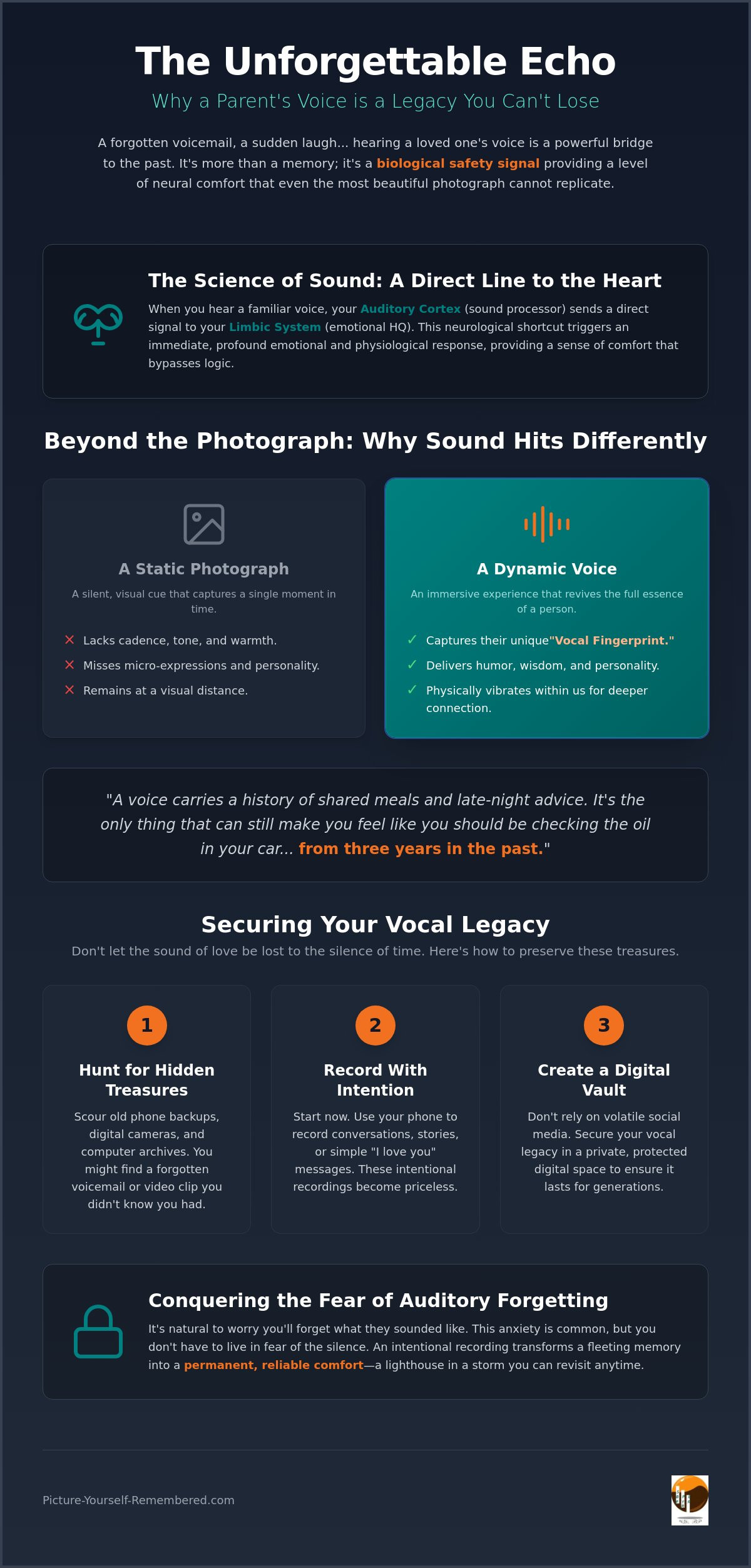
Imagine you are sorting through an old coat pocket and find a forgotten digital recorder, or perhaps a stray voicemail suddenly plays through your phone. In an instant, your mother’s laughter fills the room, and the world seems to tilt on its axis. The emotional impact of hearing a deceased parent’s voice is a unique, powerful force that can feel both like a warm embrace and a sudden, sharp ache. It is a biological safety signal that provides a level of neural comfort that even the most beautiful photograph cannot replicate.
We often worry that the specific cadence of a parent’s storyteller voice will fade over time, leaving us with only silent memories. It’s a heavy thought, but it is one we can face with intentionality and grace. After all, your dad’s voice is probably the only thing that can still make you feel like you should be checking the oil in your car from three years in the past. This article will help you understand the science of auditory memory and show you how to integrate these sounds into a healthy healing process. You will also find actionable tips to secure these vocal treasures for the future, ensuring the sound of love is never lost to the silence of time.
Key Takeaways
- Understand how the brain processes familiar sounds as a safety signal, explaining why a simple voicemail can provide deeper neural comfort than a stack of old photos.
- Explore the profound emotional impact of hearing a deceased parent’s voice and why these auditory memories are often the most precious yet vulnerable parts of a legacy.
- Master a gentle five-step process for recording your own stories, ensuring you can share your wisdom without feeling overwhelmed by the emotional weight of the task.
- Discover why capturing micro-expressions alongside speech creates a dynamic connection that preserves a person’s true personality far better than a static image.
- Learn how to secure your vocal legacy in a digital vault, protecting your family’s most meaningful stories from the instability of social media platforms.
Why the Sound of a Parent’s Voice Lingers in the Soul
A parent’s voice is the first sound we ever truly know. Long before we understand the complex meaning of words, we recognize the vibration, the lilt, and the safety found in those familiar tones. We call this a vocal legacy. It’s the auditory essence of a person’s identity; a collection of sounds that carry their wisdom, their humor, and their unique way of existing in the world. When we talk about the emotional impact of hearing a deceased parent’s voice, we aren’t just talking about a digital file. We’re talking about a bridge that spans the distance between then and now, providing a sense of continuity that photos alone can’t achieve.
In the early stages of loss, the brain often tries to fill the silence. You might think you hear them calling your name from the kitchen or catch the ghost of their laugh in a crowded room. While these grief responses are common, they’re often fleeting and can leave you feeling unsettled. In contrast, an intentional recording offers a steady, reliable comfort. It transforms a “hallucinated” moment of grief into a purposeful act of connection that you can revisit whenever you need to feel their presence. Finding an old voicemail can feel like finding a lighthouse in a storm.
To better understand this concept, watch this helpful video:
The “Vocal Fingerprint” and Personal Identity
Every person possesses a unique vocal fingerprint. This is the specific combination of cadence, pitch, and warmth that makes your parent sound like “home.” It isn’t just what they said, but the way they paused before a punchline or the soft way they said your name. These sounds carry a history of shared meals, late-night advice, and quiet mornings. Let’s be honest, even the most groan-worthy Dad joke feels like a masterpiece when you can hear that specific “I think I’m hilarious” chuckle he used to give right after the punchline. That sound is a piece of his soul that remains reachable, carrying an emotional weight that anchors us to our history.
The Fear of Auditory Forgetting
One of the most painful parts of the healing journey is the fear that you’ll eventually forget what they sounded like. It’s a natural anxiety that many people face, and it can feel like losing them all over again. This fear is actually tied to the science of sound and memory, which explores how our brains store and retrieve auditory signals. While echoic memory is brief, our long-term emotional memory is incredibly sturdy. You don’t have to live in fear of the silence. Take a moment this week to check your old phone backups or digital archives for saved voicemails; you might find a hidden treasure you forgot was there. By securing these recordings now, you ensure that the sound of their love remains a permanent part of your family’s story.
The Science of Sound: How Your Brain Responds to a Familiar Voice
When you hear your mother’s soft “hello” or your father’s deep belly laugh, your brain does much more than just process sound waves. It initiates a complex neurological dance. The auditory cortex, which handles sound, has a direct hotline to the limbic system, your brain’s emotional headquarters. This is why the emotional impact of hearing a deceased parent’s voice feels so immediate and profound. It’s not just a memory; it’s a physiological experience that can soothe your nervous system in ways a photograph simply cannot.
A parent’s voice often functions as a safety signal. From infancy, we are wired to associate these specific frequencies with protection and care. These neuro-associations mean that even a simple phrase like “I’m proud of you” can trigger a flood of dopamine and oxytocin, providing a sense of comfort that bypasses your logical mind. Audio feels more intimate because it physically vibrates within us, whereas visual stimuli remain at a distance. If you’re looking for a way to begin your own collection of these signals, you might consider how recording your own story can offer this same peace to your own children one day.
The Vagus Nerve and Auditory Comfort
Prosody, or the rhythmic lilt and melody of a person’s speech, plays a vital role in our well-being. When we hear the familiar cadence of a parent, it can stimulate the vagus nerve, which helps activate the parasympathetic nervous system. This is the part of your body responsible for “resting and digesting.” It’s a biophilic response, a biological sense of belonging that tells your body it is safe to relax. Auditory resonance is the physical vibration of sound that creates a sense of presence.
Why Voice Triggers Deeper Memory Retrieval
Have you ever noticed how a specific song or voice can instantly transport you back to a specific moment? This is the “Proustian” effect of sound. It hits the emotional centers of the brain before the logical ones can even catch up. Research published in The Healing Effects of After-Death Communications suggests that these auditory connections are a normal, healthy part of the grieving process. Mirror neurons also play a role; when you hear the joy in your parent’s recorded voice, your brain actually mirrors that emotion, allowing you to feel their happiness as if it were your own. It’s the biological equivalent of hearing your name called and instinctively checking if you finished your chores, even decades later.
To make the most of these recordings, try these practical steps:
- Create a dedicated space: Listen in a quiet, comfortable area where you won’t be interrupted.
- Focus on the tone: Pay attention to the warmth and laughter in their voice rather than just the literal words being said.
- Keep it brief: If the experience feels heavy, limit your listening to short bursts. Even thirty seconds of a parent’s laughter can shift your mood.
Beyond the Photograph: Why Video Memories Hit Differently
Photos are silent witnesses to our history. They capture a specific hairstyle, a favorite sweater, or a sunny afternoon in the park. While these images are precious, they are inherently static. They represent a moment frozen in time, whereas a video captures a personality in motion. The emotional impact of hearing a deceased parent’s voice is significantly amplified when you can also see the subtle crinkle around their eyes or the specific way they used their hands to emphasize a point. This “presence effect” creates a bridge across time, making it feel as though they are speaking directly to you rather than just being a subject in a frame.
Authenticity is the key to this connection. In a world increasingly filled with filtered and polished media, the most comforting recordings are often the most raw. You don’t need professional lighting or a script to capture the essence of a person. In fact, research suggests that experiencing these sensory reminders is a non-distressing part of bereavement for many people. It allows for a continued bond that feels grounded in reality rather than the “uncanny valley” of highly edited or AI-generated content. Watching an old video also reminds you that Mom spent the first thirty seconds of every recording asking if the “red light was on” while staring directly into the lens.
The Static vs. The Living Memory
A photograph shows us how someone looked, but a video shows us how they lived. When you see a parent’s face light up as they tell a familiar story, you are witnessing their spirit in real time. This is why digital remembrance has become such a vital part of modern legacy planning. It transforms a memory from a flat image into a living heirloom. These dynamic records preserve the micro-expressions and vocal nuances that define a person’s unique presence in your life.
The Power of Direct Address
There is an incredible emotional weight in hearing a parent say your name. A direct message recorded for a future milestone carries a sense of ongoing relationship that transcends physical absence. Systems like a scheduled delivery system allow these messages to arrive exactly when they are needed most, such as on a wedding day or the birth of a first child. While a photo is a look back at the past, a recorded voice is a gift given to the future.
To ensure your video memories are preserved with care, consider these practical steps:
- Focus on stories, not just dates: Ask your parents to describe how they felt during a specific life event rather than just stating when it happened.
- Check your background noise: A quiet room ensures their “vocal fingerprint” is clear and easy to hear years from now.
- Keep it natural: Encourage them to talk to the camera as if they are sitting across the kitchen table from you.
- Back up your files: Use multiple storage methods to protect these files from digital decay or hardware failure.
Practical Ways to Preserve and Revisit These Heartfelt Echoes
Transitioning from understanding the science of sound to actually capturing it can feel like a daunting task. The emotional impact of hearing a deceased parent’s voice is so significant that the very idea of sitting down to record can feel heavy. However, this process doesn’t have to be perfect; it just has to be real. Think of it as a conversation across time, where your presence is the most valuable gift you can leave behind. You are creating a bridge for your children to walk across whenever they need to feel your strength.
To begin this journey, follow this simple five-step guide to creating your own vocal legacy:
- Find your quiet: Choose a room with soft surfaces like carpets or curtains to minimize echoes.
- Select a heart-centered prompt: Instead of a rigid script, use a question like “What is my favorite memory of us?” or “What advice would I give you for a hard day?” to spark natural storytelling.
- Check your lighting: Sit facing a window for natural light, unless you are going for that shadowy “witness protection program” look.
- Embrace the imperfections: The stumbles, laughs, and “umms” are what make your voice uniquely yours. Don’t edit out the humanity.
- Label and secure: Give the file a clear name and store it in a place designed for longevity, rather than a temporary folder.
Recording for the Future: A Gentle Framework
When you record for your children, focus on storytelling rather than scripting. A script can often mask the warmth and personality that makes your voice a safety signal. Consider recording “micro-messages” for specific life milestones, such as a wedding day or the birth of a first child. These small, intentional acts of love ensure you are there for the moments that matter most. For a deeper look at this process, you can explore our guide on recording messages for loved ones.
Preserving Existing Voices
Many of us already have “vocal fingerprints” hidden in old home movies or saved voicemails. Take the time to extract these audio clips and move them to redundant storage. Relying on a single old phone is a recipe for heartbreak if that device fails or the battery swells. A voice preserved today is a time capsule of love for someone ninety-nine years from now. It is a way to ensure that your influence continues to ripple through generations. If you are ready to secure these memories for the long term, you can start by setting up your Video Message Storage today.
Securing the Future: How to Ensure Your Voice is Heard in 2026 and Beyond
We’ve spent this journey exploring the deep connection found in sound, but we must also consider where these echoes will live. Many people rely on social media platforms to hold their family history, yet these spaces are often ephemeral. Accounts can be deactivated, passwords lost, or data ownership shifted by corporate policy. To truly honor the emotional impact of hearing a deceased parent’s voice, you need a solution that prioritizes longevity over likes. A digital vault acts as a sanctuary for your personal stories, ensuring that your most intimate messages aren’t buried under a feed of strangers’ lunch photos.
There is a quiet, steady peace of mind that comes from knowing your voice is secure. It allows you to live fully in the present, knowing that your future presence is already accounted for. This isn’t about dwelling on the end of a journey; it’s about ensuring the light of your influence continues to shine. By taking this step, you are providing your family with a safety net of love that they can reach for whenever the world feels a little too quiet. It is the ultimate act of preparedness, transforming a complex technological process into a simple, meaningful gift.
The 99-Year Promise
A legacy shouldn’t just last for a season; it should endure for generations. Long-term scheduling, which can extend up to 99 years, is vital for creating a multi-generational impact. Imagine a great-grandchild you’ll never meet in person. Through a preserved video, they can hear your laughter, see your smile, and feel a direct connection to their roots. This is how you become a living part of their history rather than just a name on a family tree. Understanding how Picture Yourself Remembered works can help you see how these vaults are safeguarded to bridge the gap between the present and a century from now.
Taking Agency Over Your Narrative
You are the only person who can tell your story with your specific heart and perspective. Taking agency over your narrative is a profound gift of presence. It’s an intentional choice to remain a source of comfort for the people who will miss you most. Your family is likely already hoping you’ll save these pieces of yourself, even if they don’t know how to ask. Plus, it’s a smart move for your long-term reputation. If you don’t record your own stories, your kids might tell the version where you once tried to fix the kitchen sink and ended up flooding the entire basement. You deserve to have the final word on the masterpiece of your life.
Preserving the Melody of Your Legacy
Your voice is a masterpiece of identity, carrying a warmth and wisdom that no other medium can replicate. We’ve explored how sound acts as a biological safety signal and why the dynamic nature of video creates a presence that static photos simply cannot match. Understanding the emotional impact of hearing a deceased parent’s voice allows us to see these recordings not just as digital files, but as profound acts of love. It’s about ensuring that your unique vocal fingerprint remains a source of strength for your family long after today.
Stanley Poe founded Picture Yourself Remembered to bridge the gaps between generations, creating a compassionate and secure environment for your most precious stories. With a secure digital vault designed to last for 99 years, you can rest easy knowing your narrative is in safe hands. Go ahead and start recording today, even if you think you sound a bit like a rusty hinge before your morning coffee. Your loved ones won’t mind the gravel; they’ll just be grateful to hear your heart. Begin your legacy journey today with a Basic Membership at Picture-Yourself-Remembered and take the first step toward a future where your voice is never forgotten.
Frequently Asked Questions
Is it normal to feel upset when hearing a deceased parent’s voice?
It is completely natural to experience a rush of emotion or even a sense of being startled. The emotional impact of hearing a deceased parent’s voice can trigger a “safety signal” response in your brain, but it also highlights the physical absence of your loved one. This reaction is a testament to the deep connection you shared. If it feels overwhelming, try listening in short bursts while in a comfortable, quiet space.
How can I find old recordings of my parent’s voice if I don’t have any?
Start by checking old phone backups for saved voicemails or digital recorders tucked away in drawers. You can also look through the background noise of family holiday videos where their laughter might be captured in the room. Reach out to extended family members who may have kept old greeting cards with sound chips or video clips you’ve never seen before.
Does hearing a voice help or hinder the grieving process?
Most research suggests that these sounds help by fostering a “continued bond” with your loved one. The emotional impact of hearing a deceased parent’s voice provides a sense of continuity that bridges the gap between the past and present. It acts as a form of neural comfort that validates your history and identity, helping you integrate the loss into your ongoing life story.
What is the best way to record a message for my children to hear in the future?
Using a dedicated Video Message Storage system is the most effective way to capture your essence for the next generation. Focus on being yourself rather than trying to perform or read from a rigid script. Your children will value your authentic “storyteller voice” far more than a polished speech. Plus, it’s a great way to prove you actually knew how to use a smartphone without accidentally turning on a cat filter.
How do I ensure my digital video messages stay private until they are delivered?
Avoid using public social media platforms, as they don’t offer the privacy or longevity needed for sensitive legacies. A secure digital vault ensures your messages remain hidden and protected from data breaches or accidental deletion. This allows you to speak freely from the heart, knowing your words will only reach the intended ears exactly when you intend for them to be heard.
Can I schedule a video message to be delivered 50 years from now?
Yes, a Scheduled Delivery System allows you to plan for milestones decades into the future. Whether it’s a 50th birthday or a golden anniversary, you can ensure your voice is there to celebrate. This kind of long-term planning provides incredible peace of mind for you and a timeless gift for your heirs. It ensures your influence continues to ripple through time with intentionality and grace.
What should I say in a legacy video if I don’t know where to start?
Begin with a simple “I love you” or share a memory of a day you felt especially proud of them. You might also offer advice for hard days or tell the story of how they got their name. If you’re stuck, just describe a typical Tuesday afternoon. Those “ordinary” details often become the most cherished memories later on because they capture the true rhythm of your life.
Is a digital time capsule safer than a physical one?
Digital storage is generally safer because it isn’t vulnerable to fire, floods, or simply being lost during a move. Physical media like tapes or USB drives can degrade or become obsolete, but a secure digital vault is designed for multi-generational endurance. It keeps your story intact and accessible, regardless of how hardware changes. This ensures your family doesn’t need to find an ancient adapter just to hear your voice.
