
What if the most precious gift you could leave your grandchildren isn’t a dusty heirloom, but the actual sound of your voice and the “why” behind your most cherished traditions? It’s a heavy thought, isn’t it? We often worry that the vibrant personalities of our loved ones will eventually soften into static images. Building a digital family archive shouldn’t feel like a cold technical chore, but rather a beautiful act of intentionality. Let’s be honest, trying to coordinate a family project can feel a bit like herding cats who have very busy social calendars and a healthy suspicion of anything involving a cloud.
You likely feel that same deep desire to protect your history, yet you aren’t sure where to start or how to keep the momentum going. This guide promises to transform that overwhelm into a sense of quiet peace. You will learn how to unite your family through the simple power of storytelling and create a secure, permanent home for your memories. We are going to explore a structured plan to involve everyone from the tech-savvy teens to the storytelling elders, ensuring your shared legacy remains a masterpiece for generations to come.
Key Takeaways
- Learn why gathering multiple perspectives creates a richer, more soulful tapestry of your family’s journey than any single narrative ever could.
- Assign simple roles like the “Storyteller” or “Tech-Guide” to involve everyone, even those relatives who think the “Cloud” is just something that ruins a picnic.
- Avoid the “attic trap” by building a digital family archive that protects your most precious memories from being lost or forgotten over time.
- Follow a practical five-step plan to launch your project with a clear theme, ensuring your collective effort remains focused and deeply meaningful.
- Discover how a scheduled delivery system acts as a bridge through time, ensuring your words of wisdom reach future generations at the perfect moment.
Beyond the Solo Story: Why a Collaborative Family Memory Project Matters
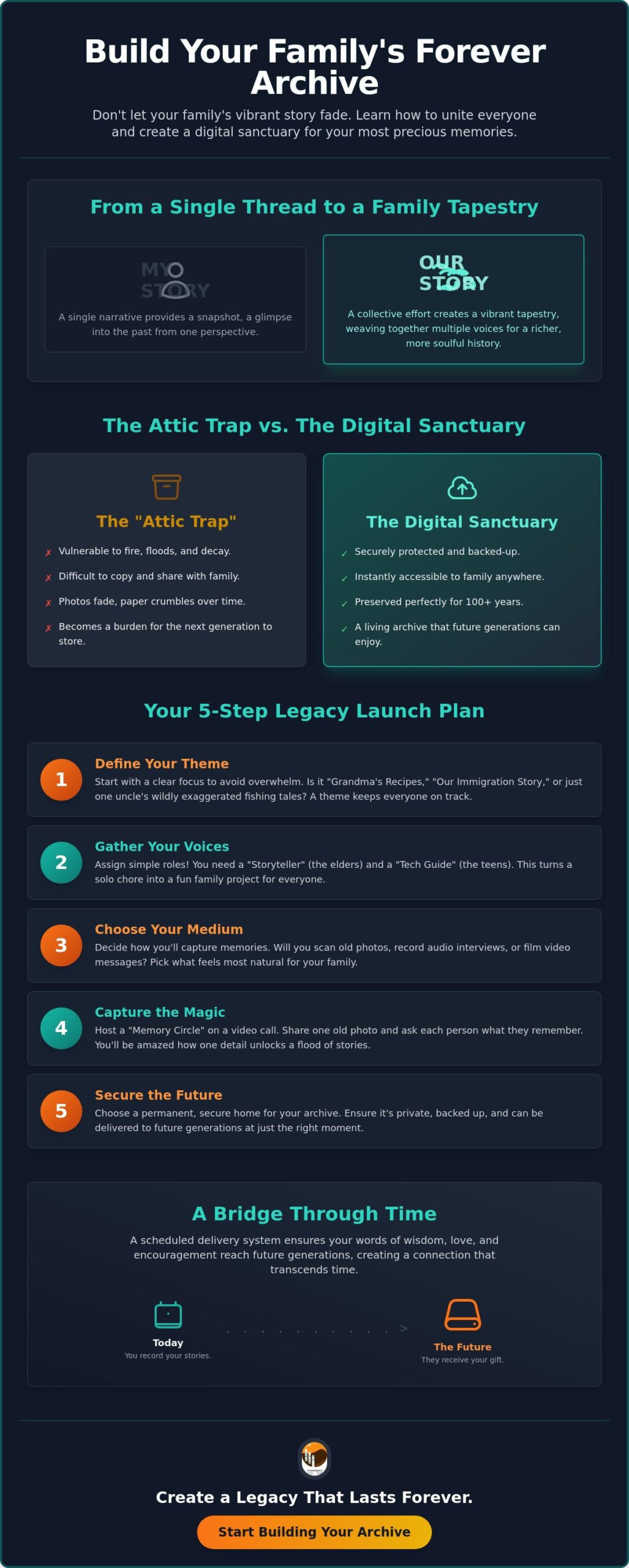
A collaborative family memory project is a shared, heart-centered effort to capture the diverse perspectives that make up your family’s unique journey. It’s the realization that one person cannot possibly hold the entire story of a lineage. While a single narrative provides a snapshot, a collective effort creates a vibrant, multi-dimensional portrait of who you are. By building a digital family archive together, you ensure that no voice is left behind and no precious detail is forgotten. It’s about moving from “my story” to “our story,” creating a sanctuary for the moments that defined you.
To better understand this concept, watch this helpful video:
When multiple family members contribute, the history becomes richer and more accurate. Your sister might remember the smell of your grandmother’s kitchen, while your brother recalls the specific life advice she gave him during a summer rainstorm. These overlapping viewpoints create a tapestry that is far more beautiful than any single thread could be. There’s a profound psychological benefit here, too. For elders, sharing these stories provides a sense of peace and validation. For the youth, receiving them offers a grounded sense of identity and belonging. Even if your family tree has a few interesting branches, every story adds to the shade it provides. And let’s be honest, we all have that one uncle whose stories are ten percent fact and ninety percent creative flair, but even those tall tales are part of the magic.
Actionable Tip: Host a “Memory Circle” video call where you share just one old family photograph. Ask each person to describe what they remember about that day. You’ll be amazed at how one person’s detail about a background character or a specific outfit unlocks a flood of memories for everyone else.
The Power of Collective Remembering
There is something nearly miraculous about what happens when a family sits down to remember. One person’s small detail often acts as a key, unlocking a forgotten door in someone else’s mind. This is the core difference between data-driven genealogy, which focuses on names and dates, and heart-driven memory projects that focus on essence and influence. While dates tell us when someone lived, stories tell us how they loved. A collaborative project is the intentional act of weaving individual voices into a lasting family tapestry. It transforms a scattered collection of files into a cohesive digital family archive that resonates with life.
Bridging the Generational Gap
In our fast-paced world, these projects serve as a vital bridge. They help grandchildren see their grandparents as real people with dreams, struggles, and triumphs, rather than just names on a chart. Technology plays a beautiful role here by making history accessible to younger, digital-native generations in a format they understand and enjoy. By using modern digital preservation strategies, you can ensure these files don’t just sit on a hard drive but actually reach the people who need them most. We believe that preserving family history is the ultimate gift to the future, a way to whisper “you belong” to generations you may never meet.
Gathering the Voices: How to Identify Your Family’s Story-Keepers
Organizing a family project can feel like a daunting task, but it becomes a joyful experience when you share the load. You don’t have to be a professional historian to create a meaningful digital family archive. The secret lies in identifying the natural talents within your circle and inviting them to contribute their unique light. Before you dive into the logistics, remember this one critical rule: start with your oldest relatives first. Their memories are the most fragile and the most foundational. Capturing their voices is not just a task; it is a priority of the heart.
The Different Roles in Your Project
- The Organizer: This is the heartbeat of the project. They keep the schedule, coordinate the dates, and gently nudge the cousins who might be a little slow to respond.
- The Storyteller: These are the family members who can turn a simple memory into a legend. They are the ones who need a platform where their words can live on for generations.
- The Tech-Guide: Usually the person who can fix the Wi-Fi in five minutes. They handle the recording and uploading, ensuring the process remains simple and accessible for everyone else.
Many relatives might hesitate to participate, claiming their lives were “unremarkable” or “boring.” You can gently remind them that the small, quiet details are often the most precious. They might not think their first job or their favorite childhood meal matters, but to a great-grandchild, those details are treasures. If you need help grounding your search in historical facts, you can explore genealogy resources from the National Archives to find a starting point. Creating a simple mission statement, such as “We are preserving our roots to guide our future,” helps keep everyone aligned and inspired by the deeper purpose of your digital family archive.
Making Participation Easy and Inviting
Forget the bright lights and formal interview vibes. Aim for coffee-table conversations where the atmosphere is warm and relaxed. Provide a list of low-pressure prompts to get the ball rolling, such as “What was the best advice your father ever gave you?” or “Tell me about a time you felt truly brave.” This approach keeps the stories genuine and heartfelt. Of course, you might have that one uncle who tries to turn his life story into a three-part epic movie with a dramatic soundtrack, but even his theatrical enthusiasm is a gift worth keeping. Once you have these precious recordings, you can use Video Message Storage to ensure they are kept safe and sound for the years to come.
Choosing Your Medium: Comparing Traditional Archives and Digital Legacies
Once you have identified your family’s story-keepers, the next step is deciding where these precious narratives will live. It is a choice between the tangible warmth of the past and the enduring security of the future. You are essentially choosing the vessel that will carry your family’s essence through time. While every medium has its own charm, the goal is to ensure your history remains accessible, vibrant, and safe from the elements. A well-constructed digital family archive acts as a lighthouse, guiding future generations back to their roots, and it does so without the risk of the light fading over the years.
Physical scrapbooks offer a nostalgic, tactile experience that is hard to replace. There is a certain magic in turning a page and seeing a handwritten note or a faded polaroid. However, they are deeply vulnerable to the attic trap. This is the unfortunate reality where family treasures are lost to moisture, fire, or simply being forgotten in a dusty corner labeled “miscellaneous.” We have all seen those boxes that haven’t been opened in decades. By the time they are rediscovered, the names on the back of the photos have often vanished from memory. Let’s be honest, most of us treat our digital storage like that one kitchen drawer full of mysterious keys and dried-up pens; we know there’s something important in there, but finding it is a different story.
Physical vs. Digital: Pros and Cons
- Physical Archives: These are tactile and nostalgic. They feel real in your hands. But they are also fragile and difficult to replicate so that every family member has a copy.
- Digital Folders: These are incredibly easy to share and store. Yet, they often become disorganized graveyards of files with names like “IMG_9921.” They are also prone to digital rot, which is the slow decay of file formats as technology evolves.
- Video Legacies: These offer the highest emotional impact. They are easy to preserve with the right service and allow your personality to shine through in a way that paper never could.
Actionable Tip: If you are starting with physical photos, digitize them in small batches of no more than twenty at a time to avoid burnout. Label each digital file with the names of everyone in the photo and the approximate year before you upload them to your central repository. This simple step prevents your history from becoming a collection of anonymous faces.
Why Video is the Ultimate Collaborative Tool
There is a unique intimacy in a video that a static photo simply cannot capture. When you see a loved one’s eyes crinkle as they laugh or hear the specific cadence of their voice, you aren’t just looking at history; you are feeling a presence. It breathes life into your digital family archive, making it a living heirloom that speaks directly to the heart. This medium captures the “why” behind the stories, preserving the nuances of a person’s identity that text often misses.
Modern technology has made recording messages for loved ones as simple as holding a smartphone. You don’t need a film crew or a professional studio to capture the essence of a person. A simple, heartfelt message recorded in a quiet living room often carries more weight than the most polished production. When recording, try to use natural light from a window and keep the background simple to ensure the focus remains entirely on the storyteller’s expressions and words.
Launching Your Legacy: 5 Practical Steps for a Successful Project
Starting a project of this magnitude can feel like standing at the base of a mountain. But you don’t have to climb it all in one afternoon. Building a digital family archive is a journey of small, intentional moments that eventually form a breathtaking view of your family’s history. By following a structured plan, you can move from the “someday” mindset to a tangible reality that your grandchildren will one day hold in their hands with gratitude.
- Step 1: Choose your theme. Don’t try to record every memory at once. Focus on a specific lens, like “Lessons Learned” or “Advice for the Future,” to give your project a clear heart.
- Step 2: Select a secure platform. You need a home for these memories that offers more than just storage. Look for a system that guarantees long-term preservation and future delivery.
- Step 3: Schedule short sessions. Aim for 15-minute bursts of storytelling. It’s much easier to find 15 minutes between coffee and errands than it is to schedule a three-hour marathon.
- Step 4: Curate and organize. Group your contributions by the person who will receive them or by future milestone dates, like a 21st birthday or a wedding day.
- Step 5: Set a delivery schedule. This is the most vital step. Decide who gets to see each message and exactly when they should receive it.
Setting the Theme and Tone
The theme you choose acts as the compass for your project. If your family is full of adventurers, perhaps “The Great Migration” is the right fit. If you are a family of thinkers, “Kitchen Table Wisdom” might resonate more deeply. You can use a digital time capsule approach to keep your efforts focused on the future impact rather than just the past. Unless you want your legacy to be a four-hour debate over who actually broke the living room window in 1978, a clear theme keeps the conversation productive and meaningful.
Recording and Organizing with Ease
You don’t need a Hollywood budget to capture high-quality audio and video. Your smartphone is a powerful tool when used correctly. Simply find a quiet, carpeted room to minimize echoes and ensure your voice is the star of the show. You can start small with a Basic Membership and gradually expand your digital family archive as more relatives join the project. It’s also vital to think about future-proofing, which simply means choosing file formats that will still work on computers fifty or ninety-nine years from now. This ensures your words don’t become unreadable digital ghosts. To make sure your messages reach their destination exactly when they are needed, consider setting up a Scheduled Delivery System today.
Securing the Future: How Picture-Yourself-Remembered™ Bridges the Generations
The final piece of the puzzle isn’t just about where you store your memories, but how they are delivered to the people who will cherish them most. Stanley Poe envisioned a world where your digital family archive doesn’t just sit in a dark corner of the internet, but acts as a living bridge through time. His vision was to create a safe sanctuary for stories that could last up to 99 years. This level of foresight transforms a simple collection of files into a sacred trust, ensuring that the light of your family’s influence never truly goes out; it is the difference between leaving behind a box of unsorted papers and leaving a curated library of the heart.
Most people treat digital storage like a digital attic, a place where things go to be forgotten. But a Scheduled Delivery System is the key difference between a storage folder and a vibrant legacy. It ensures that your words of wisdom or birthday wishes arrive exactly when they are needed, even decades into the future. Knowing that your family project won’t vanish because a social media platform changed its terms or went out of business provides a deep sense of peace. It is far more reliable than a social media site that changes its layout every time you finally learn where the “settings” button is hidden.
Actionable Tip: When you record your first message, set the delivery date for a significant future milestone, like a child’s graduation or a 30th birthday. This immediately transforms your digital family archive from a static file into a meaningful event that your loved ones can look forward to with anticipation.
A Vault Built for Centuries, Not Just Seasons
Your family’s private moments are protected by robust security protocols designed for long-term endurance. The beauty of this system is that it handles the delivery of your messages even if you aren’t there to click the send button yourself. This automation acts as a promise kept across generations, bridging the gap between the present and a future you may not see. If you are curious about the specific mechanics behind this process, you can explore the how Picture-Yourself-Remembered™ works guide for a more detailed look at the technology that safeguards your heart.
Your Next Step Toward a Shared Legacy
The most important part of any legacy is simply starting it. You have the power to take agency over your own narrative today, ensuring that you are the one who defines how you are remembered by those who follow. Don’t wait for the “perfect” moment to begin your first collaborative project. The most authentic stories are often told in the imperfect, quiet moments of daily life. Your family’s story is a masterpiece that is still being painted. By using Video Message Storage and a Scheduled Delivery System, you ensure the ink never fades and the pixels never disappear. Start your journey now and give the future a gift that only you can provide.
Preserving the Light of Your Family’s Journey
Your family’s history is much more than a collection of dates; it’s a living, breathing tapestry of love and resilience. By involving every generation in your digital family archive, you’ve ensured that no perspective is lost to time. You now understand how to move past the fragility of physical scrapbooks and the chaos of disorganized folders. It’s time to stop worrying about whether future generations will remember your voice and start giving them the gift of your presence. After all, your life story is far more interesting than anything they’ll find on a trending social media feed, even if you don’t have a viral dance to go with it.
Founded by the visionary Stanley Poe, Picture-Yourself-Remembered™ offers heart-centered technology designed for emotional endurance. You can secure your most precious video messages in a vault built to last for up to 99 years. Don’t let your masterpiece fade away into the digital mist. Take agency over your narrative and Start Your Family’s Living Legacy Today. Your story is ready to be told, and the future is waiting to listen with open hearts.
Frequently Asked Questions
How do I start a collaborative family memory project if my family lives in different states?
You can bridge the distance by using digital recording tools and shared communication platforms to gather stories. Since your family isn’t in the same room, try hosting a monthly video call where one person shares a specific memory. You can record these sessions directly or have everyone upload individual clips to your digital family archive. It’s a beautiful way to stay connected, even if the only thing you currently share is a common last name and a mutual dislike of Aunt Linda’s fruitcake.
What are the best questions to ask during a digital family archive project interview?
The most evocative questions focus on sensory details and emotional turning points rather than dry facts. Instead of asking for a date, ask your loved one to describe the sound of their childhood home or the moment they felt most proud of themselves. These heart-centered prompts help reveal the true essence of a person’s character. Actionable tip: Start with low-pressure questions about favorite traditions to help the storyteller feel comfortable before moving into deeper life reflections.
How can I ensure our digital memories will be accessible 50 years from now?
Long-term accessibility requires using standardized file formats and a platform committed to digital preservation. The Library of Congress recommends formats like MP4 for video because they are widely recognized and less likely to become obsolete. You should also choose a service that offers digital family archive storage designed for decades rather than months. Actionable tip: Regularly review your files every few years to ensure the formats are still current and the passwords are secure.
What if a family member is uncomfortable being recorded on video?
Vulnerability is a choice, and it’s perfectly okay if someone prefers to stay off-camera. You can still capture their essence through audio recordings or by having them write their stories down for another family member to read aloud. The goal is to preserve the narrative, not necessarily the image. Actionable tip: Try using a voice-only recording app first. Often, once people realize how much their words matter, they might eventually feel brave enough for a quick video.
How much does it cost to store and schedule a collaborative family project?
The investment for a collaborative project depends on the amount of storage you need and the complexity of your delivery schedule. Most families start with a basic plan to test the waters before expanding their archive as more relatives contribute. It is helpful to view this not as a monthly bill, but as a way to secure a permanent home for your history. Actionable tip: Compare different membership levels to find the right balance between storage capacity and long-term features.
Can I add more videos to our family project over time?
Absolutely, your legacy is a living masterpiece that can grow as your family does. You can add new video messages, reflections, or milestone celebrations whenever inspiration strikes. This flexibility allows your digital family archive to stay relevant and vibrant for future descendants. Actionable tip: Set a recurring calendar reminder for a Legacy Day once a year. Use this time to record a short update on your family’s latest triumphs, challenges, and shared laughter.
Who is responsible for delivering the messages if the project organizer passes away?
A dedicated legacy platform uses a Scheduled Delivery System to ensure your messages reach their destination even if you aren’t there to click send. This automation provides a profound sense of peace. You don’t have to worry about the logistics of the future because the system is built to honor your intentions. Actionable tip: Always designate a secondary contact in your account settings. This person can act as a steward to ensure the family knows the archive is waiting for them.
Is a collaborative digital family archive better than a traditional family tree?
While a traditional tree gives you the bones of your history, a digital archive provides the heart. A family tree tells you who your ancestors were, but an archive tells you how they thought, felt, and loved. They are complementary tools that work together to create a full picture of your lineage. Actionable tip: Link your video stories to specific names on your physical or digital tree. This creates a multi-dimensional experience for anyone exploring their roots.
