
What if the small silver drive sitting in your desk drawer, the one holding your most precious family videos, is actually a ticking clock waiting to run out? There is a quiet comfort in believing our digital lives are safe just because we’ve tucked them away on a piece of hardware. You’ve likely spent hours organizing folders and saving photos, trusting that this simple act of love is enough to bridge the gap between today and a hundred years from now. However, the reality of DIY digital legacy risks is often much more fragile than we’d like to admit. Technology shifts with a relentless pace, and sometimes the things we trust most are the first to let us down.
In this guide, you’ll discover why self-managed digital legacies often fail and how you can truly protect your family stories from hardware failure, password lockouts, and the silent threat of file corruption. We’ll explore how to move beyond the anxiety of “bit rot” and ensure your messages reach your loved ones exactly when they need them most. It’s about finding a simple way to let your voice carry forward without needing a PhD in computer science or a magic wand to bypass a forgotten password. After all, your legacy should be a gift, not a digital scavenger hunt where the prize is an “Error 404” message. Let’s look at how to turn your history into a masterpiece that stands the test of time.
Key Takeaways
- Uncover why digital files can “fade” like old ink and learn practical steps to prevent your most cherished videos from becoming unreadable over the coming decades.
- Identify the common DIY digital legacy risks that turn personal memories into locked puzzles, ensuring your family never faces the frustration of a forgotten password.
- Learn the vital difference between just keeping a file and ensuring its delivery, so your words of wisdom reach your children on the specific days they need them most.
- Start a simple audit of your digital footprint to find where your stories are hidden, because even a “cloud” can evaporate if you don’t have the right key to open it.
- Discover how to create a lasting bridge between the present and the future, ensuring your heirs don’t need to hire a team of professional hackers just to view your holiday messages.
The Allure and Danger of the ‘Digital House of Cards’
There is something deeply beautiful about wanting to take the reins of your own story. You’ve lived a life full of color, lessons, and laughter, and it’s only natural to want to ensure those memories are passed down with the same warmth they were created with. Many of us turn to what feels easiest: a silver thumb drive tucked in a drawer or a few folders in a free cloud account. It feels like we are in control. However, relying on these methods introduces significant DIY digital legacy risks that can quietly dismantle your hard work before it ever reaches the next generation. We often mistake the convenience of a gadget for the permanence of a legacy.
We assume that because a digital file doesn’t yellow like an old newspaper, it will remain pristine until the end of time. But without active care, these files are more like sandcastles than stone monuments. Understanding the nuances of digital inheritance is the first step in realizing that a legacy requires more than just storage; it requires a clear path to follow. A free solution might seem like a bargain today, but the cost of a lost history is a price your family shouldn’t have to pay. To help visualize how to begin this journey, watch this helpful guide on preparing your digital presence:
The ‘I’ll Just Leave a Note’ Fallacy
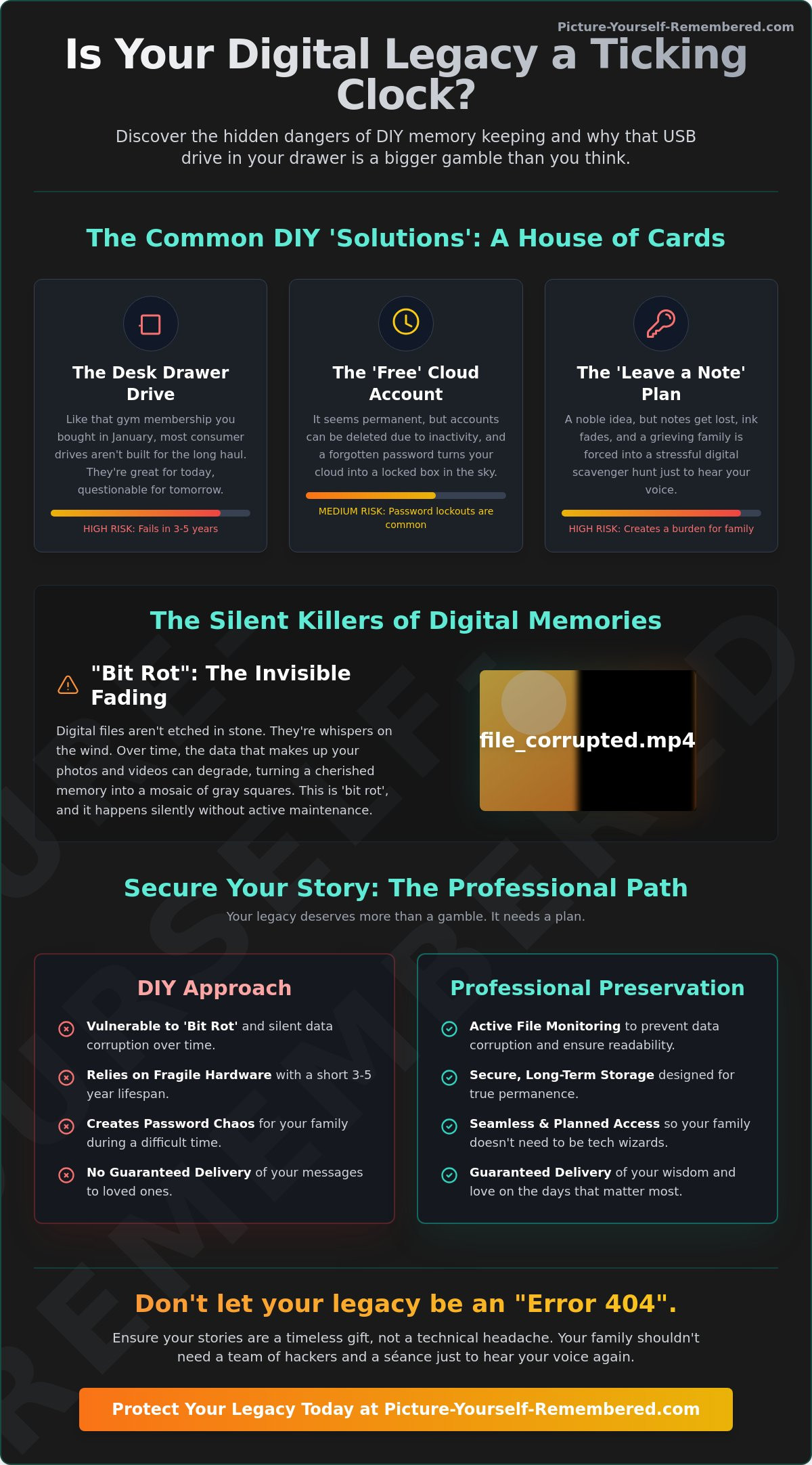
It’s a common plan: “I’ll just write my passwords on a sticky note and put it in the safe.” While the intention is pure, life transitions are often chaotic. Notes get misplaced during a move, or ink fades until a “5” looks like an “S.” Beyond the logistics, think of the heart. When a family is grieving, the last thing they want is to play digital detective, scouring old notebooks just to hear your voice one more time. A DIY approach also leaves your memories vulnerable to accidental deletion. During a well-meaning digital cleanup, someone might erase a folder they don’t recognize, unaware it held the masterpiece of your life story.
The Fragility of Modern Storage
Think about a printed photo from a wedding a century ago. It has survived decades of humidity and light. Now, compare that to a modern thumb drive. Most consumer-grade hardware is designed to last about five years before it starts to fail. Thinking a USB drive is permanent is like thinking that gym membership you bought in January will still be useful in July. Technology moves fast, and what works today might be a relic tomorrow. To keep your story alive, you need a system that breathes and evolves. Start by mapping out where your most precious memories live right now, whether that’s on a phone, a laptop, or a dusty drive. This simple audit is the first step toward true peace of mind.
The Technical Trap: Why Digital Files Fade Faster Than Memories
We often think of digital files as immortal, as if they are etched into the very fabric of the universe. In reality, they are more like whispers on the wind. While a physical photograph might yellow with age, it remains visible. Digital data, however, is prone to a silent, invisible process known as bit rot. Imagine writing a beautiful letter with ink that slowly, letter by letter, disappears until the page is blank. That is bit rot. It is the slow corruption of the binary code that makes your video unplayable or your photo a mosaic of gray squares. This technical reality is one of the most overlooked DIY digital legacy risks.
Bit Rot and Data Decay Explained
Consumer hard drives and USB sticks are wonderful for short term transfers, but they aren’t built for the long haul. Most are designed to last only about three to five years before the risk of failure spikes. Research from groups like the Canadian Conservation Institute notes that digital media often have shorter lifetimes than analog media. To keep your memories alive, you can’t just set them and forget them. You have to actively move your files to new devices and formats as technology evolves. If you don’t, your life’s story might end up trapped in a “format gap.” Remember floppy disks? Trying to open an old file format is like trying to order a latte using Morse code; you might get your point across eventually, but it’s going to be a long, frustrating morning.
The Password Paradox
Even if your files survive the hardware, they still have to survive the gatekeepers. We use two-factor authentication (2FA) to keep hackers out, but we often forget that these same locks can keep our family out too. If an account is tied to a phone number that is no longer active, those files might be gone forever. Large cloud platforms frequently update their “inactive account” policies, sometimes deleting data after just two years of silence. This makes creating a true digital time capsule much harder than it seems. Families often face grueling legal hurdles just to prove they have the right to see a photo, turning a moment of connection into a bureaucratic nightmare.
Securing your story requires a system that understands the heart, not just the hardware. By choosing a dedicated Video Message Storage plan, you ensure your legacy is actively managed and ready for the future, rather than left to the whims of a “zombie” cloud account with an expired credit card on file. When you take agency over your own narrative, you move from simple storage to true preservation.
The Delivery Dilemma: Who Hits ‘Send’ When You Can’t?
Many of us think that if we’ve saved the file, we’ve finished the job. But there’s a world of difference between storage and delivery. Storage is just keeping a file safe; delivery is making sure that file actually reaches the heart it was intended for. One of the greatest DIY digital legacy risks is assuming that simply having a USB drive in a safe is the same as a guaranteed connection. If the person you love doesn’t know the file exists, or if they can’t find it when they need it most, your message remains silent.
When we try to manage this ourselves, we often rely on a “human chain.” We ask a best friend or a sibling to promise they’ll hand over a letter or a video years down the road. It’s a beautiful sentiment, but life is unpredictable. People move. They lose touch. They forget. Expecting a friend to remember a 20-year-old promise is like expecting them to remember where they parked their car after a two-hour grocery trip; it’s a lot to ask. A professional Scheduled Delivery System removes this layer of human error, ensuring your voice isn’t lost in the shuffle of someone else’s life.
The Emotional Weight of Timing
There is a unique power in a message that arrives exactly when it is needed. Imagine your daughter receiving a video from you on her wedding morning, or your grandson hearing your voice on his 21st birthday. When you are recording messages for loved ones, the impact is found in the “when” as much as the “what.” DIY methods usually result in a “digital data dump,” where heirs are handed a pile of files all at once. This can feel overwhelming rather than meaningful. A scheduled approach turns your legacy into a series of beautiful milestones that unfold over time.
Privacy vs. Accessibility
Security is a delicate balance. If you share your passwords now to ensure future access, you lose your privacy today. If you keep them secret, you risk locking your family out forever. A dedicated service acts as a trusted bridge. It respects your privacy during your lifetime while guaranteeing that your narrative is shared only when the time is right. This is far more reliable than a “digital executor” who might not have the technical tools to manage complex delivery schedules across decades. To start moving from “storage” to “legacy,” try these simple steps:
- Identify three future milestones where your voice would provide comfort or guidance.
- Decide if you want a specific message to be a surprise or a known gift.
- Check if your current storage method allows for date-specific automation or if it relies entirely on someone else’s memory.
Auditing Your Digital Footprint: A DIY Risk Assessment
Taking a moment to look at your digital landscape is an act of deep intentionality. It is about more than just files and folders; it’s about the space your life occupies in the digital world. To truly understand the DIY digital legacy risks you might be facing, you need to step back and view your collection through the eyes of someone who will see it decades from now. This audit isn’t meant to be a chore. Instead, think of it as a gentle inventory of your heart’s work, ensuring that every piece of your personal legacy is exactly where it needs to be.
Start by following these five steps to evaluate your current plan:
- Map your memories: Create a simple list of every device, external drive, and cloud account where your stories live.
- Identify the single point of failure: Look for any story that exists in only one place, such as a single laptop or a lone thumb drive.
- Perform the relative test: Ask yourself if a non-tech-savvy relative could find and open your most important files today without your help.
- Evaluate the format: Check if your videos are in universal formats like .MP4 or if they are trapped in a proprietary app that might not exist in five years.
- Verify the delivery trigger: Determine if there is a specific, automated way for your messages to be sent on future dates, or if you are relying on someone else’s memory.
Finding Your Digital ‘Single Points of Failure’
A “single point of failure” is any one thing that, if lost, takes your entire history with it. If your house flooded tomorrow, would your digital history survive? Relying on a single physical device is one of the most common DIY digital legacy risks. True peace of mind comes from redundancy. By preserving family history across multiple secure locations, you ensure that a single accident doesn’t erase a lifetime of influence.
The 10-Year Test
Find a digital file you created ten years ago and try to open it. If you have to spend an hour searching for the right software, imagine the struggle your family will face in fifty years. Asking your tech-averse relative to navigate a nested folder system is a bit like asking a goldfish to solve a Rubik’s Cube; it’s technically possible in some alternate reality, but you probably shouldn’t bet your life’s story on it. Stick to universal formats and consider professional oversight to ensure your storage remains accessible for 99 years and beyond.
If your audit reveals gaps in your plan, don’t wait for a hardware failure to take action. You can secure your story today by starting a Basic Membership to begin organizing your digital vault with professional care.
Choosing a Secure Future: Professional Legacy Preservation
You’ve spent your life building a story that is uniquely yours, filled with moments that deserve to be heard by those who follow in your footsteps. Understanding the DIY digital legacy risks we’ve explored is the first step in protecting that narrative. While it’s tempting to rely on free tools or a simple drawer full of drives, true preservation requires a system that is as intentional as the life you’ve lived. Choosing Picture-Yourself-Remembered™ isn’t just about keeping data; it’s about ensuring the light of your influence never fades into a digital dark age. It’s about moving from a “hope for the best” strategy to a “guaranteed to be heard” promise.
A professional approach bridges the vital gap between mere storage and a lasting legacy. While a legal trust might manage your physical home or your savings, it often lacks the specialized tools needed to handle the delicate delivery of a video message to a grandchild who hasn’t been born yet. Relying on a “free” cloud account for your legacy is a bit like trusting a toddler with your favorite white sweater; it might be fine for a second, but eventually, things are going to get messy. A dedicated system ensures that as technology shifts, your files are updated and your story remains accessible for generations to come.
The Picture-Yourself-Remembered™ Difference
Our approach is designed with both the heart and the future in mind. By starting with a Basic Membership, you gain access to a professional digital vault built for 99-year endurance. This isn’t just a folder in the sky. It is a structured environment where your Video Message Storage is actively managed to prevent the bit rot and format gaps we discussed earlier. Our Scheduled Delivery System acts as your personal time-traveling messenger, removing the burden from grieving family members and ensuring your words arrive with perfect timing. We use high-level security protocols to keep your most intimate reflections private until the exact moment you’ve chosen for them to be shared.
Taking the First Step Toward a Lasting Legacy
The journey toward peace of mind doesn’t have to be overwhelming. You don’t need to organize your entire life in a single afternoon. Instead, take a small, meaningful action today to see how the system works for you. Here is a simple way to begin:
- Record one short “message for the future” for a loved one.
- Upload it to your secure vault and set a delivery date for a specific milestone, like a graduation or an anniversary.
- Experience the emotional relief of knowing that this one piece of your heart is “locked in” and protected forever.
There is a profound sense of quiet dignity that comes from being prepared. When you take agency over your own narrative, you ensure that your family stories are preserved with the same care and artistry with which they were created. Your life is a masterpiece; don’t leave the frame to chance. Choose a future where your voice continues to guide, comfort, and inspire long after the hardware of today has turned to dust.
Preserving Your Voice for the Generations to Come
Your life story is a masterpiece that shouldn’t be left to the mercy of a dusty USB drive or a forgotten password. We’ve seen how the silent threat of bit rot and hardware failure can quietly erase years of memories; it’s like trying to keep a sandcastle safe from the rising tide. Navigating the DIY digital legacy risks we’ve discussed means moving from a place of worry to a place of quiet preparedness. You deserve to know that your reflections will remain as vibrant as the day they were recorded.
Our founder, Stanley Poe, created this bridge to ensure no family story is ever cut short by a technology shift. With a secure digital vault and a scheduled delivery system designed for 99 years of endurance, we help you stay connected to your family’s future milestones. It’s a way to be there for your loved ones when it matters most. Think of it as a very long-term RSVP to your family’s future celebrations, hopefully with fewer awkward seating charts. Secure your story today with a Picture-Yourself-Remembered™ Basic Membership and take the first step toward a legacy that truly lasts. Your narrative is a gift; let’s make sure it’s one that can always be opened.
Frequently Asked Questions
What exactly is ‘bit rot’ and should I be worried about it?
Bit rot is the silent decay of the data that makes up your digital files. It’s like a digital moth eating away at a favorite sweater; you don’t notice until there’s a hole. You should be concerned because it can make your most precious videos unplayable over time. To combat this, try to open and refresh your files by copying them to new storage every few years to keep the data active.
Can I just use a legacy contact on Facebook or Google instead of a paid service?
Legacy contacts are helpful for closing accounts, but they don’t provide a way to store personal videos or schedule future messages. One of the primary DIY digital legacy risks is relying on platforms that might change their rules or delete inactive accounts. These tools are designed for account closure, not for the intentional preservation and delivery of your life’s story across many decades.
How do I know a digital legacy service will still be around in 50 years?
Reliable services use a membership model to fund the ongoing technology migration required as the years pass. This support allows for active migration, which means moving your files to new formats as old ones become obsolete. It’s about building a foundation that is meant to outlast the device you’re holding right now, ensuring your narrative remains accessible to your great-grandchildren.
Is it better to store my legacy videos on an external hard drive or in the cloud?
Neither is a perfect solution on its own because hard drives fail mechanically and consumer clouds can be deleted if an account sits idle. To avoid common DIY digital legacy risks, you should use a dedicated Video Message Storage system. This approach combines the accessibility of the cloud with professional management and redundancy, so your story isn’t lost if a single device or credit card expires.
What happens to my digital legacy if I forget my master password?
Forgetting a password is a universal human experience, much like walking into a room and forgetting why you’re there. If you are managing your legacy alone, a lost password can mean your family is locked out forever. A professional vault has secure recovery paths to ensure your heirs can access your memories without needing a court order or a lucky guess at your favorite childhood pet’s name.
Why shouldn’t I just email future messages to my family now and tell them not to open them?
Sending an email today and asking someone to wait ten years is a lot of pressure to put on a loved one. Emails are easily buried in an inbox or deleted during a routine cleanup. A Scheduled Delivery System ensures your message arrives as a beautiful surprise on a specific date, keeping the emotional weight of your words intact without the risk of an accidental early opening.
How does a professional digital vault differ from standard Dropbox or iCloud storage?
Standard storage is designed for the now, while a professional digital vault is built for the always. Services like Dropbox are great for sharing work documents, but they don’t offer the 99-year endurance or the delivery triggers needed for a legacy. A Basic Membership provides a structured space where your narrative is treated as a masterpiece worth preserving rather than just another set of temporary data.
Can a digital legacy service help me deliver messages on specific dates like a wedding?
Yes, delivering messages on specific future dates is the heart of what a professional service provides. Our Scheduled Delivery System allows you to choose a date, such as a wedding morning or a milestone birthday, and ensures your voice is there to celebrate. It transforms your digital history into a series of meaningful gifts that unfold exactly when your family needs to hear from you most.
