What if the most beautiful parts of your journey, the sound of your laughter or the quiet wisdom you have gathered over decades, simply evaporated into a cloud of digital dust? It is a heavy thought, yet many of us unknowingly make common mistakes in preserving family memories that leave our stories vulnerable to time and changing technology. We often treat our digital archives like a kitchen junk drawer, secretly hoping that “Future Us” will somehow have the magical patience to sort through ten thousand blurry photos of Sunday brunch. It is okay to feel overwhelmed by the sheer volume of files or the fear of being forgotten; most people feel exactly the same way.
You are about to discover the hidden pitfalls of memory preservation and learn how to safeguard your family’s most precious stories for a century. We will walk through how to move beyond cluttered hard drives to create a living legacy that speaks clearly to the generations you will never meet. By the end of this guide, you will have a clear, heart-centered plan to ensure your voice remains a steady light for your great-grandchildren, transforming your personal history into a masterpiece of intentionality.
Key Takeaways
- Learn how to avoid “Silent Photo Syndrome” by pairing your visuals with the heartbeat of their story, ensuring they remain treasures instead of digital clutter.
- Stop waiting for the “perfect” moment to record your thoughts; authenticity is far more precious to your descendants than professional editing or a fancy backdrop. (Besides, your “bed head” just proves you were a real person who actually slept.)
- Identify the common mistakes in preserving family memories, such as trusting social media for long-term storage, and learn how to combat the quiet threat of digital decay.
- Discover the beauty of using a scheduled delivery system to share video messages for future milestones, allowing your love to be felt at weddings and birthdays for decades to come.
- Take agency over your narrative today by moving from a passive collector of files to an intentional storyteller who secures a legacy for the next century.
The ‘Silent Photo’ Syndrome: Why Context Matters More Than Content
Imagine finding an old photo of a woman laughing in a sun-drenched garden. You can see the sparkle in her eyes, but you don’t know why she was happy, who was standing behind the camera, or what she hoped for her children. This is what we call “Silent Photo Syndrome.” It is one of the most heartbreaking yet common mistakes in preserving family memories. We often spend years collecting the “what” of our lives while completely forgetting to record the “why.” Without the story, a photograph is just a flat image on a screen; with the story, it becomes a living window into your soul.
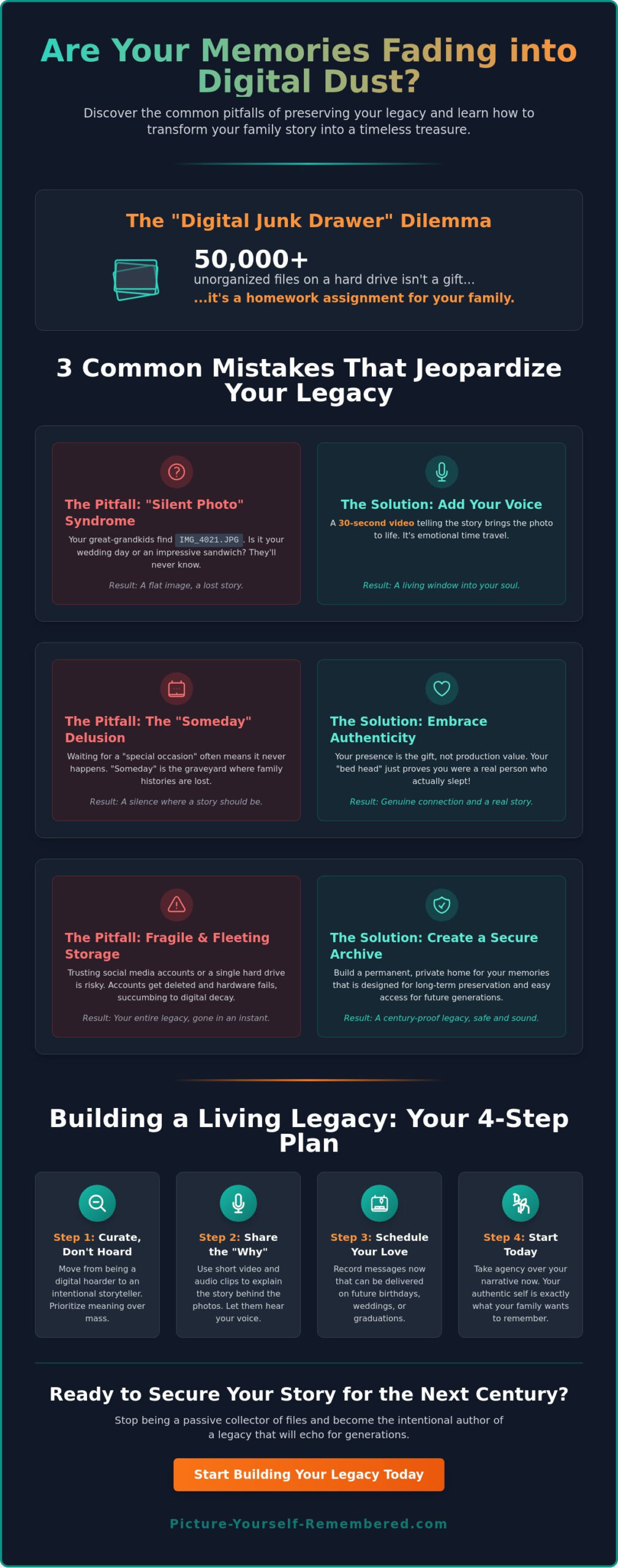
When we hand down a hard drive containing 50,000 unorganized files, we aren’t actually giving a gift. We are giving a homework assignment. Our loved ones want to feel connected to our journey, but they can easily feel buried by the sheer volume of digital clutter. It’s like handing someone a library where all the book covers have been ripped off. To truly honor your history, you must move from being a digital hoarder to an intentional curator who prioritizes meaning over mass.
To better understand the importance of moving beyond simple storage, watch this helpful perspective on honoring your history:
The Mystery of the Unlabeled Digital Folder
Your great-grandchildren will probably look at a file named “IMG_4021.jpg” and feel absolutely nothing. It could be a photo of your wedding day or just a picture of a particularly impressive sandwich you ate in 2014; they have no way of knowing. One simple way to fix this is by using established media preservation techniques like adding “story metadata” to your digital files. If you right-click a photo on your computer, you can often add a description or “tags” in the file properties. However, a 30-second video message explaining the day is worth more than a 1,000-word caption. It turns a mystery into a cherished memory.
Missing the Sound of a Voice
A voice is a fingerprint of the heart. It carries the specific lilt of your humor, the warmth of your encouragement, and the unique cadence of your personality. While text tells a story, a voice shares an experience. Don’t just record the big milestones. Record the “mundane” things, like your favorite childhood recipe or the way the air smells before a summer storm. Hearing a loved one’s laugh from fifty years ago isn’t just a recording; it is a form of emotional time travel that bridges the gap between generations. It’s much better than leaving your descendants to guess if Great-Grandpa Joe was actually funny or if he just had a very expressive mustache.
The Perfectionism Pitfall: Waiting for a ‘Special Occasion’
Many of us fall into the trap of believing that our life story requires a grand stage or a professional film crew to be worthy of being told. We wait for the “perfect” milestone, like a 50th anniversary or a retirement party, to finally sit down and record our thoughts. This hesitation is one of the most frequent and avoidable common mistakes in preserving family memories. By waiting for a special occasion, we often miss the quiet, beautiful moments that actually define who we are. Your grandkids won’t care if your hair was messy, but they might wonder why you’re wearing that 1980s sweater in 2026.
The truth is that your presence is the gift, not your production value. When we delay the act of sharing because we don’t feel “ready” or “prepared,” we risk leaving a silence where a story should be. Understanding these common mistakes in preserving family memories allows you to move past the paralysis of perfection and into a space of genuine connection.
The ‘Someday’ Delusion
“Someday” is a comfortable place to hide, but it is also the graveyard where many family histories are lost. We tell ourselves we will get to it once we lose weight, once the house is cleaner, or once we have “more important” things to say. The reality is that your children and grandchildren crave the version of you that exists right now. I challenge you to a five-minute “micro-recording” today. Simply pick up your phone and record yourself answering one question: “What is a small thing that brought me joy this week?” If you need more inspiration on where to begin, you can explore this guide on how to tell your life story with grace and ease.
Authenticity Over Artistry
In a world obsessed with filters and scripts, your true, unedited self is a rare and precious treasure. You don’t need a teleprompter or studio lighting to be remembered. In fact, a conversational tone, as if you are talking to a dear friend over a cup of coffee, is much more evocative than a rehearsed speech. While the Library of Congress provides excellent resources on personal digital archiving to help you organize your files, the most important step is simply to start where you are.
Adopt a “record now, edit never” philosophy. The stumbles, the laughs, and even the occasional background noise of a family pet are the textures of your real life. These “imperfections” are exactly what future generations will find most endearing about you. If you are ready to begin, you can easily secure these moments using video message storage to ensure they are kept safe until the time is right for them to be seen. Your story is a masterpiece in progress; don’t wait for the final brushstroke to let someone see the beauty of the work.
Digital Decay and the Fragility of Modern Storage
We often think of digital files as permanent, yet the reality is much more fragile. Unlike a printed photograph that can sit in a shoebox for decades, digital data is prone to something called “Digital Decay.” This is the slow, silent process where files become unreadable as the hardware they live on begins to fail. Based on current data from 2026, most hard drives only last between three and five years, while even the sturdiest USB drives might only hold your data for a decade. Relying on a single laptop or an old thumb drive is one of the most dangerous common mistakes in preserving family memories. It is like building your family’s history on a foundation of shifting sand.
Beyond hardware failure, we face the challenge of “password silos.” This happens when our most precious stories are locked behind encrypted accounts that no one else can access after we are gone. Without a clear strategy to pass these keys to the next generation, your digital legacy could vanish the moment a subscription expires or a password is forgotten. Creating a “Digital Vault” strategy is not just about storage; it is about ensuring your voice remains reachable across the decades. It requires a plan that outlives the hardware cycles of today.
The Social Media Storage Myth
It is tempting to treat social media platforms like a free, eternal archive. However, these platforms are designed for sharing, not for long-term preservation. When you upload a video, the site “compresses” it. This is a technical way of saying it strips away the fine details to make the file smaller and easier to stream. Over time, these copies lose the crispness of the original. More importantly, you don’t own the “land” your memories live on. Terms of service change, and platforms can disappear. Moving your legacy content off social platforms and into a dedicated video message storage system ensures your story isn’t at the mercy of a corporate algorithm.
Format Rot and Lost Access
Remember the floppy disk? Today’s standard video formats, like the MP4, will eventually face the same fate. This is “format rot,” where the software needed to play a file becomes obsolete. If you are currently digitizing family archives, you must consider how those files will be migrated to new formats as technology evolves. Trying to find a computer that can read an old CD in 2026 is already like trying to find a unicorn that also knows how to fix your Wi-Fi. A truly secure archive doesn’t just hold your files; it manages them so they remain playable for the next 99 years. Take agency over your narrative now, before your life’s work becomes a digital ghost trapped in a format nobody uses anymore.
Building a Living Legacy: Practical Steps to Do It Right
Moving from the fear of digital decay to the joy of creation is a beautiful transition. It is the moment you stop worrying about what might be lost and start focusing on what can be given. One of the most common mistakes in preserving family memories is treating your history like a filing project rather than a conversation. Instead of organizing your digital archive strictly by date, try organizing it by emotional value. A folder named “Life Lessons” or “My Hopes for You” is far more likely to be opened by a grandchild than one labeled “2026_Backup_01.” Organizing by date is fine until you realize you can’t remember if that vacation to the Grand Canyon was in 2005 or 2006, but you definitely remember the face your son made when he dropped his ice cream onto a cactus.
To keep your story vibrant, consider a regular “legacy check-in.” Just as you might visit a doctor for an annual physical, take an hour every few months to add a new chapter to your narrative. This ensures your archive grows with you, capturing the wisdom you gain in real time. It transforms preservation from a daunting task into a rhythmic act of love.
Storytelling Over Statistics
Your descendants don’t just want to know when you were born or where you worked; they want to know who you were. Focus on sharing the values that guided your decisions and the lessons that shaped your character. If you find it hard to start, try answering these three simple prompts: “What was a moment that made you feel brave?”, “What is the hardest lesson you ever learned with a smile?”, and “What did you love most about your own parents?” These small windows into your heart provide much more connection than a list of dates. If you are feeling stuck, you can find more inspiration in this guide to recording messages for loved ones.
Establishing a Reliable Delivery System
The greatest story in the world is useless if it never reaches the person it was meant for. Many people rely on “hope” as their delivery strategy, assuming someone will find their files and know what to do with them. This is a gap that often leads to lost history. A truly intentional legacy uses a Scheduled Delivery System to ensure specific messages reach loved ones at the perfect moment, such as a wedding day or a 30th birthday, even decades from now.
As a practical first step, create a “Legacy Map” for your family. This is a simple document that tells them exactly where your stories are kept and how to access them. It removes the guesswork and ensures your voice isn’t silenced by a forgotten password. If you are ready to secure your place in their future, you can begin your journey with a Basic Membership today, ensuring your masterpiece is preserved with the dignity it deserves.
Picture Yourself Remembered: Bridging the Gap Between Generations
The journey of preserving a life is not a solitary path but a bridge built with love. Stanley Poe envisioned a world where no story would ever be lost to the silence of time or the clutter of a hard drive. This vision became Picture-Yourself-Remembered™, a mission dedicated to ensuring your unique essence, your wisdom, and your laughter remain a steady presence for the people you love most. By understanding the common mistakes in preserving family memories, you’ve already taken the first step toward a more intentional life. You are moving beyond simple data storage and stepping directly into the heart of true legacy creation.
Our platform was born from the belief that every person is a masterpiece. We don’t just offer a place to keep files; we offer a sanctuary for your soul’s expression. While others focus on the technical “how,” we focus on the emotional “why.” Our mission is to help you bypass the common mistakes in preserving family memories by offering a sanctuary that values your voice above all else. Think of this as a time capsule that actually works, unlike the one you buried in the backyard that is currently just a rusty tin of soggy baseball cards and disappointment.
Secure Video Vaulting for the Long Haul
Peace of mind is the foundation of any lasting legacy. When you use our Video Message Storage, you’re placing your stories into a professional-grade digital sanctuary designed for endurance. We understand that your history is priceless, so we treat it with the quiet dignity it deserves. Our tiered system is built to grow alongside your family, ensuring that as your story expands, your storage does too. It is about more than just bits and bytes; it is about the security of knowing your face and voice are safe for the next 99 years. You can learn more about the heart behind our process by exploring how the service works.
Scheduled Delivery That Grows with Your Family
The most profound gift you can give is your presence at a moment when you are needed most. Imagine your grandson receiving a video message from you on his 30th birthday, filled with the specific encouragement he needs for that stage of life. This is the magic of our Scheduled Delivery System. It solves the “delivery problem” that plagues so many other preservation methods. Instead of hoping someone finds a folder, you can ensure your love arrives exactly when it should.
Getting started is a gentle, inviting process. You can begin with a Basic Membership today and record your first message in minutes. My actionable tip for you is simple: don’t wait for a grand occasion. Record a “just because” message for someone you love right now. Take agency over your own narrative and transform your history into a gift that will be opened for generations to come. Your story is ready to be told; let us help you ensure it is heard through Picture-Yourself-Remembered™.
Secure Your Voice for the Next Century
Your life is a masterpiece of stories, lessons, and laughter that deserves to be heard by those who haven’t even been born yet. We have explored how to avoid the common mistakes in preserving family memories, from the trap of perfectionism to the fragility of unmanaged digital files. By choosing intentional storytelling over simple data collection, you transform a cluttered hard drive into a profound act of love. Your great-grandchildren won’t care if you had the latest smartphone in 2026, though they might be confused by your old photos of every salad you ever ate.
Founded by Stanley Poe to bridge generational gaps, Picture-Yourself-Remembered™ offers a compassionate, human-centered approach to legacy planning. With secure vaulting for up to 99 years, your narrative is safe from the shifting tides of technology. It’s time to move past the anxiety of being forgotten and step into the peace of being prepared. Start your journey of remembrance with a Basic Membership today and ensure your light continues to shine. Your story is a gift only you can give; the world is waiting to receive it.
Frequently Asked Questions
What is the biggest mistake people make when saving family photos?
The most significant error is saving images without their stories, often called “Silent Photo Syndrome.” When you store thousands of files labeled with random numbers, you’re leaving a burden for your descendants rather than a gift. One of the common mistakes in preserving family memories is assuming the context will be remembered forever. To fix this, try recording a quick voice note to accompany each digital album explaining who is in the photo and why the moment mattered.
How can I make sure my digital videos are still viewable in 50 years?
Avoid relying on physical media like CDs or USB drives, which can fail in as little as two to five years. Instead, use a secure, managed cloud vault that prioritizes long-term endurance. The best way to ensure your videos survive is to use a service that monitors technology shifts and updates file formats as they evolve. This proactive approach keeps your memories accessible even as the devices we use today become relics of the past.
Is social media a good place to keep my family memories?
Social media is wonderful for sharing, but it is not a safe long-term archive. Platforms frequently compress your files, which permanently lowers the visual quality of your precious moments. Additionally, you don’t own the digital land where your memories live; a change in terms of service could lock you out. It is much safer to move your legacy content into a private Video Message Storage system where you maintain total control over your narrative.
What should I say in a video message for my children’s future?
Focus on sharing your values, your hopes for them, and the specific lessons that shaped your character. Your children don’t need a lecture on why they should eat their broccoli; they want to know why you once thought that neon tracksuit was a good idea. Try using heart-centered prompts like “What is the bravest thing I’ve ever done?” or “What do I want you to remember when life feels difficult?” These personal truths create an enduring connection.
How do I ensure my family can access my digital legacy after I’m gone?
The key is to use a system that includes a delivery mechanism rather than just a locked storage box. One of the common mistakes in preserving family memories is creating password silos where your stories are trapped forever. You can prevent this by naming a trusted person in your Legacy Map and using a platform designed to deliver your messages automatically at the right time. This ensures your voice is heard without your family playing digital detective.
Can I schedule a video message to be delivered 20 years from now?
Yes, you can absolutely use a Scheduled Delivery System to send messages to the future. This allows you to time travel your love to specific milestones, such as a grandchild’s college graduation or a child’s wedding day. Simply record your message, choose the recipient, and pick the future date you want it to arrive. It is a beautiful way to remain a steady, encouraging presence in their lives even when you cannot be there in person.
Why is video better than a written letter for a family legacy?
While letters are beautiful, a video captures the unique vibration of your voice, your laugh, and the sparkle in your eyes. These sensory details carry your personality and emotion in a way that text simply cannot replicate. Hearing a loved one’s voice from decades ago provides a visceral sense of connection that bridges the generational gap. It turns a historical record into a living, breathing experience for your descendants to cherish and hold close.
What happens to my stored videos if the technology changes?
A professional legacy service handles the technical migration of your files so they remain playable as new formats emerge. Just as we moved from VHS to digital files, your storage provider should ensure your memories aren’t left behind on obsolete digital islands. By using a managed vault, you don’t have to worry about whether an MP4 will still work in 2076. The system evolves with the times, keeping your story vibrant and accessible for the next 99 years.
