
What if the most valuable heirloom you leave behind isn’t a vintage watch, but the simple sound of your voice explaining why you always planted marigolds in the spring? According to a 2023 survey by Allianz, 86 percent of people value life lessons far more than financial assets, which is why learning how to document your life story for your family is such a profound act of love. You might feel that your daily rhythm is too quiet for a book, or perhaps the thought of navigating digital storage feels like trying to program a VCR in 1985. It’s easy to let the scale of the task lead to procrastination, but your narrative is a masterpiece that deserves to be preserved. Your story matters.
This guide offers a gentle, step-by-step approach to capturing your essence with dignity and ease. We’ll explore a clear starting point to help you begin today, discover secure ways to store your messages, and find the peace of mind that comes from knowing your voice will be heard at future milestones. Let’s transform your cherished memories into a lighthouse for the generations to come. It’s time to take stewardship of your legacy and truly picture yourself remembered.
Key Takeaways
- Learn how to move beyond simple facts and dates to capture your true essence, ensuring your unique voice continues to offer comfort for generations.
- Identify the five essential categories of the “Legacy Framework” to prioritize the stories and turning points that truly shaped your character.
- Discover how to document your life story for your family by weighing the intimate “twinkle in the eye” of video against the classic permanence of a journal.
- Follow a simple two-step plan to map out your history—because trying to summarize your entire existence on the fly is a great way to accidentally invent a nap.
- Understand the risks of “Digital Decay” and learn how to secure your narrative so it remains a cherished heirloom for the next 99 years.
Why Documenting Your Life Story is the Ultimate Act of Love
Think of your life as a masterpiece in progress. While a traditional family tree provides the skeleton of your history, your legacy provides the heartbeat. Learning how to document your life story for your family allows you to transition from a list of names and dates to a living narrative. You’re offering your children and grandchildren a map of your heart, not just a branch on a genealogical chart. It’s the difference between a dry birth certificate and the warmth of a shared secret or a hard-won lesson.
There’s something sacred about the sound of a voice. When we lose someone, the silence can feel heavy; yet, a recording of a laugh or a specific turn of phrase can bridge the gap between generations. This process of life review isn’t just for those who follow you; it’s a gift to yourself. Reflecting on your journey helps you find peace and meaning in the path you’ve walked, validating that your daily joys and struggles have intrinsic value. When you decide to learn how to document your life story for your family, you aren’t just filing papers, you’re practicing stewardship over your own essence.
To better understand the power of your personal narrative, watch this helpful video:
Moving Beyond Names and Dates
Your grandchildren will likely skip over your birth certificate to find the story of your first heartbreak or the time you took a risk and failed. They want to know the “why” behind your choices. This is the essence of what a memoir is, focusing on personal experience rather than just a chronological list of events. In our fast-paced digital world, these recorded moments become your emotional fingerprint, a unique impression that only you can leave behind. Digital remembrance ensures that your wisdom isn’t lost to the fading ink of old letters, but remains accessible and vibrant for the future.
Overcoming the ‘I’m Not Interesting’ Myth
Many people hesitate because they feel their lives lack grand adventures. You don’t need to have climbed Everest to have a story worth telling. Your daily joys, like the way you take your coffee or the specific smell of your kitchen during the holidays, are the threads that weave a vivid portrait. Honestly, even your questionable fashion choices and those truly tragic, feathered haircuts from the 1970s are essential parts of the tapestry. To get started, try this simple exercise:
- The Five-Minute Legacy: Ask yourself what you’d say if you had exactly five minutes to speak to your family 50 years from now. What values would you want them to inherit?
- Focus on the Small: List three small habits that make you “you,” such as your favorite recipe or a silly song you sing to the dog.
- Embrace the Ordinary: Remember that your perspective on everyday life is a treasure to those who love you.
Choosing Your Narrative: What Stories Does Your Family Need to Hear?
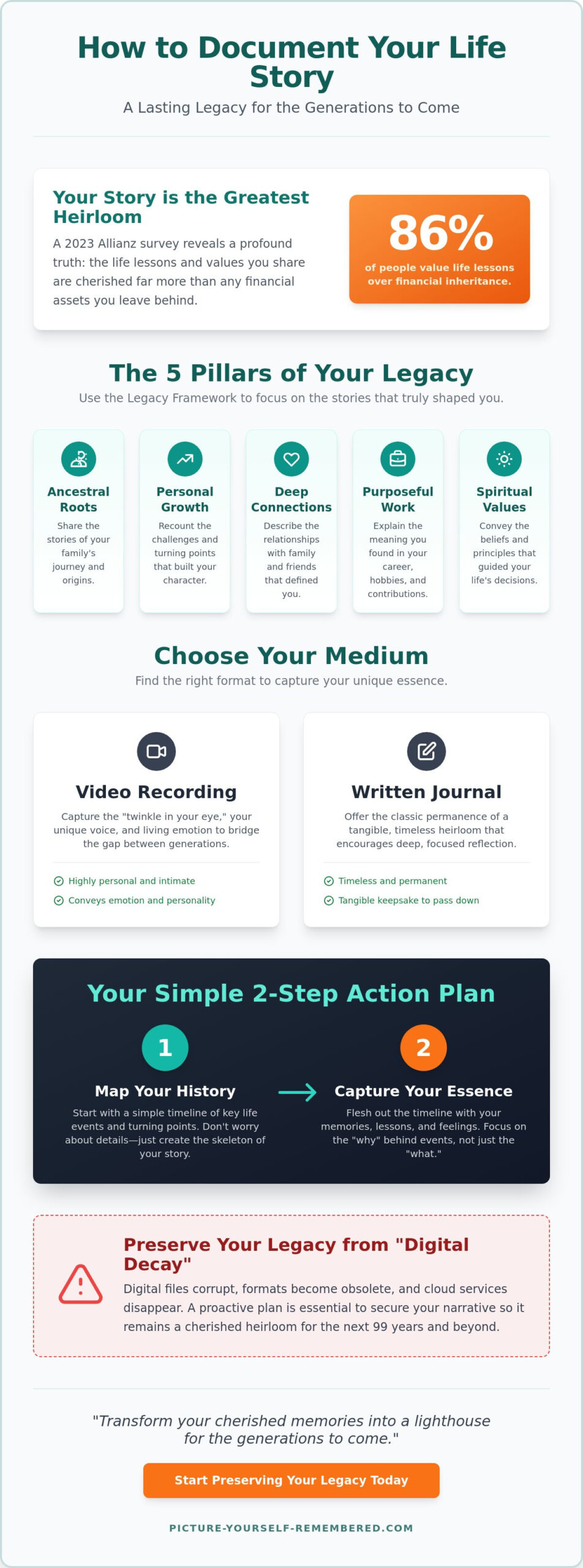
Learning how to document your life story for your family is a gift of intentionality. It is not about listing every mundane event in chronological order, but rather about curating the essence of your journey. You are the architect of your own history. To make this process manageable, I recommend using the Legacy Framework, which prioritizes five specific categories: your ancestral roots, your personal growth through challenges, the deep connections you’ve fostered, your life’s purposeful work, and the spiritual values that guide you. By focusing on these pillars, you capture the unspoken history that a simple photo album can never fully express.
As you explore how to document your life story for your family, remember that your vulnerabilities are often the most valuable parts of the narrative. Your grandchildren don’t need a list of your trophies; they need to hear about the turning point moments that shaped your character. Perhaps it was the time you lost a job in 1992 and found a new path, or the quiet courage it took to mend a broken relationship. To help structure these reflections, you can Write a Personal History that focuses on the “why” behind your choices. This approach ensures your legacy is a living testament rather than a static record.
The Core Memories: Childhood and Young Adulthood
The foundation of your story begins with the sights, sounds, and scents of your earliest years. Think back to your first home. Can you still smell the yeast in your mother’s kitchen or hear the specific creak of the floorboards? When you move into young adulthood, focus on the first time you felt the weight and wonder of true independence. Maybe it was moving into your first apartment in 1978 with nothing but a mattress and a dream. Sharing these moments helps your family see you as a person, not just a relative. It’s also a great time to mention that questionable 1974 haircut that you thought looked sophisticated at the time, but now serves as a hilarious reminder of your youthful confidence.
- First Job: What did you do with your very first paycheck?
- First Car: Describe the freedom (and the mechanical smells) of that first vehicle.
- First Big Mistake: What did you learn when things didn’t go as planned?
Wisdom and Wishes for the Future
Your life lessons are the inheritance that never depreciates. Sharing your hopes for your descendants should feel like a warm embrace rather than a lecture. Focus on resilience. Tell them how you stayed standing when the world felt shaky. If you find it easier to speak than to write, you might consider recording messages for loved ones to ensure your tone and warmth are preserved. This allows you to offer guidance with a gentle touch, ensuring your voice remains a source of comfort for generations to come. If you feel ready to begin this beautiful process, explore how we can help you preserve these memories with the dignity they deserve.
Video vs. Pen: Finding the Right Medium for Your Essence
Choosing the best way to document your life story for your family is an act of deep intentionality. It requires you to consider which vessel best holds your unique spirit. A handwritten journal offers a tactile, quiet permanence that can be tucked into a cedar chest for decades. It invites a slow, reflective reading experience. However, video offers something text cannot: the specific melody of your laughter and the way your hands move when you’re excited. It preserves your “essence” in a vibrant, breathing format.
While a pen captures your thoughts, a lens captures your presence. Statistics from archival studies suggest that physical paper can last over 200 years if acid-free, while digital files often require a “refresh” or migration every 7 to 10 years to avoid format obsolescence. You’re balancing the physical endurance of ink with the emotional resonance of a voice. Don’t feel pressured to be a cinematic genius. If you look a bit like a deer in headlights during the first three minutes of your recording, just remember that your family loves the deer, too.
The Power of the Visual Narrative
A video message serves as a digital heirloom that speaks directly to the next century. To look and sound natural, avoid a stiff script. Instead, imagine you’re having a living room conversation with a dear friend over a cup of tea. This approach lowers the stakes and allows your warmth to shine through. When considering how to document your life story for your family, remember that authenticity beats high production value every time.
- Keep the bloopers: Don’t edit out the moments where you stumble or pause to think. These human “glitches” are often what future generations will find most endearing.
- Check your light: Sit facing a window during the day. Natural light honors your features far better than a harsh overhead bulb.
- Sound matters: A quiet room is more important than a 4K camera. If they can hear your heartbeat and your sighs, they can feel your love.
Combining Methods for a Multi-Layered Legacy
You don’t have to choose between the screen and the page. In fact, the most robust legacies often use a multi-layered approach. You might use the written word to record the “what”—the dates, names, and family trees—while using film to explain the “why.” This creates a rich, textured history that appeals to both the mind and the heart.
Try using physical photos as “props” during a video recording. Holding a 1974 polaroid while explaining the smell of the ocean that day bridges the gap between the past and the present. To keep these different elements secure, consider the role of a digital time capsule. This tool allows you to organize video clips, scanned letters, and voice memos in one protected space, ensuring your narrative remains a cohesive gift rather than a scattered collection of files.
A Step-by-Step Action Plan for Capturing Your History
Mapping out your journey begins with a single piece of paper. This “Life Map” isn’t a detailed census; it’s a collection of the milestones that shaped your essence. Draw a line from your birth to today, marking the peaks of joy and the valleys of growth. By visualizing your path this way, you create a compass for your narrative. It’s a simple way to learn how to document your life story for your family without feeling like you’re writing a massive textbook.
Once your map is ready, gather 5 to 10 key photos or objects. These are your anchors. Perhaps it’s a faded ticket stub from a first date or a worn wooden spoon from your mother’s kitchen. These items act as prompts, helping you recall the smells, sounds, and emotions of a specific era. To preserve these physical anchors as beautifully as your digital stories, you can discover Modern Memory Design for custom framing that turns your history into art. Think of this as a quiet date with your younger self; luckily, you already know you’ll like each other’s company.
Your surroundings matter deeply during this process. Find a quiet, meaningful corner of your home where you feel at peace. This could be a sun-drenched chair by the window or a desk where you’ve written a thousand letters. A calm environment allows your voice to remain steady and reflective. Finally, decide on your delivery plan. Deciding how to document your life story for your family involves choosing who hears what and when, ensuring each message reaches the right heart at the right moment.
Organizing Your Thoughts Without the Stress
Building a legacy isn’t a sprint. Set a timer for just 15 minutes a week to focus on one specific memory. This small commitment prevents the “blank screen” syndrome and keeps the process joyful rather than burdensome. If you find yourself stuck, use prompts like “What was the first car I ever owned?” to get the ink flowing. You can find more inspiration in our guide on preserving family history to ensure your words endure for generations.
Addressing Sensitive Topics with Grace
Every life has its shadows. When you encounter difficult periods or family secrets, approach them with the heart of a steward. You don’t have to share every painful detail to be honest. Instead, focus on the “Forgiveness Narrative.” Use your story to heal old wounds by sharing what you learned and how you moved forward. This act of emotional stewardship protects your family’s history while offering them a path toward their own peace.
Taking these small, intentional steps ensures your voice remains a cherished part of your family’s future. If you’re ready to turn these memories into a masterpiece, it’s time to start your legacy journey today.
Securing Your Legacy for the Next 99 Years
Many of us trust our most precious memories to social media platforms, assuming those digital profiles will stand as a permanent record. This is a risky gamble. Digital decay is a quiet thief; a 2024 study by the Pew Research Center found that 38% of all web pages that existed in 2013 have already vanished. Social media accounts can be deactivated, terms of service change, and platforms eventually fade into obscurity. Your life story deserves more than a fleeting existence on a server that might not exist in twenty years.
Picture Yourself Remembered acts as a bridge between your present self and your descendants a century from now. It provides a sanctuary for your narrative, moving beyond the chaos of the public internet. This intentional approach to how to document your life story for your family ensures your essence isn’t lost to a forgotten password or a defunct app. By planning for a 99-year horizon, you are performing an act of stewardship for those who haven’t even been born yet.
One of the most profound ways to use this service is through the Future Milestone feature. Imagine the impact of your voice reaching across decades to speak to a great-grandchild on their wedding day in the year 2080. You can offer wisdom, share a blessing, or simply remind them of the love that flows through their lineage. This isn’t just storage; it’s a scheduled delivery of your heart at the exact moment your family needs it most. You maintain total control over who sees your messages, balancing deep privacy with the certainty that your words will reach the right people when the time is right.
The Digital Vault: More Than Just Storage
You might think a USB drive in a desk drawer is enough, but hardware fails and physical objects are easily misplaced during moves or life transitions. A dedicated digital vault offers a level of security that consumer hardware cannot match. When you understand how Picture Yourself Remembered works, you realize it’s about the peace of mind that comes from professional-grade preservation. Your messages are protected and ready for their future debut, regardless of how technology evolves.
Starting Your Journey Today
The best time to begin is while your stories are fresh and your voice is strong. If the process feels big, start small. Record a simple one-minute “Hello” message today just to test the waters and get comfortable with the camera. A Basic Membership simplifies the entire process of creating a video legacy, guiding you through the steps with warmth and clarity. This is the most meaningful way to master how to document your life story for your family without feeling overwhelmed. Because your cat shouldn’t be the only one with 10,000 videos on your phone.
Start Writing Your Forever Today
Your narrative is a masterpiece that deserves a permanent home. By now, you’ve seen that choosing the right medium and following a simple action plan makes the process feel less like a chore and more like a celebration. Stanley Poe founded Picture Yourself Remembered to bridge the gap between 3 generations, ensuring your essence isn’t lost to time. Let’s be honest; your grandkids might actually listen to your advice if it’s delivered from a high-tech digital vault rather than shouted across a noisy Thanksgiving dinner. Learning how to document your life story for your family is the ultimate act of stewardship. You’re not just saving files; you’re securing 99 years of connection through our secure digital vault protection. We offer scheduled delivery options that reach your loved ones up to 99 years in the future. It’s time to turn your memories into an enduring legacy that speaks across decades. Begin your journey with a Basic Membership and safeguard your story for 99 years. Your life is a beautiful collection of moments. We’re here to help you keep them bright for the next century.
Frequently Asked Questions
Is it better to write my life story or record a video?
Choosing between writing and video depends on your comfort; however, video captures the essence of your being in a way text cannot. While a written journal is a cherished artifact, recording a video ensures your family hears the specific cadence of your laughter and sees your smile. Since 93% of communication is non-verbal, seeing your expressions provides a level of emotional connection that letters alone often miss.
How do I start my life story if I don’t think I’ve done anything special?
Learning how to document your life story for your family starts with the realization that your everyday presence is the masterpiece they will miss most. Focus on the small, rhythmic details like the smell of your Sunday morning coffee or the 3 specific values that guided your career. Your legacy isn’t built on world-shaking events; it’s built on the quiet stewardship of your relationships over 365 days of every year.
What are the best questions to ask myself when documenting my history?
The most effective questions move beyond simple dates and explore the deeper narrative of your journey. When you research how to document your life story for your family, focus on prompts that reveal your heart, such as what 3 lessons you’d share with your 20-year-old self. Consider what specific moment in 1985 changed your perspective on love, or which 2 challenges shaped your resilience the most.
How can I ensure my digital messages are actually delivered in 50 years?
You ensure delivery over the next 50 years by using a dedicated legacy platform and the 3-2-1 backup strategy. This means keeping 3 copies of your story on 2 different types of media, such as a cloud server and a physical hard drive, with 1 copy stored in a separate location. Setting up a digital legacy contact on your primary accounts ensures your loved ones gain access when the time is right.
Should I include difficult or sad memories in my family legacy?
Including your struggles provides a roadmap for your family to navigate their own storms with grace. A 2010 study from Emory University found that children who know their family’s “oscillating narrative” of both successes and failures show significantly higher levels of emotional resilience. Sharing how you overcame 2 or 3 major setbacks creates a bridge of strength for future generations to walk across as they face their own trials.
How long should a video message for my family be?
Aim for video segments that last between 5 and 15 minutes to keep the narrative engaging and focused. It’s better to record 4 short videos about specific life chapters than one 60-minute marathon that might feel overwhelming for your grandchildren to watch. Think of these as cherished digital portraits that your family can view during a quiet evening of reflection or a quick afternoon break.
What happens to my digital time capsule if the technology changes?
Trusted legacy services actively migrate your files to new formats as technology evolves, much like how we moved from physical film to digital files. By saving your story in universal formats like .mp4 for video or .pdf for text, you ensure the files remain readable on 99% of future devices. Don’t worry; your story won’t end up like that dusty box of 8-track tapes in the attic that no one can play.
