

What if the most precious heirloom you leave behind isn’t a piece of jewelry, but the gentle sound of your voice saying exactly what needs to be heard? It’s completely natural to feel overwhelmed by the weight of your own history. Most of us worry about what to say in a final message to family because we want to provide comfort without leaving any love unsaid. A 2023 study by the Allianz Life Insurance Company revealed that 86 percent of people value shared life lessons more than financial inheritances. You aren’t just writing a note; you’re acting as the visionary architect of your own narrative.
Let’s be honest, figuring out your legacy is much easier than trying to explain to your nephew for the tenth time how to use “the cloud” without him deleting your photos. This guide will help you distill a lifetime of love into a meaningful message that brings peace and preserves your essence forever. We’ll walk through how to find the right words, ensure your personality shines, and handle the technical stewardship of your story with quiet dignity. You’ll discover practical steps to create an enduring connection that will be cherished for generations.
Key Takeaways
- Learn how an “Ethical Will” transforms your legacy from a simple list of assets into a celebratory gift of your values and deepest beliefs.
- Master the “Three Pillars” framework of Gratitude, Wisdom, and Forgiveness to help you decide exactly what to say in a final message to family.
- Compare the tactile permanence of a legacy letter with the vibrant, living resonance of a video message that captures your unique essence and laughter.
- Follow a gentle, step-by-step guide to move from a blank page to a heartfelt narrative that honors your life’s journey with quiet dignity.
- Discover how to safeguard your words in a digital vault so they never end up lost in a junk drawer next to that mysterious 2008 flip-phone charger.
The Heart of the Matter: Why a Final Message to Family is a Gift
Thinking about what to say in a final message to family often feels like holding a heavy stone. It’s natural to feel a bit overwhelmed by the gravity of the task, but I want you to shift your perspective. This isn’t a somber obligation; it’s an intentional act of stewardship for your family’s emotional future. You’re planting a garden that they will walk through when they need shade the most. By distilling your life into words, you transform a period of loss into a celebration of connection and enduring love.
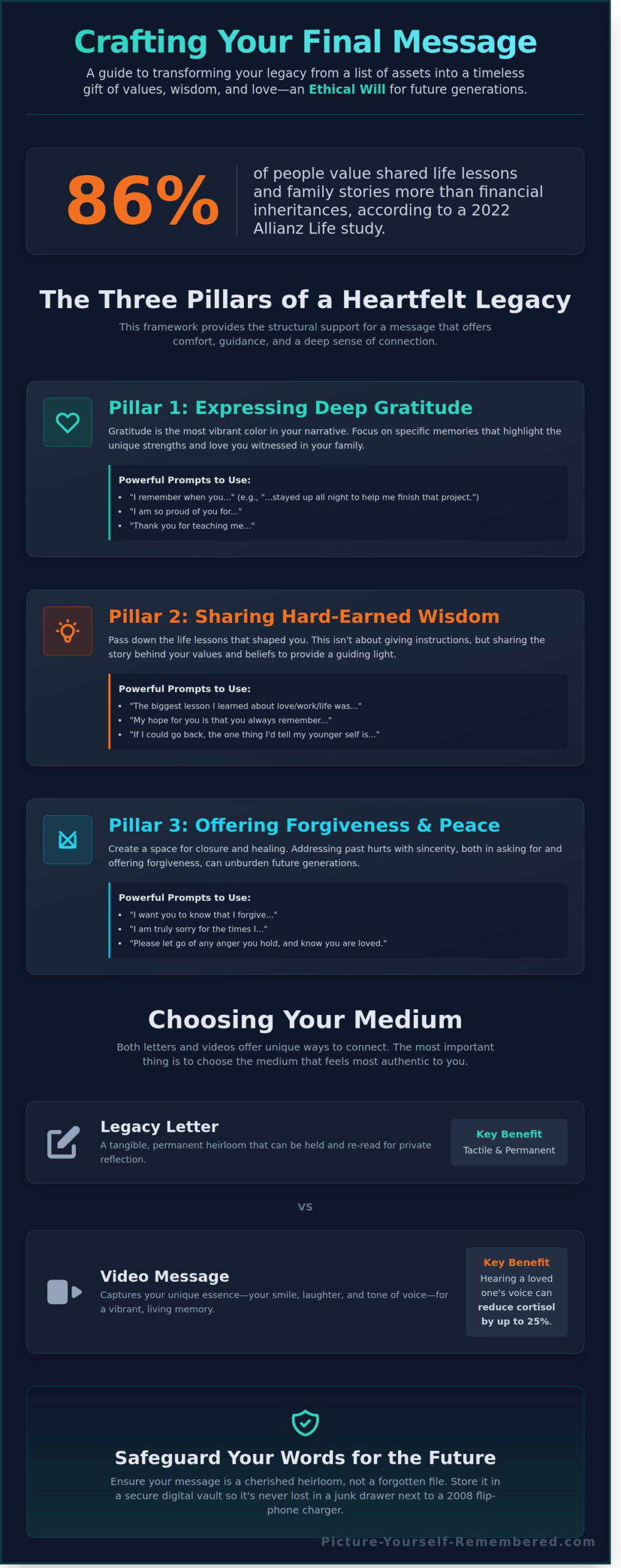
While a standard legal will handles your physical assets, an “Ethical Will” focuses on your spiritual and emotional wealth. This practice dates back over 3,000 years, rooted in the desire to pass down wisdom rather than just property. A 2022 study by Allianz Life found that 86% of people value family stories and life lessons more than financial inheritances. By creating Ethical Wills and Legacy Letters, you ensure your cherished values don’t disappear, providing a narrative bridge between generations.
To better understand how to begin this journey, watch this helpful video:
Consider the “Key-Finding Dilemma.” We’ve all spent twenty minutes hunting for car keys when we’re already late for a 9:00 AM appointment, yet we often forget to leave a map for the people we love most. I can never find my reading glasses when they’re perched on my own forehead, but I can certainly find the time to leave a guide for my children. Leaving a message ensures they aren’t left searching for answers or comfort in a hurry. It provides psychological peace, acting as a steady hand on their shoulder during the grieving process.
Breaking the Silence: Overcoming the Fear of Starting
Perfection is the enemy of the sincere. You don’t need to be a Pulitzer Prize winner to share your heart. Start by carving out a 20-minute window in a space that feels sacred to you, perhaps a sunlit kitchen table or a favorite park bench. Speak naturally. If you wouldn’t use a word like “heretofore” in a Sunday brunch conversation, don’t use it now. Your family wants to hear your unique rhythm, not a formal script.
The Impact of Your Voice and Presence
There is a unique physiological peace that comes from hearing a loved one’s voice. A 2021 study in the Journal of Social and Personal Relationships noted that familiar voices can reduce cortisol levels by up to 25%. While a letter is beautiful, a video allows your family to see your smile and the way your eyes crinkle. Your “ordinary” stories about a failed first date or a favorite childhood dog are the extraordinary treasures they will play on repeat. Picture yourself remembered not just for what you owned, but for the light you left behind.
The Three Pillars: What to Include in Your Final Message
Think of your final message as a heart-map for those you love. It isn’t a list of instructions or a dry legal summary; it’s the distilled essence of your journey. To help you decide what to say in a final message to family, we use a framework called the Three Pillars: Gratitude, Wisdom, and Forgiveness. These pillars provide the structural support for a legacy that feels both sturdy and light. They allow you to offer a sense of quiet dignity while ensuring your voice remains a warm presence in their lives long after you’ve moved on.
Pillar 1: Expressing Deep Gratitude
Gratitude is the most vibrant color in your narrative. Instead of general praise, try using the “I remember when” prompt to ground your love in reality. You might say, “I remember when you stayed up all night to help me finish that project,” or “I remember the way you always knew exactly when I needed a quiet cup of tea.” These specific snapshots highlight the unique strengths you saw in your spouse or children. Don’t leave the room without saying “I am proud of you” one last time. It’s a phrase that carries immense weight; it provides a lasting sense of validation that your loved ones will carry for decades. If you’re struggling to organize these thoughts, you might explore how to archive these memories with intentionality.
Pillar 2: Sharing Your Life’s Wisdom
Wisdom is about the values that defined your path, like resilience, honesty, or simple kindness. Sharing these doesn’t mean you’re giving a lecture. You aren’t trying to be preachy; you’re offering a compass. Focus on your hopes for their future without being overbearing. Sharing wisdom doesn’t mean you have to reveal the secret location of your 1998 stash of Beanie Babies; focus instead on the treasures of the heart. Try to write a single sentence that summarizes your personal philosophy. This could be something as simple as, “Always look for the light in others,” or “Kindness is the only currency that never devalues.” This sentence becomes a steady anchor they can return to whenever the world feels chaotic.
Pillar 3: The Healing Power of Forgiveness
Forgiveness is the ultimate gift of peace. When you address past wounds with a spirit of release, you create a clean slate for your family’s emotional future. Use the phrases “I forgive you” and “Please forgive me” to dissolve any lingering shadows. When you consider Themes in Final Conversations, a study spanning a 12-year body of research, it becomes clear that these messages serve as a vital bridge for emotional continuity and identity. By explicitly releasing them from any guilt they might feel after you’re gone, you’re performing a final act of stewardship. You’re ensuring that when they think of you, they feel the warmth of your love rather than the weight of things left unsaid. This clarity is a profound act of love that simplifies what to say in a final message to family.
Choosing Your Medium: Legacy Letters vs. Video Messages
Deciding how to deliver your heart’s message is a beautiful part of this creative process. A handwritten letter provides a physical anchor that your loved ones can hold when they feel a bit adrift. In contrast, a video captures your essence in a way that ink simply cannot. It preserves the specific crinkle around your eyes when you laugh and the unique cadence of your voice. You don’t need a professional film crew or a degree in cinematography to make this happen; your smartphone and a quiet corner are plenty. Unless your handwriting looks like a coded message from a stressed doctor, a pen and paper offer a rare kind of intimacy. If you feel torn between the two, consider a hybrid approach. Record a three minute video for immediate comfort and write a deeper letter for long term reflection. This ensures that when your family searches for what to say in a final message to family, they find your presence in every possible way.
The Power of the Written Word
There is a profound, tactile comfort in a letter. A 2021 study by the Journal of Social and Personal Relationships found that receiving handwritten notes significantly increases feelings of social connection compared to digital communication. To ensure your words endure, choose acid free paper with a pH level above 7.0, which prevents yellowing for over 100 years. You might also create a legacy binder. This is a simple, organized folder where you keep your letters alongside photos and family stories. It’s a gift of clarity. Your family won’t have to wonder where your stories are kept; they will be safely gathered in one place.
The Magic of Video Legacies
Video acts as a digital heirloom, bridging the gap for grandchildren who may not have the chance to know you in person. Seeing your expressions provides a sense of “living” history. To get the best result, face a window during the day to let natural light illuminate your face. Position your camera at eye level using a stack of books so the perspective feels like a natural conversation. It’s about connection, not perfection. When you share what to say in a final message to family through video, your tone of voice conveys love that words on a page sometimes miss. It’s a way to remain a steady, comforting presence in their lives forever.
A Step-by-Step Guide to Crafting Your Heartfelt Message
Creating a lasting legacy is a gentle process of distilling your life’s essence into a form that your loved ones can hold onto forever. It isn’t about achieving literary perfection; it’s about the stewardship of your story. A 2023 survey by the Legacy Project found that 72% of adults feel a deep sense of peace after documenting their life stories. Deciding what to say in a final message to family can feel like a mountain, but we can climb it one step at a time.
Step 1: Brainstorming. Sit in a quiet space for 20 minutes with a notebook. Use prompts to unlock memories that define your journey. Don’t worry about the order yet. Just let the images and feelings surface naturally.
Step 2: Drafting. Write or speak freely. This is your “messy middle” where you shouldn’t self-edit. If you’re recording a video, talk to the lens as if it’s your best friend. Your raw, honest emotions are far more valuable than a polished script.
Step 3: Refining. Read through your draft and focus on the emotional takeaway. Is your message clear? Ensure each person knows exactly how they impacted your life.
Step 4: Securing. Choose a reliable method for storage. A single USB drive is a risky bet; data corruption can happen unexpectedly. Use a secure, cloud-based service designed for legacy preservation.
Step 5: Updating. View this as a living document. You might want to add a new thought after a family vacation or a milestone birthday. Revisit your message every 12 months to ensure it still reflects your heart.
Actionable Prompts to Get You Started
If you feel stuck, these five prompts can help bridge the gap between your heart and the page:
- My favorite memory of us is…
- The thing I admire most about you is…
- If I could give you one piece of advice, it would be…
- I feel most connected to you when we…
- My greatest hope for your future is…
Consider writing specific notes for milestones you might miss, such as a grandchild’s wedding or the birth of a great-grandchild. Addressing the family as a whole creates a shared foundation of strength, while individual messages honor the unique path you walked with each person.
Technical Checklist for Recording
When you focus on what to say in a final message to family, the technical details should support your voice, not distract from it. Record a 30-second test to check your audio. If you sound like you’re underwater, move to a room with more soft surfaces like rugs or curtains. Ensure your background is tidy but personal; a favorite chair or a bookshelf tells its own story. Try not to record with the camera pointing straight up your nose; nobody needs a high-definition tour of your nostrils while they’re reminiscing. Use a delivery system that provides your survivors with easy, permanent access to your narrative.
Picture Yourself Remembered: Safeguarding Your Voice for the Future
There is a specific kind of quiet peace that comes from knowing your words are safe. Once you have decided what to say in a final message to family, the next step is ensuring that message actually reaches them. We often assume a handwritten note in a desk drawer or a video file on a laptop will survive the decades, but life is unpredictable. Physical papers yellow and fade; hard drives eventually click their last breath. By choosing a dedicated steward for your story,
Securing the Echo of Your Heart
Crafting your legacy is less about the end of a journey and more about the enduring strength of your love. You’ve learned that focusing on the three pillars of wisdom, gratitude, and forgiveness provides a clear map for your thoughts. Whether you choose a written letter or a soulful video, the most important step is simply starting. Deciding what to say in a final message to family is a profound act of stewardship that ensures your essence isn’t lost to time. You don’t need to be a world-class poet or a tech genius to do this; your family already loves your stories, even the ones you’ve told a hundred times at Thanksgiving.
Stanley Poe founded Picture Yourself Remembered to bridge generational gaps with a simple, compassionate process designed for everyone. Your words belong in our secure digital vault, which uses 99-year delivery protocols to guarantee your message reaches the right hands at the right time. It’s a practical way to trade uncertainty for peace of mind. Don’t leave your most important words to chance or a dusty shoebox in the attic. Start preserving your heart-centered legacy with a Basic Membership today. Your story is a masterpiece, and it deserves to be heard for generations to come.
Frequently Asked Questions
What is the most important thing to say in a final message to my children?
The most important thing to tell your children is that they were loved unconditionally and that you are proud of the person they’ve become. While it’s tempting to give life advice, focus on the essence of your bond. According to a 2023 survey by Allianz, 86% of heirs value emotional legacies like these more than financial inheritance. Share one specific memory, like the time they finally mastered riding a bike, to ground your love in a real, lived moment.
How long should a final video message or legacy letter be?
Your final message should ideally be between 5 and 10 minutes for a video, or 2 to 3 pages for a written letter. This length allows you to share your heart without feeling rushed or becoming overwhelming for your loved ones. Think of it as a highlight reel of your soul rather than a full biography. If you find yourself hitting the 20 minute mark, you might be trying to write an epic trilogy; save the sequels for your memoirs and keep this focused.
Is it too depressing to record a goodbye message while I am still healthy?
It’s not depressing to record a message while healthy; it’s actually a profound act of stewardship and love that provides immense peace of mind. Recording from a place of strength ensures your true essence and vitality are captured clearly. A 2022 report from The Conversation found that 60% of people who complete legacy tasks feel a significant reduction in anxiety. Think of it like an insurance policy for your heart, ensuring your voice is there when it’s needed most.
How do I ensure my family actually receives my digital message after I’m gone?
You can ensure your family receives your message by using a secure digital legacy vault or appointing at least two trusted legacy contacts on platforms like Apple or Google. Don’t just leave it on a random USB drive in a sock drawer. Write down the location and access instructions in your physical will or a “When I’m Gone” folder. Providing clear directions to your executor ensures your digital narrative isn’t lost to a forgotten password or hardware failure.
Should I talk about my funeral or estate plans in my final message?
You should generally keep your final message separate from your funeral or estate plans to focus on the emotional connection. Use this space for what to say in a final message to family, focusing on love and shared history rather than logistics. While your will handles the “what,” this message captures the “why” behind your life. If you do mention your service, keep it brief, perhaps noting one song that perfectly captures your spirit.
What if I get too emotional and cry during my video recording?
If you get emotional and cry during your recording, please keep going because your vulnerability is a gift to your family. These tears are a testament to the depth of your love and the richness of your life’s narrative. Your family won’t look for a polished, Hollywood performance; they want the real you. If you need a moment, take a 30 second breath, sip some water, and continue when you’re ready. Authenticity is always more beautiful than a perfect script.
Can I update my final message later if my family situation changes?
You can and should update your message as your life and family situation evolve over time. It’s wise to review your legacy documents every 3 years or after major life events like the birth of a grandchild or a wedding. This ensures your message remains a current reflection of your heart. Think of it as a living portrait that grows more detailed and vibrant as your journey continues. Keeping your reflections updated ensures no one feels left out of your final embrace.
How do I start a message to a family member I’ve had a difficult relationship with?
When addressing a difficult relationship, start by acknowledging the shared history you have without assigning blame or reopening old wounds. Focus on a single positive memory or express a simple wish for their future peace. Deciding what to say in a final message to family often involves finding a path toward reconciliation or closure. You might say, “Our journey wasn’t always easy, but I want you to know I value the time we spent together.” This creates a bridge of grace.
